Showing posts with label Bladelius. Show all posts

July 21, 2011

Swedish Statement / Audiomatic / Ultimate Reference at KLIAV 2011

In Swedish Statement / AudioMatic room 835:

Audiophile grade music streaming via NAS (network attached storage) will be demo'ed. You'll be able to see the new Bladelius USB DAC in action.

Specifications:
* Accepts data up to 24 bit/192 kHz
* USB powered
* Asynchronous USB transfer, re-clocking with a fixed low jitter crystal clock
* Galvanic isolation between USB and the analog circuits, which means no noise from the computer will be transferred to your amplifier
* Super low noise power supply with multistage regulation and filtering
* For low out of band noise we use low order modulator
* For a more "analog" behavior (no pre-ringing) we use a digital filter with minimum phase
* The analog output stage is a high performance stage with high drive capability


The fact that this DAC uses a minimum phase filter, like the one in Meridian and Ayre CD players, pique my interest. I am sure to check it out.

If you are a Bladelius Embla owner, then the latest iPad app for Embla remote will interest you too.


In Swedish Statement / Audio Matic room 837:

The beautiful looking and great sounding Vitus Audio Reference series will be on demo. The system will include the RI-100 Integrated amplifier, the RL-101 Linestage and RP-101 Phonostage.

The Vitus electronics will be running together with Marten Getz loudspeaker and EAT Forte S Turntable.

Starhill 4 and 2B:

These 2 rooms will be dedicated to showcasing AV.

The Vivitek D8300 Large Venue Projector transitions 1080p between professional and home applications.
Vivitek's latest technology - Vivi-Blending, which provides ultra wide screen with 4-6 megapixels will be introduced to the showgoers in room 2B. Some examples of Vivi-Blending use:
12 projector immersive screen - US Marine Corp

Low cost ultra wide display for Windows desktop

Lastly, there will be the Asian premiere of the ADAM Grand Theatre Series loudspeakers, touted by the famed German loudspeaker maker as the new reference for home cinema sound.

March 21, 2011

Ask For Demo? Bladelius Ask Power Amp, Now In Audiomatic.

The Bladelius Ask is one good sounding amplifier, also kind to mother nature.

As the world goes green, the current statement green consumer product that anyone aspiring "greenie" credentials ought to have is a hybrid car. Now high end audio goes hybrid too! In the form of the Bladelius Ask power amp, cosmetically designed to match the absolutely fabulous Embly "silent" digital media player.

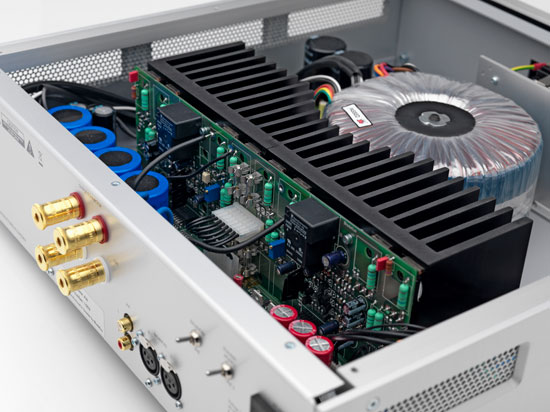
The 2 x 165W stereo amp is a hybrid design between the traditional class A/B and class D operation. I had a brief audition of the Ask, sourced by the Embla, powering a pair of B&W 802D and was amazed by it's transparency, refinement, poise and control. In fact, I thought it sounded very much like the bigger 300W Ymer model, only with less specified power. However, I wasn't sure if I was listening to it's class A/B or class D operation at the time, but it sure sounded good regardless.
The impressive build quality inside the Ask.

Remember the Bladelius Embla??? It's so far ahead of it's time then, it's still not beaten today.

The Bladelius Embla has been around for so long, that it's nearly forgotten, but on that very same day, I was glad I got re-acquainted with it again. I also learnt that the Embla also plays FLAC, WAV, amongst computer music files and will support up to 32/192, bits/sampling rates, via it's two USB inputs. I was not in to CAS at the time when I last reviewed the Embla in year 2008, so I did not check out that feature at all then. So it would be nice if you can bring your music files in a USB drive and go audition the Embla and Ask combo.

For audition appointments, call Eugene at 012-3222698.

October 6, 2009

Swedish Truth. Bladelius Idun Pre Amp.

Fine satin finish face with form follows function industrial type design.

As I was carrying the Bladelius Idun pre amp home, one thing kept popping in to my mind, it is very heavy for a pre amp. Before hooking it up with the rest of my system, I peeked inside through the ventilation slots and found the reason for the heft, a huge power trans inside located just behind the left front panel. It would seem bigger than some power trans inside some of the more modest stereo power amps! And it is this big, big power supply that would repeatably proved why this pre amp always sounds so in control, even when the going get tough, the Idun stay cool throughout it's performance, never flustered or showing any signs of edginess. Whilst on the build description still, there's only two small PCB boards inside the big, sturdy all aluminium case. A control PCB resides at the front panel where the display and volume knob resides and another PCB board is installed at the back panel, direct soldered to the RCA and XLR inputs and outputs, for the shortest possible signal path. This is true audiophile philosophy design. The all aluminium remote supplied is the same as the one used in the more expensive Bladelius Saga pre amp and the Embla Memory player, which with familiarity is much easier to use the second time now. One feature which I had found particularly useful is the individual input level setting, which allows for a very uniform volume loudness, irregardless of source selected. So far so good, let the sound begin!

The very small button and smaller print remote, but easier to use with familiarity.

They say an audio system equipment largely dictates your music play list, from my very recent two pre amp experience, I just couldn't agree more. When I had the JRDG Capri pre amp in my system, the dynamics and rhythm forward driving qualities lead me to play mostly pop and rock music, especially LPs, during it's time in my system. The Idun on the other hand is the exact opposite, it's rather quiet and reserved if controlled musical presentation had me favouring more toward jazz and classical repertoires. Don't get me wrong me here, both are very good pre amps for the money, but I am merely describing their respective sound character presentation, for the ease of system matching in mind.


The Bladelius Idun, just barely fitting in to my FE spider like rack.

In comparison, the Bladelius Idun is just as quiet as the JRDG Capri for back ground noise, both are certainly quieter than my older designed Pass Labs X2.5. The Bladelius Idun is certainly more transparent sounding than my Pass X2.5 from the mid highs onwards, whilst the Pass is a tad more colourful at the bottom end. The tonal quality of the Idun can be classified as neutral with a tinge of warmth for good measure. The highs are very clean and tidily presented, and will remain so, even at very demanding passages in the crescendo of orchestral music, like the Rachmaninoff Symphonic Dances, with Eiji Oue conducting the Minnesota Orchestra, a HRX recording by Reference Recordings. The Idun coolly holds the orchestra at full on crescendo together on whilst the Pass X2.5 seems to be losing it. The Idun's mids are not lush and full bodied as the Pass X2.5 but it's also slightly more focused on the vocals. If the Pass X2.5 give you an orange size mouth, the Idun will re-focus it to the size of a Malaysian 50sen coin. The bass, like the rest of the frequency spectrum, is laid back, but still highly revealing from note to note, and will present kick drums cleanly and forcefully.

This excellent recording by Spectral's professor Keith O' Johnson is a must have CD, to experience a well recorded hall ambiance. The first track, Non-allegro-Lento-Tempo I in C minor, alone is worth buying the CD!

The Idun's forte is the presentation of staging and imaging, especially playing classical music. The Idun will recreate the whole spectator ship experience with ease, especially when playing well recorded materials like the one mentioned above.Listening to that Rachmaninoff RR CD, I had the similar sensation as if I am attending a Dewan Filharmonik Petronas concert. The Idun's ability to recreate hall ambiances and atmospheric spatial cues adds a touch of reality to the whole music listening experience. When playing blues and jazz pieces of more inmate nature, the Idun has the ability to bring you to the recording studios or if listening to a jazz club concert, it will recreate the whole scene realistically, minus the smoke smell.

The Bladelius Idun is also highly transparent as demonstrated when playing the opening track Maastricht Salon Orkest Andre Rieu/Serenata. This is a truly fabulous hifi track, titled Serenade for Voice & Piano or Orchestra(Rimpianto) No.1, Op.6, that not only test a system's transparency to the max, but offered to do so yet in such a musically digestible manner. You see, this track has(some say 3) little nightingale birds chirpping away between 8-9 ft in sound stage height, accompanying Andre's violin interplay with piano backing. And in the faint back ground of the track, right between the musical notes, the recording also captures what seems to be a highway, or a busy road out side the studio, just faintly audible in the back ground of it all. If your system is transparent enough, some say you could even hear the number of cylinders of the buses or trucks passing by! After hearing this track via the Bladelius Idun, I can confirm that the above statements are no mere exaggeration, well, maybe not the one about the buses and trucks, but the truth is closer to reality when the track played back via the Bladelius Idun pre amp.


Another reason to test your system, with great music to boot! As per Andre Rieu's usual high standards of entertaining violin play. The birds on track 1 are digitally reproduced by the way, but in a well set up system, they are as alive sounding as the real thing!

The Bladelius Idun is pretty good on macro dynamics but there is a slight trade off when handling micro dynamics. Meaning huge orchestral crescendos are easily handled but a solo classical guitar string attack, would appear to be slightly blunted, however, the sustain and decay part that follows is gives me no reason to complain.

Unlike the Pass Labs X2.5, the Bladelius Idun doesn't do the following. It doesn't present music with added lushness. It doesn't play a fool to poorly recorded materials, irregardless of source. It doesn't dramatised musical events like the Pass do. The Idun just gives you almost everything on the recording source. I said "almost", only because I had experienced other pre amps that are a few rungs higher up the price ladder(the ARC Ref 3 and Bladelius Saga comes to mind), that will present music with even more transparency, wider bandwidth at both frequency extremes, and even more noise free, just to put things in to perspective.


The Idun's back panel, all the inputs and outputs are direct soldered to audio pre amp PCB board.

I quite like the Bladelius Idun retailing at RM$14.8k. It certainly is an option very viable if one's musical diet are mainly classical, jazz and well recorded audiophile variety music. It'll however, ruthlessly expose all the commercial quality, of poorly recorded pop/rock and chart music's short comings. I will certainly keep the Idun in mind should I plan to next upgrade my pre amp.

Bladelius is sold by Audiomatic, contact Eugene, tel:012-3222698

August 2, 2009

Reference Redifened! Bladelius Saga Pre and Ymer Power Amps.

This is an old post of ours in the blog we previously contributed to.

The Bladelius Saga Pre amp. Built on the same deep chassis platform as the Embla CD player.

The MONSTROUSITY called Bladelius Ymer! Watch out for the really sharp edges and corners!

I know I am supposed to live with the Bryston for a little while. But when a full set Bladelius came calling, courtesy of Audiomatic, my knees grew weak and accepted the offer in no time. Ahhh..... I am such am audio slut!

Both the Bladelius Saga and Ymer are top drawer stuff. The Saga pre amp costing RM$32K and the 300W class A/B Ymer power amp will set you back by RM$49K. These are clearly some of the most expensive components to have ever graced my audio cave.

My hifi rack, the FE spider clone struggled to contain the Saga, which is much deeper than most other equipment.

The Bladelius Saga is a full feature pre amp with 3 balanced, 6 single ended inputs and 2 balanced plus 2 single ended outputs. There's also a tape loop provided. You may also adjust the input level of each source individually, so that they all match in volume output, which ever your source is. I found this feature to be very useful to tweak the sound of the system, as it effects the perceived stage depth or forwardness somewhat, depending on setting allocated for each source. I found my self setting the Marantz CDP input to 0(zero) input level, and setting the phono stage input level to -1. I also found I prefered the -1 setting with the Bladelius Embla CDP. You can also individually label each input by name.

The back end of the Saga, input on the left and outputs on the right. Note the RS232 jack, so that you can connect to a PC or laptop for future software up grades, if available.

The Ymer power amp is monster sized, weighing close to 60kgs and no grab handles are provided for the job of lifting it from the box in to place, on my amp rack. Even with 2 person on the job, the satin smooth aluminium finish of the chassis casing is slippery from the hand. The corners are sharp as knife, as I had my hand and fingers cut whilst moving it in to place. Removable grab handles is a nice idea if Bladelius wants to retain the nice, fuss free look of the power amp. A peek on the inside reveals this is a dual mono design in the truest of sense! There are 2 large identical power supply trannies inside, each supplying power to a bank of storage caps, then to the left and right channels with their dedicated heat sinks, all packed inside the casing. The only thing the dual mono channels share is the chassis mounted IEC power input socket, and the all aluminium casing.

The Ymer needs two amp racks to support it, as it is so........ long!

I first mated the Saga to my Marantz CD7 at the front and the Ymer power amp further down the chain, then lastly, my faith full pair of Audio Physic Spark doing speaker duty. My usual array of AQ Sky, Cardas Golden Presence interconnects are used with 2 pairs of speaker cables being used in the session. First being the JPS Super Conductor 3, and later the Siltech Classic G5 LS88 speaker cable. All my usual power arrangements are used including the Torus Power RM8A PIU(Power Isolation Unit).

I loved the sound of the system comprising the Marantz CD7, AQ Sky interconnect, Saga pre amp, Cardas Golden Presence interconnect, Ymer power amp, JPS Super Conductor 3 speaker cables and the Audio Physic Spark speakers. The sound was reproduction was the most realistic ever heard in my audio cave. At this level of sonic excellence, I no longer think about the highs, mids and lows, nor do I think about the staging and imaging. I did not think about scrutinising the sound at all! I've never heard instruments like violin and piano reproduced with such beautifully woody harmonics and truth of timbre. Playing techniques and each violinist's breath could be heard clearly and distinctly. When playing vocals, the alive and breathing qualities are very apparent too. Guitars have that convincing "twang" to it, followed by the woody resonance of the body. Bass string instrument, had texture, fret board finger work all apparent and the strings bounces with each note tune fully. Drums had stick attack, skin texture and that hollow reverb that follows. Cymbal work is always realistic, yet never calling attention to itself, but has that dimensional quality(a.k.a. audiophile "air"), that projects it right at the back of the stage, but still each detail easily heard and followed.

The back end of the Ymer power amp. I love the non shorting WBT Nextgen speaker terminals. I think they are the best!

The amazing part is the stage does appear much bigger than my room. When listening in the dark at night, that room less sensation can be a little hair raising at times. The system was super silent. No tweeter hiss, back ground noise, white noise, nor any nasties were heard.

I started listening with Telarc's Round Up CD, featuring Erich Kunzer conducting Boston Pops Orchestra. This famous wild west themed CD has being heard a billion times, yet played thru the Bladelius combo, the presentation is wholly refreshing. The opening cattle scene track, the whole cattle field was portrayed on to the speaker's back and side walls, like a huge semi curved canvas(like the screen of some THX equiped cenimas) of a cattle scene art work, realizing depth of field by the various cattle "moo....ing" placement and cowboy riding horses back and forth and the final round up! To me this is just un real. The only thing that diference this from reality is the missing smell of fresh grass and cow dung! By the time I got to track 3 of the Round Up CD, The Magnificient Seven theme, I call it the Marlboro track(it was used in the famous cowboy advertisement campaign by the Marlboro cigarete brand), I was getting goose bumps all over, due to the uncanny resemblence of the experience comparable to sitting on row M of the the Dewan Filharmonik Petronas. The gorgeous, majestic tone of the orchestra coming full on in a Crescendo just made me flip over and over again. I was virtually breathless at the end of that track.

My other significant half, whom is always indifferent to whatever sounds my audio cave makes, suddenly decided to come in one day, when I was playing the very familiar Tube HiFi Violin CD, featuring Wilhem Dennigen on the Guarneri del Gesu 1735 violin with piano backing in the background. She exclaimed that the sound of the violin and the piano was a if in reality, performed right before her! When the track Air, from Suite no.5 was played, a popular wedding tune, she was moved to tears. She's my Dewan Filharmonik Petronas concert partner, and she knows classical music way better than me. She said "now, that's the first time I hear your hifi do the violin and piano tone right!" That statement coming from her, is testament to the highest fidelity of the Bladelius Saga and Ymer combo!

I then proceeded to replace the Marantz CD7 with the Bladelius Embla Basic. While the Embla Basic, was just as detailed and as transparent as the Marantz, it some how sounded a little on the lean, "cool" side of neutral, tonality wise. The Embla certainly had lower noise floor and better dynamics, but somehow portrays music with a little mechanicalness. Strange indeed, as I would have taught being made from the same factory, I would expect better synergy from the Embla than the Marantz CD player. I can only deduce that the Bladelius Saga and Ymer combo was revealing enough to let the Marantz strut it's stuff to the max.

However as usual, coming from such highly transparent equipment, the Saga and Ymer combo will always reveal your system's weak link, if there was one. I wondered if the system would sound as good without the help of the Torus Power? I was shock that the overall system transparency, delicate resolution, and musicality performance parameters dropped a notch or two, sans the Torus Power, with everything plugged direct to wall supply. This proves you must have good power for the Bladelius combo to perform to their very best. Next, as the dead line of the JPS Super Conductor 3 speaker cable came along, which I substituted with the Siltech Classic G5 LS88. Again I noticed a drop in overall performance. The highs were still nice and tidy, the mids are still breathy but have less density, body mass perhaps? However the bass became a little lean and less punchy overall. Dynamics and transient peaks were more subdued than before.

I was surprised, that the Audio Physic Spark speakers, remained unfazed by all the grand equipment it had to support and manages to reveal all the changes noted above. In short, it was up to the task.

The same remote set as the Embla CD player is provided, but operating the Saga is less daunting as almost all comands are direct button accessed. Not menu navigational screen prompted, like the Embla.

In the right audio system configuration, as I found out from my above experience, the Bladelius Saga and Ymer are capable of truly exceptional and absolutely life like musical performance, which more than fully justifies their asking prices. Can I dare say that "they're a steal comparing with some of the more established big brands"?

I think I may have grown silk ears by now, because my high end reference, has just being redifined!

I don't really want to return them, just yet.


Bladelius is sold by Audiomatic, contact Eugene, tel: 012-3222698

Future Forward! Bladelius Embla Basic CD Player.

This is an old post of ours in the blog we previously contributed to.

The Bladelius Embla Basic CD player.


Ladies and gentleman, this is what the future of audiophile quality CD players looks like! Well at least that's what I think any way. Mike Bladelius(product designer and owner of Bladelius) would very much agree with me on this too! He!He!

Here, we not only have a CD player in the traditional sense, but also included in the feature count is a silent replay system. What's a silent replay system? you ask.
The front panel menu display, when backing up CDs to flash memory card. Note the no. of corrected jitter errors!
It's a feature that allows you to back up all your CDs in to the Bladelius Embla's flash memory card. In Basic guise as the review sample provided(recommended retail price is RM$26K+), it is estimated to store up to the equivalent of 60 bit perfect CDs in full resolution, and jitter corrected. This mode of playback is said to reproduce better sound quality, more efficiently, as the transport jitter error is taken out of the playback system, due to the flash memory card having no moving parts at all. You may install additional flash memory cards latter at cost. That means you can potentially store your whole CD library in to the Embla. Now isn't technology great???

A fully loaded, full featured Bladelius Embla Premium, which is expected to cost you more than RM$45K!, is said to be in the works. You get front panel touch screen navigation and a back lit touch screen, hand held remote control plus 2 extra digital filter options.
Allison Kraus, Forget About It CD was backed up in to the flash memory card, note that the CD cover was uploaded from the internet, via the RS232 port connected to a computer. I got this when I backed up a non English TOC CD. No picture too!
I can tell you straight and now, that the Embla Basic is not, that basic after all! It's got over sampling on/off option, sampling frequency option, 44.1, 48, 96 and 192 kHz are available. Also on offer is a digitally operated phase switch, for those really concerned about this sort of thing. There are also USB, Bluetooth and a host of other inputs available for you to stream music in to the Embla's flash memory card for storage, or replayed via your high end audio system.

There are just too many options and features available to mention here, otherwise, I'd start to sound like a product brochure. For full feature listing of the Bladelius Embla, check it out here: http://www.bladelius.com/embla_released.html

Now we get to the important part, the sound! The Bladelius Embla, when playing with the 192kHz up sampling setting used, does remind me very much of the Esoteric X-03 reviewed last month. Only in checking the Embla's spec on the above link, I found out that it uses a Teac transport! However, I cannot confirm is it's of the VRDS variety.

When playing CDs the conventional way, the noise floor is vanishingly low, the overall presentation is very clean, very tidy. Transparency is first rate, as it plays out all the information that is embedded on the CD, nothing is added or subtracted. If it's a poorly recorded pop or rock recording, you'll know it. If it's a lush sounding classical recording, it'll sound like that too. This is about the most uncoloured, true to source CD player I've ever experienced in my system.

I found my self mostly using 44.1kHz oversampling setting for most pop and rock recordings, for a little more immediacy in the music's presentation, and 192kHz up sampling setting for classical and jazz recordings, for better presentation of hall ambiance or studio spatial cues and a little bit more audiophile "air".

But what couldn't prepare me for next to come was that, when a CD is backed up( the Embla will ask you if it should back up each time it detects a new, previously unplayed CD or other source is inserted), and jitter corrected, then stored in to the Embla's flash memory card. When replaying from the flash memory card, the music took on a slightly more focus imaging, better separation between instruments within the sound stage and more organic flow in it's presentation. You can say that I preferred the sound when played back via the flash memory. However, I must state that tonally, the Embla lies in the slightly lean, "cool" side of neutral, which makes partnering it with warmer or musical sounding amps and speakers essential. But that's just my musical preference, yours may differ.
Doesn't the Embla look nice on my audio rack?
However, I do have a few operational quibbles about the Bladelius Embla.

First is the CD slot, which I find that it scratches both the top and bottom surface of my CDs a bit when inserting or ejecting in a hurry. You'll need to exercise care when inserting or ejecting CDs. Bladelius could take cue from in car CD receivers, which has foam lined CD slots.

Next, for the price of RM$26K+, I'd expect the remote to be at least back lit. The remote is well built and heavy aluminium in feel, which is good. But then, as the remote is capable of controlling a full Bladelius system, it has many, many small rounded, black buttons, with even smaller black labelling fonts. It's an absolute nightmare to operate initially. Only after a few days of practice and familiarity, the task of operating the remote became less daunting.
See what I mean about the well built remote control??? What makes it more frustrating is that the Embla Basic is a two button only machine!!! You only have "Standby" and "Eject" button on the front fascia. Every thing else is done via the remote.
Lastly, during it's time in my system, the Embla's software did hanged a few times, usually when changing between replaying from flash memory to inserting CD for replay. Also noted is that it's software does not recognise non English CD TOCs(table of contents). Eugene of Audiomatic tells me that Bladelius is aware of the issue. A new version of the software that addresses the issue will be available for upgrade soon. The new version of upgraded software can be up loaded to older Embla players via it's RS232 port connected to a computer with Internet link.

As far as I know for now, there are no other high end CD players with this concept of backing up your CDs for storage and replaying via it's internal flash memory card(and sounding better too!), just yet. However, I am also very sure that the competition is out there watching the success of the Embla with great interest. Surely the competition does not want to be left behind either. I am also wondering with great interest, when that happens, at what entry price level would this concept be available in the not too distant future?

If the price tag does not seem too daunting for you now(high end price tags are always daunting, aren't they?), and like Mike Bladelius's idea as much as I do, then wait no more!

You can, buy the "Future Forward" today!

Bladelius is sold by Audiomatic, contact Eugene, tel: 012-3222698