Showing posts with label Torus Power. Show all posts

February 20, 2021

Go Big Or Go Home! Torus Power RM 16 AVR

Torus Power RM16 AVR


Torus Power RM8 AVR, spot the diference?


It's been a good 10 years since I've settled down with the Torus Power RM8 AVR. Read my original review here:  http://hifi-unlimited.blogspot.com/search/label/Torus%20Power

I have been happy with my chosen power supply solution for so long, I had never considered any form of change or up grade. For me, the Torus Power RM8 AVR is always a keeper. 10 years is a long time in any product life cycle, and unlike any of my other hifi equipment that came & went, the Torus Power stayed. Even when I moth balled my hifi and took a sabbatical then restart, I still stayed the course with the RM8 AVR, as I believed even with newer generation products in the market, the Torus Power remains one of the top solutions when it comes to power supply & conditioning.

The Torus Power is a balanced transformer based design with a voltage regulator circuit added for good measure, keeping the output voltage at 230V+/-10V range. In my hands, 10 un-eventful years passed by with no wants, and the Torus Power more than satisfying my hifi power needs.

Then came one fateful day a local used hifi classifieds this Torus Power RM16 AVR appeared and I started thinking, hmm..........., what if? After consideration of the worst outcome would be that I just spent a few thousand to top up a trade in deal, would result in no sound improvement!

I called the dealer who put up the advert, made the deal discussion and the rest was set in motion. a few days later, the dealer called that he would deliver to the Torus Power RM16 AVR to my place, and bring the RM8 back as a trade in. Weighting at nearly 60kgs. 3 of us  had a tough time bringing the RM16 AVR up 2 flights of stairs in to my man cave, located in the 1st floor of my house. Once that was done, bringing down the 40kgs RM8 AVR was less of a problem.  

This is the Torus Power RM8 AVR with 5 UK style power points, the RM16 AVR has only 1 extra point, even though it has double the power supply capacity! 


I proceed to plug the RM16 AVR in to my system and realized that despite the big heavy box, I only got 6 UK style power points, compared to 5 on the RM8 AVR. However, I only needed 4 to use om my system.

I fire up the system, not expecting much sound difference nor improvements. I am totally surprised by what I heard. 2 things stood out the moment the first track played on my Sony CDP X-7 ESD CD player, first the already black background just got blacker......, like black hole to nothingness, it's eerie! Next the high frequencies gain a buttery smoothness, a much longer tail end decay in to that black nothingness. I get the same full bodied, thick mid range magic as before. However the bass took on a more integrated in to the sound stage character. In the past I could still hear some the bass notes coming from the woofers of my PMC IB-2i speakers, but now all the bass is coming from the front stage imaging! another bass area improvement was the flabbiness. Forcing the big boy PMC speakers in to a small room was kinda cramping it's style. I had some degree of bass flabbiness that vibrated that whole room when then particular room mode hit! Funnily enough, the Torus Power RM16 AVR with is double capacity had much, much more grip on those 10 inch pistonic bass woofers that PMC uses. That bass flabbiness as mentioned, whilst not totally eliminated, was however, much reduced, to the point it's barely noticed. I guess there are limitations when going against the law of physics?

Overall, going the double the power supply didn't make sense at first. You see, my system was barely drawing 3 amps peak and when using the RM8 AVR, I already had more than double the headroom to spare. I was thinking buying more head room was probably a suckers game! However, now after a week in to the change over, I felt the trade up was more than a fair deal. I am glad I done it!

Wishing all our regular readers GONG XI FA CAI!  


May 29, 2020

Re-Introduction To My HiFi Circa January 2019

My simplified 2 rack HiFi system, circa January 2019, to start my journey again after a 3 year plus hiatus

Let me tell you about my reintroduction in to HiFi again, circa January 2019. With a remodeled home many things have changed, except my man cave, whic remains untouched at the same 12ft x 10ft x 9ft(L x W x H). Small room, and the urge to make it 14ft x 10ft x 9ft(L x W x H) was there, but I had resisted as I loved the way the speakers loaded my room, sound wise. So all it got was a fresh new coat of paint & some LED strip lighting. I started with the room because over the years, my HiFi philosophy have come to embrace the room as the starting point, followed by speakers, amplifiers & lastly sources in the order of hierarchy in the degree of sound influence. Allow me to further explain why it all starts with the room. The room as we choose to house our HiFi system in to, will determine how big a speaker pair allowed, which will in turn tell you how big a power amplifier should be, then comes preamp to be the source switch and volume control plus maybe, just maybe add sonic flavours to your source, which ever you choose. Make no mistake, the job of the source is to extract as much musical information from the media medium as possible. My hifi set up reflects just that philosophy as above and a little more as we go along. 

This set up consisted of items that were mothballed from the past, such as my PMC IB2i speakers, ATI Reference 6004 power amp, Kuzma Stabi S turn table and lastly Torus Power conditioner. Add in some new elements such as the Aesthetix Janus preamp/phono stage & Sony CDP X7-ESD CD player. 

PMC IB2i speakers

The PMC IB2i have been in my past system before. They came in to the picture as replacement to the pair of PMC Fact 8. I fell in love with this pair of speakers at the time of it's review in these pages. At the time, budgetary issues prevented them from being mine. However as PMC introduced a newer model in the form of IB2 SE, this pair made it's way from the showroom to my place with some discount. My HiFi philosophy also dictates that speakers should always be British, especially variations or students of the past BBC Technical Dept designs. Those guys really did much research in to all that make great speakers.

In theory, the pair of IB2i speakers are somewhat over sized for my room dimensions, but with careful placements of not only the speakers, but also my throne in avoiding room modes, made it a possibility in practice. These are speakers with a big sound and real beefy bass. Being a 3 way design with a dedicated silk dome mid range, the magical vocal is always there, ever present when playing music. The highs are not extended like newer speaker designs, but that's OK, as with the right source material, it can still relay the amount 'air' required for 'live' recording that is so dependent on the illusion of being there. The Achilles heel of having such a big speaker is the requirement for an equally big, beefy amp, which is the subject coming next!
     
ATI Reference 6004 power amp

ATI is not a new HiFi manufacturer as they have been doing that for other big American high end brands since 30 years or so ago. ATI amplifiers are designed by Morris Kessler, even if not as famous as Nelson Pass, Mark Levinson, Dan D' Agostino or John Curl, he is definitely in the same technical prowess when it comes to amplifier designs. All good designers but different design philosophies & technical implementation. Coming back to my HiFi philosophy for amps, my choice would always be American muscle.

The ATI Reference 600X series is designed as a multi channel high end AV amp. It can be configured for 1-7 channels in a single chassis at time of purchase. I wanted a four channel 350W amp, so I got an ATI Reference 6004, the last numerical denotes the number of channels in a single chassis. Why 4 channels you ask? Bi-amping, ever since I did that with a pair of stereo Magnet amps, I can never go back to normal stereo. So each one of the PMC IB2i speaker is powered by one channel for the bass driver & one channel for the mid range & tweeter.

I found the ATI Reference to be extremely transparent & powerful for an AV multi channel design. Which is all one needs for HiFi, gain on a wire. Some may accuse it of not being the last word in refinement and I agree, but it has a certain mid range texture that's invariably missing on those over refined amp designs too. So in HiFi, you always win some, lose some. It's just what parameter is more important to win or lose only, your choice determines the brand and design.
Asthetix Janus pre-amp, comes with built in phono stage. It is basically a simplified Calypso & Rhea rolled in one box for those who needs to de-clutter their HiFi!

The Aesthetix Janus represents another American amp choice for me even if it's a tube based design. We reviewed the Aesthetix Calypso in these pages before and liked it quite a bit. I felt it's performance came closest my pre-amp reference of sorts, the Audio Research Reference 3. Many argue that this is a decades old design, but to me this tube based pre-amp struck a balance between  being transparent & the way it adds a tinge of golden rose hue to the tonal color of music is nothing short of magical. Newer ARC Reference designs have since improved on linearity, lowered noise floor & higher resolution capability, but lost it's musical soul in the process.

Sorry if I digressed, but the Aesthetix Janus represented just that, as in the very slight tinge of rose gold hue added in to the tonal color does wonders to lift music, give it soul, make it just a little bit more humanized. Partner those sonic qualities with a full function remote and high quality phono stage, then is it any wonder why it deserves to be here?

I know Jim White as an excellent phono stage designer. If one can excel at making 1000X amplification,  preamp design would seemed like childs play, wouldn't it?   
Sony CDP X7-ESD CD player, the best of Sony circa 1988!

The 1988 Sony CDP X7-ESD is a special breed indeed, if you didn't know that? I have not come across another CD player that comes with transformer coupled XLR output! The X7-ESD is the first ES series CD player to include XLR output, and Sony went all out to make it special. While the BB PCM 53 DAC chip is one generation before the best, PCM 63, the sound from this Sony unit is truly something else. I used to have the Marantz CD 7, which was a truly magnificent CD player, if not for it's sound quality, then at least for it's collector's value.

The Sony is from a decade before the Marantz, yet will not lose out anything in terms of sound quality, shows that Sony as the CD format's co-developer was truly ahead of the curve at the period of what could be called the Golden Age of CD players, which is from the late 80's till late 90's. I would almost always favor high end Japanese CD players(the other exception being Philips CD players) as they made the transports, and built them to last a life time. I know mine did, it's more than 30 years now and still plays music like as if it was new!
Kuzma Stabi S, or baby Kuzma as many would come to call it!

This Kuzma Stabi S replaced my Linn LP12 turn table sometime after this pages probably in 2014. In terms of design the Kuzma is totally a different breed altogether. I liked the bare bones design of a solid high mass turn table equipped with a 12 inch unit pivot Stoggi arm, fitted with my trusty, long service Benz Micro LP cartridge.

For a small turn table, the sound is big boned & bold. The design is also very quiet in terms of bearing noise and that double thick cast iron platter gives equally big, ballsy bass. Never mind if it's the cheapest turn table among Franc Kuzma designs. The Kuzma family sound is just as evident here as in his bigger, badder ass designs. it's also a very musical turn table, otherwise it will be difficult to persuade me to move away from the Linn Sondek LP12.
Torus Power RM 8A, yes 8 Amperes is all you need. It's showing 1.6A current draw at idle, when my system hits it's Rock & Roll stride at 104dbs, it would be drawing a little over 4.2A! 

The Torus Power Conditioner needs no introduction as you can catch or revisit my adventures with it here within these pages. That's what buying the best equipment do, it stays with you for a long..... time, and possibly maybe for a lifetime. No further thinking about what ifs or regrets later, years down the road.

So that's all about the equipment, as all cables and accessories are carried over from the past and can be viewed from these pages. All I can say is that after 3 years living without HiFi, I am just glad to be back and have sound, good or bad. My journey starts all over again from here on. 

January 23, 2012

Best Power Line Gear 2011.

These were the few power line conditioners we managed to lay our hands on in 2011. While I had tested the Torus Power RM8A AVR sometime in 2010, I didn't felt that the improvements in sonic qualities to be tangible enough for me to up grade. However something changed in the power supply grid in my area since and the Torus made a comeback!

Torus Power RM8A AVR is the best all in one power solution for me.


Torus Power RM8A AVR.

It's the ultimate all in one box power supply solution, for people residing in areas where their power supply lines are not only soiled with EMI/RFI interference, but also huge voltage swings. While EMI/RFI interference is generally agreed by consensus to degrade sound quality of a given hifi system, voltage swings can shortened lifespan of all electronics. Personally, I do feel that it's a factor that does effect a given system's sonic signature too. Too low a supply voltage(below230V)  and the sound gets all mushy, lethargic, and a general lack of drive in the music. Too high the supply voltage(above 250V) and the sounds turns harsh, with tizzy highs and vocals sing like as if they're screaming at you! Usually accompanied with a strong, dense white hash in the quiet musical passages, which mask away low level details. I am a happy Torus Power user, enuff said.

Runimg Springs Audio Duke is design exclusively for power amps!


Running Springs Audio Duke.

This is a passive power filtration designed to restore transient and dynamics losses in a given system, by working on the power amps. With the RSA Duke in Odoislueth's system, the musical canvas achieved a jet black state of nothingness and we felt that perhaps that contributed to faster transient response and stronger dynamic swings. It just made orchestral crescendos peaked just that much higher, and rock music rendered more energetic. However, the Duke's additional qualities did not take away the suppleness, sweetness and organic qualities that were already part of Odiosleuth's system vocabulary. Here's a no compromise approach to passive power conditioning.

Shunyata Hydra V-Ray II is an improvement in passive power filtration of past versions.

Shunyata Hydra V-Ray II.

Odiosleuth has been a Shunyata fan for a few years now. With each update, we felt Shunyata is moving away from the warm, cuddly effects introduced by the use of their PLC equipment in a given system. With the latest Hydra V-Ray II, the move to neutral sonic grounds is complete. While I felt the move is in line with current high end standards, some may miss the older style Hydra sound characteristics. By the way, the new generation Shunyata Hydra Triton series is now here, and we hope to try them out pretty soon.

I can't think of any other PLC products to mention here. Next, we look at some Best Cables 2011.

January 6, 2012

Most Significant Changes In My Hifi 2011.

For me 2011 was the year the CD format went obsolete, well not totally, only because I still use them in my car for routine drive time listening. I rated the Bryston BDP/BDA-1 combo so highly, I decided to get them for my own listening pleasure. Yes, they require a totally changed mindset in terms of handling, storing and music playback. However, once I got used to the new practices, it just became another part of my autonomous audiophile habit, taken for granted! 
The Bryston BDP/BDA-1 combo is just perfect for me and my digital music files.

Having lived the Bryston combo for nearly a whole year now, I am still in the process of finishing all the rips from my CD collection and storing them in to my hard drives. I've also downloaded plenty of hi-rez files from the likes of Linn Music, HD Tracks, 2L, Chesky, amongst many other legit pay for music sites. The coolest thing about the Bryston combo is that I can access my music via my iPhone 4 any where from my home!
Isn't she sexy? The "cool" iPhone control interface that is!


The Bryston combo can be said to have the best compromises between convenience, sound quality, and life style all in one product. I've never look back towards my CD collection with fondness, only because 16 bit AIFF or FLAC files just sounded better, compared to the original disc it self, playing in a CD player!(I must however, qualify the statement with "unless the CD player is a TAD D-600") Hi-rez music is just icing on the cake, even if some of the files are of questionable quality. 
The Torus Power RM8A twins. The AVR version below is the best for those residing in ares where voltage in-stability is a major concern.  

The next item that took my system performance a few notches up is the Torus Power RM8A AVR. This it self is a further up grade from an RM8A isolation trans, from the noisy and unstable power supply in the Subang Jaya area! While some have questioned my wisdom for spending way too much on what is, essentially a power conditioner, all I can say is this, "to each his own, as in hifi there is no wrong nor right, only what sounds right to my ears, as it should be yours too!" 
The 3 piece Pass Labs X0.2 is cumbersome for sure, but once I heard it, I no longer wanted the X1 pre amp, which was my original up grade target!


The final piece in the 2011 up grade puzzle came in the form of a Pass Labs X0.2 pre amp. If you've been reading this blog for the past year or so, you'd realised that 2011 is the time we went all out to listen to some of the best pre amps in the market today. So why did I choose what is essentially a dated, last generation product when I have tasted some of the latest and greatest? I offer you two excuses. First, all those super duper, latest and greatest high end designs are simply out of my reach financially. The JRDG Corus sounded particularly "out of this world" in my system, but I simply can't afford it. The next excuse is what some audiophiles call synergy. I simply found the older X0.2 to have such complementary synergy when mated to my Pass Labs old dog, the Aleph 0 power amp. While the latest top pre amp designs, including the XP-20 that Odiosleuth bought, have improved lower noise floor, and better low level transparency with overall neutrality, I've always thought the X0.2 brought a degree of warmer tonal palette and romanticism that is more in line with my system's sonic synergy, and audio preferences.

I still love my music in all forms and genre which I consider as most important criteria when assembling, or up grading a hifi system. While I aim to take it slow and easy this year, who knows what 2012 has in stored?

February 19, 2011

Sweeter The Second Time Round. Torus Power RM8 AVR.

Torus vs Torus! My original RM8A sitting on top of the RM8 AVR, my new found sweetie! No struggle this time for sure.

I highly praised the Torus RM8 AVR last year when I reviewed it. Many wondered why I didn't make the "not so significant" jump? That's right folks, while I like many advantages of it's sonic virtues over my resident RM8A(non AVR model), the differences just wasn't compelling enough for me to dosh out my cash for the small sonic up grade. I dutifully returned the unit to AV Designs soon after the review period.

But what has changed? TNB's erratic power supply came in to play again. I constantly monitor my in coming voltage every time I turn on my music. I guess it's a silly and some what neurotic obsession of mine? During the time when I reviewed the Torus Power RM8 AVR, the in coming voltage to my place was relatively stable. And during those 18 months or so when I had the non AVR Torus Power, the in coming voltage from the wall remained stable between 232V and 253V band width. That meant having the Torus Power RM8 AVR during the review period sometime in April/May 2010 showed only small, insignificant sonic improvements.

The recent re-development and up market property project expansion near my area has resulted in the voltage surge by the month of September 2010. My home appliances were breaking down at an alarming rate, washing machine, DVD player(another one died?), AV receiver and light bulbs just went buzz........ed! I went in to serious voltage monitoring mode again, while the lower end still tracked 232V, the upper end reach 268V! Especially at nights when I am in the mood for some musical therapy.

I tend to notice that the sound of my hifi system tend to take on a more strident, harsher mid range tone, highs become more granulated and sticky. White haze and electronic glare would become evident in the music back ground. For two months, I was enduring the sonic nightmare, while monitoring the in coming voltage, while silently hoping things would go back to the way the were. By December 2010, it seems the in coming voltage would continue to swing towards the higher end of the monitored band width.

By January 2011, I couldn't take it anymore. I asked for the Torus Power RM8 AVR to be returned to me again, which James gladly did so. From the moment the AVR-ed Torus was plugged in, I was treated to sonic bliss all over again. Only this time, the sonic improvements were markedly more than I last remembered it to be! Why, I am not sure but I can probably say that the power supply to my area is worst now, compared to when I last tested the unit. That's why I can report much more sonic advantages this time round.

I won't bore you all again with all the sonic and sound description of what the AVR brought, which has been discussed in the review article last year. All I can say is that every sonic benefit that was stated there, is now at least twice more powerful than before. Yeah! Yeah! Rolls your eyes, that Big E is talking crap again! I know, I know!

This just proved again, the improvements that a Power Line Conditioner(PLC) brings to the system in use does depends very much on the quality of the in coming voltage supply. If one is lucky enough to have relatively stable power supply, than the use of an AVR will not bring much difference. However, my recent experience does indeed suggest that AVR is a necessity, if one's in coming voltage is highly un stable. For sound and protection benefits, the regulated pleasure of the Torus Power RM8 AVR is really sweeter the second time round!

And this time it's certainly not going back to AV Designs.

Torus Power is sold by AV Designs, contact James or Tony at 03-21712828.

July 7, 2010

Oh No! Not Another Power Struggle? Torus Power RM8A AVR.

Now if you think Big E reviewing another Torus Power product, and can bet your father's farm that the rest of the review is gonna be good, you're not totally right either! I can tell you straight away, that this is gonna be another bloody fantastic review! If you wanna pass reading this review, now is the time to stop, and wait for my next posting(which I promise is not going to be about Torus Power!). If you wanna know how and why this Torus Power is so fantastic, then read on.

As a very satisfied Torus Power user, my affinity for the product is no secret. To me, the Torus Power RM8A was one of the best sounding PLC product available in the market at the time of purchase. It's a little more than a year now, and Torus Power has come up with an AVR featured variant of it's PLC product line up. I could not contain my enthusiasm and asked James of AV Designs for a test drive.

The idea is simple, take the already very successful line of Torus Power isolating transformer based PLC product, add a new AVR board to regulate the in coming A/C voltage, and pass the treated juices to the transformer for total isolation from the rest of house power circuit, followed by a protection circuit, then send pure juices out of the box via 5, 13 amps UK style outputs. Torus Power will still not do the Nema5 spec, US style outputs for their international models though, just in case you're wondering.

The implementation, however is not as simple. The whole transformer has been re-designed with multiple input windings to accommodate the new micro processor controlled, relay driven AVR board. If your mind rang an alarm bell from the words "relay driven", I can understand. I've previously owned relay driven AVR products that goes "click, clock, tick" every time the multiple relays are engaged and dis-engaged to regulate the A/C voltage. In short, it was very noisy and intrusive to music appreciation activity of the audiophool kind. The Torus version is dead quiet in operation, so much as to you can hear a pin drop quiet! I don't know how they do it, but they did. What price do you expect to pay for such an exacting engineered product? Is RM$26k worth the consideration?

But you may ask, why do we need an AVR(Automated Voltage Regulator)? Good question. I can give you a few practical and one sonic reason to make a case for the AVR. As some may already know, our beloved national power company, TNB doesn't do a very good job of supply clean power and regulated voltage. Hence the need for a PLC product with an AVR feature.

Here's a few practical case where one needs the AVR feature,

1) Those with tube power amps. Because one needs to adjust the tube bias every now and then to compensate for optimum operating life span, the AVR feature keeps the in coming voltage constant, hence the need for bias adjustments is less due to reduced tube stress and tube life span is lenghtened. This is especially critical if one is in to NOS tube rolling, where tubes can cost a fortune, if you can find em'.

2) Those with hifi or AV equipment that has switching power supply inside. One of the weakness of the highly efficient switching power supply is poor tolerance to large voltage swings. The power supply tends to self terminate in the process! What equipment has switching power supplies? Most DVD and Blu-ray players, LCD/DLP projectors, plasma, LCD or LED screens, class D power and pre amps are using switching power supplies.

3) If one lives in an area where TNB power supply voltage swings are high. My place in Subang Jaya used to record between 221 and 269V for example. My many complains to TNB saw them making an effort to reduce their tolerance to a much tighter 228 and 264V lately.

There's however, only one sonic reason why one needs an AVR in their hifi system. That's better sound. Though TNB list power supply spec at 240V, for some reason, many hifi equipments tend to sound better with 230V supply. The sound benefits are usually reduced grain on the highs, harshness in the mids and more tune full bass. While 240V supply can sound more dynamic with some hifi systems, I think most audiophiles tend to favour refinement over un restrained dynamics.
Double Take! The Torus Power RM8A twins, the AVR model is below, the one with an indicator display window on the right. I just wished the display fonts are just some what bigger for improved read ability.

The Torus Power RM8A AVR is very, very heavy. You'll need 2 persons to haul this thing home. It's physically longer than my resident RM8A too. The front face plate is the same, except that indicator display window on the right, which is rather small. Again, everything on the back panel is the same, except for the right corner, where an RS232 port(for PC interface and tuning) and some trigger links are provided for custom installations. The indicator display tells you 3 useful information, like input and output voltage, plus current draw in amperes.

I connected the Torus Power RM8A AVR exactly the same as per my usual arrangement with the RM8A. Everything else in my system remains the same thru out the review period.
The AVR version has a deeper body length, which makes racking it almost impossible.

The rear panel is exactly the same, except the top right corner offering RS232 port connection and trigger links for custom install uses. The RS232 allows PC connection, so that any future software updates and tech support can be up loaded from the Torus Power www.
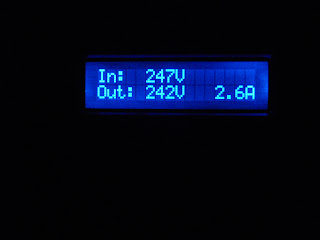
The indicator display tells you the input/output voltage, and system current draw. The output voltage is factory set for 240V, but in my 3 weeks time spent with Torus Power RM8A AVR, the output voltage seems to track between 238-242V. This is beacuse AVRs are re-actionary by function, compared to power regeneration devices competing in the PLC market today.

The indicator also tells you it's IP address for connecting to PC.

The sound of my system when powered by the Torus Power RM8A AVR, sounded very similar to when powered by the RM8A, though not surprisingly so. The tonal quality maintained that full flavoured, golden blend coffee kau, kau(espresso like, in fact) taste. Rich, dark and velvety would best describe it's sonic character. When analysed in detail, the high frequencies seems a tad smoother, and tidier too. The high hats shimmer and fade in to air still, but without that slight feathering edges(this is hard to tell except by A/B/A comparisons). The mids offers the same warmness and body density, except the sibilants of some recordings becomes less irritatingly so. For some funny reason, it's still there(and any sibilant can't be good!) but the AVR version makes it that much more acceptable, just because the sibilants are less prickly to these ears. Bass quality is just a tad tighter still but again, that's something only a back to back A/B/A test will reveal.

Now, here's where the major improvements of the AVR version lies. The staging and imaging factor. The RM8A AVR just opens up the sound stage further, further still beyond room boundaries than previously experienced. The stage depth layering becomes that much more distinct. Hall atmosphere and acoustics on "live" recording is highly convincing. With the AVR each musical instrument and performer has their individual time and space, with elbow room to spare. Imaging took on rock solid stability that my non AVR RM8A just doesn't do. With the AVR version, one can sit slightly off center and still be rewarded with a solid center image. In other words, you can move about quite a bit before the center imaging starts to lose focus and collapse eventually. In short, the spatial dimensionality and imaging palpability factor of the sound stage is first rate.

All the above sound description is based on what the AVR model builds up from the un regulated model of Torus Power RM8A. For a more complete or a re-fresher take on the Torus Power RM8A, please go to my original posting of Power Struggle?, dated 14 March 2009.

In summary, the Torus Power RM8A AVR builds on the strengths of the already impressive sounding RM8A. Then it improves upon a few key areas that if a direct comparison had not taken place, I would not have known could be better. The quantum of improvement is not exceeding big, but if the little things matter, they would add to the further enjoyment of an already great hifi set up. I would say the AVR model brings further refinement to a well proven concept. The Torus Power RM8A is no longer the best sounding PLC in the market today(it's now decidedly 2nd best sounding. He!He!), that "best sounding" position has just been filled by the Torus Power RM8A AVR. I know some one has already parted with his Torus Power RM8A to make way for the new in coming Torus Power RM8A AVR. Congrats to tha man!

Would I put my money where my mouth is and do an up grade? Is it worth while to spend RM$8k more for what is, perhaps a sonic improvement of the last mile?

Good questions, as they have been troubling me since the Torus Power RM8A AVR left my audio sanctuary. Let's see what happens.

Quay Sera, Sera, what ever will be, will be.
The future's for all to see.
Quay Sera, Sera, what will be, will be..........

Note: For some in explicable reason, Big E went all poetic and now, musically philosophical after each encounter with a Torus Power product! Now, is that another one of those things that make ya go hmm...................?

Torus Power is sold by AV Designs, contact James Tan, tel: 03-21712828

August 2, 2009

Torus Power RM8 Int'l - Take Two

This is an old post of ours in the blog we previously contributed to.

Panzer has been waxing lyrical about the Torus Power RM8 In'tl power line conditioner, he even has a love poem for it :-) . With an endorsement like that, how can I resist listening to the Torus Power RM8 myself? Panzer is a great pal, he delivered the Torus to my place last Saturday, and, as we can see in his last post, suffered silently in withdrawal.


Well, I'll just cut to the chase - after a 3-day listening period, I admit that I am now firmly in Panzer's camp. I usually take longer to come to a final conclusion about a piece of hifi, but since my findings echo Panzer's, who has more extensive experience with the Torus, I believe my feeling is right.

Admirably, the RM8 displayed its excellent performance even with all the cards stacked against it. First is the powercord from the wall, since mine is a Shunyata Python 20A version for my Shunyata Hydra 8, while the Torus Power RM8 takes a 15A cord, I have to substitute with a stock powercord that came with my Pass Labs amp. Second, as the Torus Power RM8 Int'l comes with UK style outlets, I have to use adapters for all the powercords from it to my equipment.

With all these limitations, I would not consider what I am writing as a review of the Torus Power RM8, just take it as a person's listening experience then.

The RM8 needs some warming up period, about 2-3 hours, after that, as I left the unit powered on permanently, its temperature (just warm to the touch) and performance stabilized. Throughout all my listening sessions, my entire system sounded more confident, it was as if my EgglestonWorks The Nine luodspeakers were saying "yes, finally this is a signal that i can really work with". All the twists and turn, dynamic swings, subtle cues and broad strokes in the music came through clearly. It is quite unbelieveable that I was listening to many smeared and veiled moments in music before the Torus Power RM8.


Take Hugh Masekela's 'Hope' cd, the spontaneous shouts and applause among the live audience never sounded so well defined and so well separated. Previously, the vocal and saxophone could sound slightly hard and shrill at certain points in the recording, but with the RM8 in place, these artifacts were totally cleaned up. The entire recording sounded natural and unforced, even at the most explosive moments.

Compared to the Shunyata Hydra 8 that I am using now, I have to say that my system performs better with the Torus Power RM8, as it should be at close to 3 times the price of the Shunyata. Shunyata may portray vocal, especially female, a little more colourfully and sultrily, while the Torus Power sounds really neutral, at the end of the day it would be the listener's preference that it will come down to. However, in other aspects, Torus Power is indeed ahead.

From what Panzer writes, we know he takes the Torus Power RM8 as the leading contender for the king of plc hill. Though there are a number of others that we have not heard, I believe he is not far off the mark. Not at all.

Power Struggle? Torus Power RM8A.

This is an old post of ours in the blog we previously contributed to.

The Torus Power RM8A.

James of AV Designs called, "hey, are you having problems with the Torus Power?" I replied, "No, why would you say so?" James responded, "I just saw your posting called Power Struggle?, with a picture of the Pure Power and the Torus side by side".

In truth, I actually struggled to review the Torus Power RM8A, because every time I sit down and play some of my favourite music through my hifi system, with intention to evaluate it's performance and how it subjectively changes the sound perceived, I always end up just flipping thru disc after disc, for a few hours, drawn in to and subconsciously unaware, lost in music! Totally forgetting to do my evaluations just minutes in to the first song! And that, is no bad start. James must be relieved to hear that.


The rear panel with 5 outputs and 1 input(right, not shown).

The Torus Power is a 32kg beast of an PLC, which required again, the help of another good friend to help me haul it up in to my first floor audio cave. The build quality is first class inside out, as should be for a top price point PLC costing RM$18K! Unlike the Pure Power reviewed the week before, with it's high tech, sophisticated look, the Torus sports a rather plain if very sturdy look. There's no fancy blue dot matrix display, no multi function settings to monitor or set. Just a plain "ON/OFF" switch on the left side that glows half orange when switched "ON". At the back panel is a standard 10A rated IEC input and only 5 British 13A style outputs! I wish there was at least 6 outputs(8 would be even better!), that way I can power my whole system via the Torus Power RM8A. James, care to advise Torus Power to be more generous with the outlets, if possible?

The full rear panel pic.

The theory of Torus Power as per explained by Richard of Pure Power(whom knows his competitors well!), uses a huge transformer to isolate the audio system, plugged in to it, from the rest of the power grid in your house and quite possibly your neighbourhood! I tested the Torus Power RM8A by using a multi meter and found the input is indeed completely isolated from the output. However, I also found the same daisy chaining of the outlets as per Pure Power practise, but only after a filter and protection circuit board( seen on the right hand side of the internal picture). It would seems that both the Canadian companies choose to do things differently from their American and British competitors, whom seems to place more faith in individual or duplex output filtering.

The simple insides, the secret is in the giant isolation, balanced transformer, which sits on custom mounted brackets with sorbothane like material for insulation againts vibrations(which I never felt with hand placed on top of unit). Note the filter and protection circuit board on the top right, some say because of that, the right most (viewed from this pic) output sounds the best and should be used for source.

The sound, the Sound, oh.... the SOUND! With the Torus Power RM8A powering my Marantz CD7, Pass x-2.5 Pre and Aleph 0 Mono blocks, all the best virtues of my system is enhanced. The already warmish tonal flavour of the system blossomed in to a rich, full aroma gold blend coffee like "kau""kau", sensation. It's sound?, the mids are thick in density yet smooth in the highs, leaving no after taste what so ever. The bass, while not iron fist ed like presented with the Pure Power, is just very tune full and bouncy. It doesn't make my amps sound like it's on steroids, neither did it make my speaker sound like it's grown a pair of 8 inch woofers either! It's forte is micro dynamics rather than macro dynamics! Every thing sounded as it should be, only with the musical emotion factor brought to the fore. There's a certain way the music flows through the system powered by the Torus Power RM8A. Call it P.R.A.T. but not like Naim style, which is fast and bouncy. This P.R.A.T. factor here is of the rather relaxed kind, it lulls the audiophile in me with a sense of serenity, while the music slowly but surely, does it's magic to disarm all my audiophile prejudices, and just allow me to subconsciously flow in to the music, connecting with it's emotional message. This elusive quality(seek ed by so many, yet never knew it, but seldom found on systems at any price point) my fellow readers, is what separates the merely good hifi from a system with greatness!

My self, and a few other lucky souls included, have already witness the greatness in the by now legendary LS3/5A speaker, vintage amps based system of Mr Jo Ki. Jo has always waxed lyrical on the profound influence of the Torus Power RM8A had at shaping the sound of his system today. With the Torus Power RM8A in my system and from this brief experience, I can, finally relate to his point of view, because I can too, finally, experience musical playback at a higher emotional connecting level, stimulating goose bumps inducing sensory to boot. This experience is priceless, and one will not know that it's there until one experiences it. A hifi system playing music without this sensation, no matter how good it's audiophile qualities are, is just like watching the "Happy New Year's fireworks!" each year, very nice but also pretty pointless once the shows over.

O.K. back to the audiophile reality, the noise level of the system is the most silent that I've ever heard. The overall sound presentation is very coherent, almost liquid like yet very tidy. Images are solidly anchored within a sound stage(almost like you're there too!) which is beyond room boundaries, and very clear perception of depth, should a recording contains the spatial information. In live concert hall recordings, like the Jacky Cheung Live 2004, the hall ambiance is convincingly reproduced and the band backing Jacky Chueng can be clearly heard arranged in layers just behind the solid image in front, which is Jacky himself. Audience hand claps are also very realistic, very important if you need convincing yourself to "be there!".

I have a little poem, context taken and modified from a U2 song which nicely describes the at odds behaviour of the Torus Power RM8A that I've experienced.

It's silent yet never dark.
It's dynamic yet doesn't thrill.
It's substance yet without style.
It's loud yet never noisy.

Greatness in a box!

By now you can probably tell, that when hifikaki takes the Torus Power away for a counter point, to see if it effectively solves the dreaded Bandar Utama power supply quality issues, I'll be having a tough time re-adjusting to the cruelty called reality! The reality is I can't afford the Torus Power RM8A at this point in time now(with bad news coming in every single day about the impending and what could be a long lasting "Great Recession!"), but I know that I have found the last piece in my equipment chain of intended purchase, the final piece that brings greatness to my system. For my system and subjectively, my ears(certainly not healthy for my bank a/c), the Torus Power RM8A(or may be the RM16A?) is still the best PLC out there today!

A Technical note: Balanced transformer? What's does it do to our music? Just like our XLR balanced interconnects, the "positive" and "negative" signal cores run along side within the cable, thus canceling out each other's noise, resulting in lower overall audible noise floor. A balanced transformer works the in the same manner where both the "live" and "neutral" carrier core is winded along side each other, thereby cancelling, each other's inherent noise, there by lowering the audible noise floor.

Torus Power is sold by AV Designs, contact James Tan, tel:03-21712828