Showing posts with label Kenwood. Show all posts

September 21, 2023

A Post Modernist? Kenwood KX-5010 Cassette Deck

The Kenwood KX-5010 with it's accompanying original remote at press photo

What does one do after making possibly the best sounding product of an era? Well, Kenwood like so many other companies, started introducing convenience features. You see, the Kenwood KX-880G and all it's others in the series managed to stay in production from 1982 to 1989, in any industry especially consumer products, 7 years product life span is a mighty long............ time. In 1990, a new decade, Kenwood introduced the new generation of KX series cassette decks, now modelled as 5010 & 9010.

Both KX-5010(a 2 head, single capstan transport) and it's top of the line model, the KX-9010(3 head, dual capstan transport), now comes with remote control, a large horizontal FL display, neatly integrating the tape counter, tape type & L/R peak level meters, in an attractive yet easy to read from a far design. Styling wise, this is the biggest improvement over the KX-880 & 1100 series design, while novelty was nice when it lasted, now seems so very dated, especially that vertical L/R peak level meter in which the fonts used were too small to be seen from a far. Most transport control buttons were carried over to save cost as by the 1990's CD players have began to dominate the music format as source & cassette starts to lose it's dominance. So new models with carry over parts bin was a logical and clever move, costing wise when launching a new product. Car manufacturers do it all the time!

The back panel also has system remote trigger jacks, if you're into an all singing & dancing Kenwood stack system

Extra features are always welcomed, and that includes the ability to make a one touch test recording of about 30 seconds after blank tape is inserted, then automatically rewinds and playback the result for your sound quality evaluation. one can repeat the process several times at a touch of the "Record" button, until satisfactory sound recording setting is achieved, before goin for the full tape recording. It's like having a 3 head tape deck feature with 2 heads only! Another feature which I absolutely love about the Kenwood KX-5010 is the Direct Drive transport, despite being a single capstan transport design, wow & flutter spec is only 0.25% low, which many dual capstan design transport probably also cannot match. I now find Direct Drive transport very good with pulling power, especially during playback of old and sometimes slightly sticky tapes. When other decks are struggling, the Kenwood continue to play with stable speed. By the way, the Direct Drive feature is not new, but carried over from the previous KX-880 series.

I think Kenwood KX-5010 had a strong foundation to build upon, being based loosely around it's very capable predecessor of KX-880HX. Will it sound as good, with added features?

The internals also looking very similar to the older KX-880G!

Opening the cassette door reveals the single capstan, 2 head transport

Let's find out! From the first tape playback, the performance similarity to it's predecessor, the KX-880G is obvious. Crystalline clear tonality, speed stability, punchy bass and highly extended treble all shines through. However, I have 2 doubts started developing after a few tape playback. First was bandwidth, with familiarity, I just felt that perhaps the band width of the KX-880 series was still better in the regards, because the highs were more liquid, had less white noise. Next, another area the predecessor also did better in terms of micro dynamics, especially in tracks where double bass, or bass guitar plucks & piano pings were prominent, the older model certainly offered much more clarity on the proceedings.  In other areas of the performance of the KX-5010, the sound was clearly cut from the same cloth as the KX-880 series, just with a few more rough edges only. Both shared a similar tonal quality, stable speed & dynamic overall sound. Maybe in some cases, if remote control, post modern styling & recording feature is your thing, then the Kenwood KX-5010 cassette deck is up your alley. 

This Kenwood KX-5010 unit is in great cosmetic condition and comes with per-programed after market remote, supplied by mu buddy, Oh. Please contact him if one is interested in purchase of this deck. His asking price is not high, for a fully reconditioned unit which looks & sounds good!

However, if one priorities cassette playback sound above all else, then the KX-880G in which I previously reviewed, is the much better defacto choice of the two. I have made my choice the moment I heard the KX-1100G, in which playback sound performance wise, opens up a whole new level of performance over both the KX-5010 or KX-880G. The 3 head machine just cost much more, that's all!

I am now really starting to believe a folklore amongst cassette deck communities, that the best golden age for really great sounding decks were made from 1978-1982!  This due to the fact that as I narrow down my to keep cassette decks to last 5 surviving, despite the many I have written about here, I just realized 2 out of 5 in my collection are from the 1982 year,  That's kinda significant. Don't you agree?

August 12, 2023

Glorious Past! Kenwood KX-1100G Cassette Deck

Kenwood KX-1100G is sold from 1982 till 1989 in various guises, last being KX-1100HX, which includes Dolby HX Pro for recording from radio, as per KX-880D and all the other guises

This was the cassette deck that virtually made the name for Kenwood back then in 1982, that's exactly 41 years ago, along with it's lower model, the KX-880G which I toyed with last year. It sounded so good that I was considering to buy the review sample, but I decided to hold out the purchase, in hope that one day, the top line KX-1100G would become available. Just my collection habit, that I will only keep 3 head decks.

Finally, more than a year later, Mr Oh, my trusted hifi repair guy and cassette aficionado, had restore 2 units of the KX-1100G and asked if I wanna toy with it? Hell yeah! A bit more about the Kenwood KX-1100G. It's a 3 head, direct drive, dual capstan, 3 motor Sankyo tape transport design, used in much like the high end Nakamichi's of the days gone by. Tape loading cover opens manually, via a push button on top of the power ON button on the left side of the fascia. The cassette well is biased towards the left, as per typical design of the time, followed by that distinctive dual fluorescent display, one horizontal to indicate tape type, Dolby and timer, pluas another vertical, to indicate peak level meters for L&R channels. Transport controls are located just below the horizontal display and towards the right side is the recording level setting knobs. The whole unit weights just 6.2kgs finished in satin black with faux audiophile feet, which looks nice. Build quality is not the best, due to it's medium weight design intentions, but everything works nicely, even if the tape transport is slightly clunky when being engaged & disengaged.  

Overall, the design is exactly the same as the KX-880G, except for that audiophile feet, and the "Amorphous Alloy Combination 3 Head" description printed on the cassette cover.

The back panel is generic cassette deck layout, with RCA input & output, and power cord on the other side of the case

Only this description and that big audiophile feet separates the KX-1100G from the KX-880G, the lesser sigbling!

From the very first tape I played with this Kenwood, I was totally smitten by the sound, which was tight, clean, fast & very powerful. It does really remind me that I am listening to CD like quality sound, but from a cassette source! Tape speed stability is first rate, which comparing to some of my higher end decks, which should be better, but not! Tape pulling power is exceptional, due to it's direct drive mechanism as some of my older tapes tended to be a bit sticky, and the Yamaha K-1X can occasionally give up half way, and stop playing, but not the Kenwood, which will continue to play to the end.

Due to that speed stability, bass notes are ultra clean and very punchy, not even the slightest hint of muddiness. The mid range is crystal clear, making the vocals & diction very easy to follow. If I could want more, I would like a bit more meat in that area, but then I am already nit picking. Highs are truly extended with the slightest of hiss, depending on the tape used. Overall, this deck has the musical chops of a digital medium. I must also point out that not many cassette decks have the capability to throw a sound stage quite like this Kenwood, which is wide and deep, and clear vocal projection in the middle. Not even some of the more expensive decks can do that!

AS I only used my decks for play back, I can't comment on the recording capabilities, but if you do Google a bit and ask folks on the cassette forums, They would rate this Kenwood somewhere between a Nakamichi CR-3 or CR-5. Considering the huge price difference between this Kenwood vs those Nakamichi, I can only shower praises on the Kenwood! Perhaps a poorman's Nakamichi it could be? Only you'll know once you've used it.  

Great with pre-recorded tapes too! Seen here playing the Footloose OST with excellent sound quality

While most 3 head cassette decks can give good sound with excellent chrome or metal tapes, not many deck will sound good playing pre-recorded tapes. And this area is where the Kenwood is KING! The difference in sound quality between those pre-recorded tapes vs those self recorded chrome or metal tapes has being narrowed considerably with the Kenwood. Most high end cassette decks will play chrome & metal tapes well, but ruthlessly expose the short comings in sound quality of the pre-recorded tape. With the Kenwood, 9 out of 10 ten pre-recorded tapes will sound very good still, maybe with or or two playing slightly blur. As I have quite a few of those pre-recorded tapes, being able to play them well certainly works in the Kenwood's favor.

I bought & paid for unit just 2 days after first listen, and I think that says a lot about the sound qualities of the Kenwood. I never really believed when someone told me the cassette deck golden years were between 1978 - 1982, with this Kenwood KX-1100G plus my Yamaha K-1X experience, I am starting to see maybe there's some truth to it after all?  

By the way, I think Mr Oh still have one or 2 more Kenwood KX-1100G under restoration, just in case you're keen, do contact him a.s.a.p.

April 9, 2022

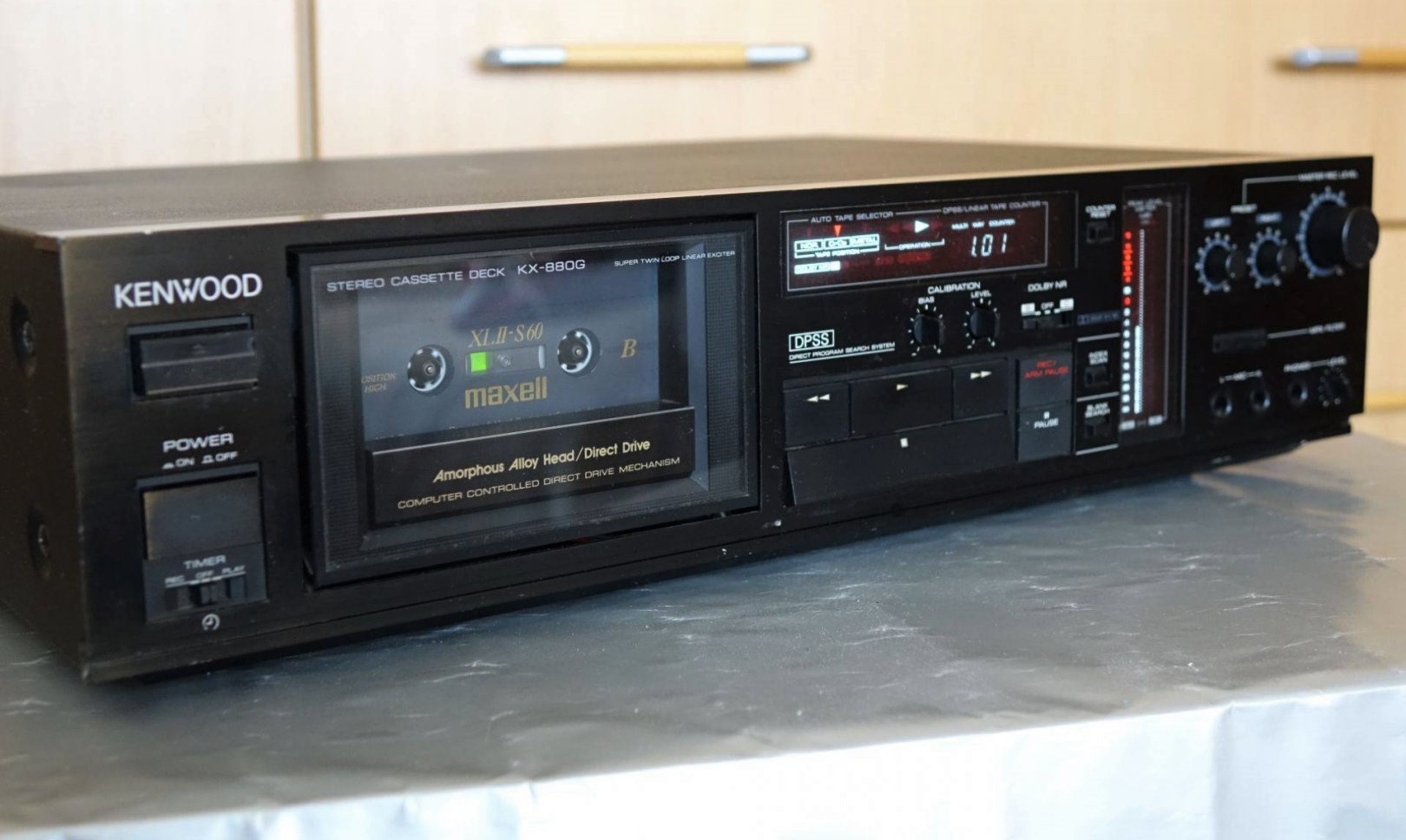
Retro Giant Slayer, Kenwood KX-880G Cassette Deck

The Kenwood KX-880 G's unique & unmistakable 2 display styling feature! Looks a little weird at first, but with a little use, I certainly have learned to appreciate the separated peak recording meter from the other display parameters

While rather heavy for a 2 head spec deck, other than a high spec Sankyo direct drive transport, and a bigger than usual power supply tranny on the left, nothing on the inside would give a clue to it's build quality & sound performance! On the middle is the power supply regulator & control board, while partitioned on the right is the audio PCB board. The Dolby B & C noise reduction board is seen standing as an attachment board. That's smart design actually as the same audio board can accommodate a Dolby noise reduction board that incorporates HX Pro in the last of the KX-880 series 

Kenwood Corporation had a healthy reputation in the hifi industry in the 70's & 80's. Like many Japanese audio giants of the era, the late 90's was the start of the dark era. However 1985 was still fine vintage as far as Kenwood is concerned. The KX-880 series cassette deck started life in 1982, and had a seven year production run in various guises until 1989. It started as the KX-880, then as the KX-880 SR, followed by the KX-880 SRII, and the mid point evolution of KX-880 G as featured here, superseded by the KX-880 D  and lastly the KX-880 HX. Being a design from 1982, the Kenwood makes no concessions for an optional remote control feature, much like the Denon DRS-810 has.

The Kenwood KX-880 series was positioned as the top spec 2 head cassette deck, with the same unique 2 display styling as the top range KX-1100 3 head deck. Of the 2 display windows, 1 horizontal displays the tape counter, tape type & status. The other vertical display is for the wide range peak recording meter. As per it's high spec 2 head deck status, the transport is direct drive type from Sankyo, which is later adopted by Nakamichi for the CR-1 & DR-1 series. The back panel is standard cassette deck, with input & output RCA and a fixed power cord. The Kenwood being nicely, but not luxuriously built weights a decently hefty 5.9kg. However, once on the inside, nothing would indicate of it's heft or sound quality potential. 

I plug the Kenwood KX-880 G in to my system, in place of the Denon DRS-810 3 head deck, and upon pressing play, the sound just blew me away! Gone were that slightly muffled mid range sound typical of cassettes, the Kenwood sounded fresh, crystal clear like a wide open window, detailed(as much as the cassette format will allow), large scaling & wide dynamic range.  The Kenwood sounds like nothing of any 2 head spec deck(and probably some 3 headers too) can ever be! I never heard any wow & flutter during it's time here, perhaps due to it's direct drive tape mechanism, but the funny thing is that very same transport used in my previous Nakamichi DR-1 had some degree of wow & flutter, even if it's just every now & then. I also thought the Kenwood in comparo, sounded much better than the much more up market Nakamichi.

This is a highly recommended buy or keeper if one just wants to listen to the best possible sound quality cassette tapes has to offer. I am sure the recording quality is equally fine, sans the off tape monitoring feature, meaning you don't know what you'll get until the end. However, should one be very familiar with tape bias settings and type types, then the results can be predictable too, caveat being this for experienced users only. For the Kenwood KX-880 series asking price of sub MYR1k, it's really a retro giant slayer!

May 26, 2021

Upgrading My V! Kenwood GE-7030 Equaliser

With a pair of  Bose 901 MK VI speakers serving as the front main channels of  my 5.2.4 Dolby Atmos surround sound system, I have discovered that adding an EQ(in the form of a Pioneer GR-555) in to the mix only for the front channels improved the over sound performance of the system. What I did not realized is that  the quality of the EQ component mattered in HT too, just like in our 2 channel stereo system. Here goes......

The Kenwood GE-7030 comes with a frequency jog dial & level up/down buttons for easy band selection and adjustment. Excellent ergonomics when in use, even if all those buttons on the front face plate seemed a little daunting at first!

Spotted this unit on FB Market Place, made the inquiry, but due to it's high asking price I actually held back & thought carefully about it for more than a month if the more expensive EQ really makes a difference? I guess some times, what's meant to be was meant to be, as what are the chances that an item is still there after a whole long month or more? Based on my trading experience on FB Market Place, the stuff is usually gone after a few days if one is eyeing & not making an effort to secure the item.

Anyway, met the seller who was a really friendly guy and he gave me about an hour of his time, just walking me thru all the bells & whistles that this Kenwood GE-7030 has got. Basically, one can work this Kenwood EQ in 3 ways. First is the most common used as 14 band Graphic EQ. Next is as a 3/14 band grouped Parametric EQ. Last is the easiest, using it's 7 pre-programed stored EQ Genre curves, which includes modes such as Flat, Pop, Rock, Car, Jazz 1, Classical 1 or Classical 2. Last but not least, that matching pale bluish dot matrix text & bar display just matches my stack of other components from Denon, Cambridge Audio & Oppo. The Kenwood does not stick out like a sore thumb, unlike my earlier Pioneer GR-333 EQ which came with bright amber bar display. And believe it or not, the Kenwood GE-7030 was sold during the 1991-1992 catalog years. The fact that it's still around today is testament to Kenwood, and probably most Japanese audio manufacturers during the era, that overall high standard of build quality. The Kenwood also came in a tall, massive & deep 2U chassis, which on itself looks just like a second AVR on the rack, but weighting only 5.4kgs. Not too heavy, but for an EQ, it's a battle cruiser. 

My HT component stack. from top, Denon X-4400H AVR, Oppo UDP-203 & BDP-83 Blu-ray player, Cambridge Audio A-120 4 channel power amp, Kenwood GE-7030 EQ, and lastly Weiduka PLC and other auxiliary components, like HD Toaster & that Arcana HD Fury(hidden behind)

The Kenwood GE-7030 unit that I bought came with some minor scratches and dings on the front faceplate, which required some touching up with permanent black marker. Once marker ink dried, with a bit of elbow greasing, the touch up will look almost seem less, unless viewed up close  

With the Kenwood EQ plugged in to my AV system, allowing me to only manipulate the front channel tonal response, I played around with a variety of settings which included Parametric, Pre-Programed, but eventually  settled on that characteristic 14 band V setting on Graphic EQ mode which worked so well on Bose 901 speakers with the Pioneer EQ in use previously. With the EQ setting been custom set in memory, I can move on to enjoy my music & movies. Yes, I actually use the HT system on Denon HEOS to stream Spotify or just MP3 file loaded from my smart phone.

The first thing that hit me was how much more transparent sounding this Kenwood EQ is compared to the Pioneer EQ. It's not a fair competition either as the Kenwood is at least 2 steps up the model line, which equals to a Pioneer GR-777 in that case. However, the Kenwood EQ operates on all logic & memory control board while the Pioneer is still based on the classic electronic sliders. I am not sure if that's the advantage here, but the difference is easily heard, it's just so much more can be heard with the Kenwood, like a veil has been lifted off the sound track and music. The Kenwood is also more powerful sounding, the music & sound tracks just comes alive, as in gun shots, cannons and explosions hit harder, kick drums "kick" harder, and vocals, crystal clear and even with nice imaging thrown in when playing music in stereo mode! While vocals is crystal clear, it still maintains a degree of body within the image of the sound stage! Bass & treble definition is also improved  with the new clarity. Highs are more airy and bass lines can be followed easily. I can't say enough how well this Kenwood EQ matched the Bose 901 MK VI speakers. 

Just a caveat if you're reading this, it may not be a good idea to add an EQ in to the mix if you're not using Bose 901 series speakers in your stereo or HT system. The unique design and sound character of the Bose 901 series speakers demands that an EQ be used with it. There maybe other speaker designs with an EQ requirement, but I believe those are far & few in between, with the Bose 901 series being the poster boy of the group!