Showing posts with label CD Transport. Show all posts

April 19, 2022

VRDS Dreams, Teac VRDS-20 CD Player

Teac VRDS-20 CD player. The bottom footer at the bottom of the four corner pillars are adjustable for height and compensate for stability if one uses a spirit level

I've always wanted an Esoteric or Teac VRDS series CDP. So when this Teac VRDS-20 unit appeared in the classifieds, I wasted no time making it mine! Amongst the Teac VRDS series CDPs, I feel the VRDS-20 is a bit of an odd ball, styling wise. It just looks like a VRDS-7 or 10 but with 4 pillars on each corner which comes with adjustable metal cone feet! I guess a bit of audiophile touches here & there wouldn't hurt. The funny part is the next in line, the VRDS-25, reverted back to the generic square box of the VRDS-10 looks! Otherwise the Teac VRDS-20 share all the family looks of the VRDS series CDPs from Teac of the early 90's era. The Teac VRDS-2- was sold from 1992-1997, and that was era of the TDA-1547 Bitstream DACs from Philips, which this unit uses a pair for it's balance output configuration and also technically, to give a more linear frequency response on both L & R channels.

This Teac has a very brutish business look, and the chassis is at least double layer copper coated in no less than 8 internal compartments. The internal construction has a no expense spared look, which I like. This unit is using the mid tier VRDS mechanism, essentially a heavily modified Sony KSS-151 transport. As a mid tier VRDS, there are some compromises to be made, but overall I feel this is still acceptable as an engineering solution. The transport is not copper coated, the bridge holding up the VRDS clamp is not die cast metal, but some kind of bulk mould compound with enough solidness to anchor the VDRS clamp, which is again a compromised solution of compound coated metal, instead of copper coated aluminum of the most premium of VRDS.  My personal view is to disregard the later economy versions of  VRDS transports with bulk mould compound bridge & plastic CD clamp, like those that currently resides in the Esoteric K-05 series CDPs. The Teac VRDS-20 was available in Champaign gold or Satin black back then. I like that little quarter window on the top casing panel to allow viewing of the VRDS CD clamp at work.


The back panel is simple digital out, which includes Toslink & Co-axial on the left, a acptive power cord in the center, and analog outputs(RCA & XLR) on the right

My Teac VRDS-20 came with this OEM remote, but is functional enough with a matching Champaign gold color scheme

I plugged the Teac VRDS-20 in to my system, in place of my usual Sony CDP-X7 ESD, using it's balanced, XLR output. all else remains the same in the system. From the very first disc I spin, the tonality of the Teac was rather flat, with a slight mid range centric emphasis which make vocals stand out slightly in from of the sound stage. The Sony by comparison, while had a warmer tonal color, has a flatter less mid range centric presentation. The Teac also sounds slightly less detailed by comparison. 

Overall, the Teac has a very agreeable sound when listened on it's own merits. The highs are polite & laid back, the mid range as I have mentioned, and bass for my preference, could be snappier. Where it falls a little short is the emotional connection or musicality as normally referred as. At this level, I think the Teac has a slightly more dynamic sound compared to my very previous Marantz CD-16D which is a machine of similar sound specifications but only slightly more musical in presentation.

Form the 2 comparison above, i.e. Teac VRDS-20 vs Sony CDP-X7 ESD or Teac vs Marantz CD-16D, I feel the latter is more of a fair comparison as both are Bitstream implementations CDP clad in copper chassis, both are closer in price point, but both using different transport & other audio parameters of CD player build up. If just looking by the eye, the Teac looks the winner with it's more impressive transport, multi layer/compartment chassis & internal layout. The Marantz however do sound somewhat better musically if judge using one's ear. I think what could've being the final arbiter? The KI(Ken Ishiwata) factor I guess, the man's not considered in the industry a "Golden Ear" for no reason!


The impressive innards of the Teac VRDS-20

Too bad the Teac VRDS-20 coaxial out didn't managed to signal lock with the input of the Teac UD-501 DAC, otherwise another sound dimension may have been possible!  

After playing the Teac VRDS-20 for a few weeks, I thought I'd try plugging the VRDS transport to my newer Teac UD-501 DAC using a co-axial digital cable, to see how the great transport can compliment a newer design DAC. The UD-501 is using the much newer AKM DAC design capable of DSD decoding, which itself is the manifestation from the continuous development from Bitstream. Unfortunately, for some reason, the Teac UD-501 DAC refused to lock in to the VRDS co-axial digital signal output once the cable was connected. I tried a couple of times but to no avail. You've gotta give up at some point, right?

Finally after like more than a decade of lusting after a Teac or Esoteric VRDS type CDP transport, my dreams came thru with this but only with a slightly underwhelming feelings on the musicality factor. Perhaps a slightly more musical cable can elevate the Teac VRDS-20? one only has to try.........  

September 20, 2020

Rebooting The Final Frontier! Sonic Frontiers SFCD-1

The Sonic Frontiers SFCD-1 was produced from 1995 till 2001. It's probably one of the most musical sounding CD players ever made at any price, even by today's standards! One listening an you'll fall in love with it's charms. By today's standard noise floor & resolution would be it's Achilles' heels, but it's golden colored tonality, rhythm & pace,  sheer musicality will get you hooked.


Here is a Sonic Frontiers SFCD-1 which I used to own sometime back in 2005 till 2007, then I sold it to a friend who loved it so much, he sent the unit to Chris Johnson's Parts Connection in Canada to have it retro fitted with SE Plus mods to the player during 2011. In all he blew a cool MYR 10 thousand bucks or so to do it. Worth every single Agung faced Ringgit, he said, upon the return of the SFCD-1 about 3 months later!

Me? The SFCD-1 was actually my first high end CD player. It sounded great in my system, but I took it for granted, I wanted more........... My next CD player was a Marantz CD 16-D which served as an interim player until I lay my hands on a Marantz CD 7, which was the unit I've always wanted. You can read about my adventures or mis-adventures with the Marantz CD 7 in these pages too.

Back to end year 2019, my friend came for a home visit when I told him I had restarted my hifi hobby. He was inspired and went home looking to restart his too. Like me, he too had moth balled his hifi set for a couple of years. Then he told me his system wouldn't start.up. Chiefly, the Sonic Forntiers SFCD-1 wouldn't turn on! He brought the unit to me in hope I could fix it. 

I opened up the player, and found that the main board still powered up, but the control board behind the face plate with the display wasn't. I had deduced my findings to him, that unless I could find a donor board with the E-prom chip still intact. There wasn't anything further I could do for him. He then told me it's OK and I can keep the carcass. The SFCD-1 laid in my place for a few months, until recently I heard that our chief hifi mechanic Mr Oh of Old Klang Road have a working unit of SFT-1(a transport only version of the SFCD-1) for sale. And so I sprung in to action. Looking to buy the SFT-1 to use as a donor machine, or to shop for parts. Mr Oh learned about my intentions and offered to help me with the parts transfer task. Below is a pictoria guide with photos provided by Mr Oh as he did the transfer job!      

The Sonic Frontiers SFCD-1(black face) and SFT-1(gold face) being wheeled in to Mr Oh's surgery room for parts transplant!

Inside the SFT-1, compared to the SFCD-1 below.

Inside the SFCD-1, note the balanced(XLR) output board and the pair of 6922 tubes(NOS Siemens matched pair), and the added on jitter board on top of the Ultra Jitter module as part of the SE Plus upgrade package performed by Chris Johnson, formerly boss & designer of Sonic Frontiers products.

The 2 round stacks of fast recovery diodes in between the blue & gold colored capacitors are also part of the elaborate SE Plus upgrade package! 

Audio output section of the SFCD-1 beefed up with ceramic tube sockets, MCaps and gold pin XLR connectors for the SE Plus upgrade package!

The SE Plus upgrades also includes more power regulators in the power supply section.

After the control board swap, the SFCD-1 came alive again!

While it didn't affect my SFCD-1, a very common problem with these CD players are the board socket pins as circled in red by Mr Oh. Over the years of usage, the pins can become loose and cause shorting of boards, or just becomes loose and the unit stops working! One way is to tightened the socket pins by using a cable tie, or better yet ask Mr Oh to individually remove the pins from the socket, give it a good press to tightened the contact points. A lot of work though. 

During testing of the SFCD-1, Mr Oh also found the CD transport needed replacement, along with the servo board, which is non-standard Philips CDM 12.4. Sonic Frontiers had modified the servo board.

Thankfully, the SFT-1 again provide the required donor CD transport mechanism servo board.....

All fixed and under going final test.

Finally, the Sonic Frontiers SFCD-1 is now singing in my audio cave again.
 

I shall take my time to enjoy my new found SFCD-1. As I listen more to it, the more I love it's golden tonal colors, it's rhythm & pace and slam dunk musical qualities. These are the very things you can't find in modern CD player designs or CAS audio. That's why I believe the Sonic Frontiers SFCD-1 will live on for many, many years to come, and their used resell values will go up, despite their troublesome reputation. They just sound so...... musically good, compared to most modern digital designs which excels mostly in technical parameters, like specifications & measured results!

Now, latest development, my friend just learned that I have rebooted his SFCD-1 and is keen to have it back after he listened to it in my place. Knowing how much he loved his Sonic Frontiers products, I'll let it go back to it's rightful owner for the cost of repairs. What did I get? if you asked, the sheer joy of being reminded why I liked this CD player so much back then! A lovely ending, don't you think so? 

June 8, 2020

CD Transport Replacement, Sony CDP-X7 ESD

As mentioned in my previous introduction of the Sony CDP-X7 ESD, I had suspected the CD mechanism & laser head was at the end of it's long 29 years service life since new! The symptoms were there, the long disc loading times, some disc unable to detect TOC, or some disc won't either play at the first or last track, and most of all, if I had to skip or reverse a track, it will take a long time to cue, then play. I was looking around for a replacement KSS-190A CD mechanism if I could. I didn't just want to replace the BU-1D laser head only. Yeah...... you can say I like my spare tire!

Found a brand new NOS unit in eBay, to be shipped from Germany, but they wanted some thing like close to 700 Euros and shipping cost have not been factored in yet! I had to turn to my next most trusty source, my sourcing buddy in China. If it's made or available in China, this guy will find it!

And found me a whole KSS-190A unit he did! Bless him..... It's a refurbish unit, come with a test video of the mechanism sent via Wechat too! 2 weeks after that, I got my package from the courier and my replacement project can commence.

Here is a step by step pictorial guide with caption to help someone if any one wants to embark on a similar exercise.   
As mentioned, the Sony is very well built, and like the Marantz CD7 I rescued from the past, one needs to remove the top & bottom cover to access the CD mechanism, and everything inside! The CD mechanism is best accessed from the bottom but some action needs to be approached from the top too! Here you see the Sony up side down, awaiting surgery!

Before the KSS-190A mechanism can be removed, we first need to dislodge the CD puck holder from the top, pull the tray out, then turn the unit back to up side down position.

A close up of the full aluminium die cast CD tray. Very few CD players of today will use this very expensive way to make a CD tray. It's mostly made from plastics of varying quality.

Next the cable loom running thru just beneath the CD transport needs to be unclipped for easy access & removal. Note the 4 springs on each corner of the KSS-190A CD transport! Just like the Philips CD Pro on my previous Marantz CD7! 

The springs do provide the CD transport some degree of suspension from external vibrations.

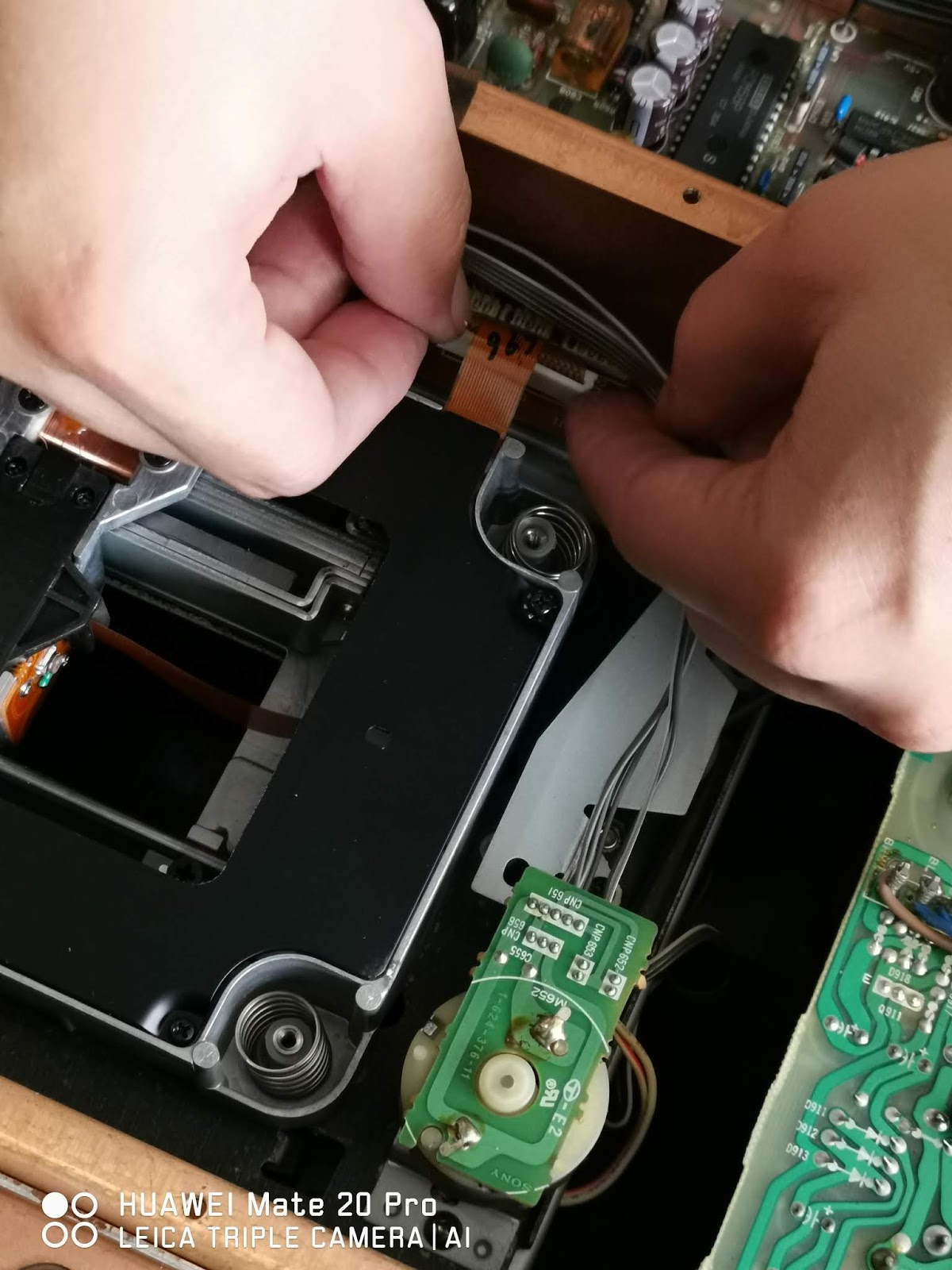
Now we remove the main ribbon cable for signal, clipped with the white plastic finished locking cover.

Due to age, the handling of this ribbon cable is delicate to say the least!

With the original CD transport out from the Sony, can you spot the new vs the original? Neither could we! What, you think that I would be crazy enough to attend to something like this on my own??? Like I always do, I consulted Wong sifu! 

We couldn't spot the diference between the out going and incoming KSS-190A, until we found this little dot of solder which acts like a shorting plug for transport! The little solder dot needs to be removed before plugging in to the Sony. You'll need a heat controlled solder gun, and very steady hands for this job. Too much heat or too slow hand motion and the ribbon cable melts along with the solder lead! I left this step to capable hands of Wong sifu!


With the ribbon cable prep step done, the replacement CD transport in re-inserted back to it's proper place, be mind full of the cable loom running just over the transport, carefully aligning the cables back in to the white plastic twist clip to hold it in place.

Now it's done, that's how tidy things should be when doing cable management! While working on the CD transport, we also took the opportunity to replace the CD tray drive belts, by removing the little Mabuchi motor and cover assembly on the top right of the picture. Sony's attention to details is that they even cover all moving parts with a stamped steel cover, with the belt & transfer gear vaguely visible on the top right of the picture.

Note the super thick sliding rails on which the BU-1D laser head assembly sits on! The degree of over engineering evident here is astounding! Also note the green coated spring on the bottom left of picture, the other 3 springs are just plain finished, not sure why, but some thing to keep in mind in order to replace in the same position after removal. Also note the transport locking screw just above the green coated spring! be sure to unlock the screw after installation, otherwise the transport won't work during testing, and we found out the hard way!

Speaking of the CD tray belt change, the esteemed Mr Oh supplied me the necessary rubber belts. Bless the man & his treasure chest of audio spares! The small belt is the one you saw on the picture above. The bigger belt is buried much deeper inside the CD transport. 

Now that the CD transport replacement work almost complete, it's time to turn the Sony right side up and run some test. First, the CD tray in/out test, checked & super smooth! 


And now for the CD test, using my favorite CD, Pink Floyd's Dark Side Of The Moon!

Great results, TOC detected, the CD plays well, skip & reverse tracks work fast and paused checked!

With one final naked shot, see the twin XLR output trannies towards the back of the player? Sony never did balance audio signal on any CD player like this anymore! Just too expensive now days...... We proceed to close both the top and bottom covers and call it a day!

Withe replacement a success, it's back to enjoying the music. It took almost 200 hours or so for the refurbished CD transport to run in and start to sound good somehow. May be I am experiencing psycho acoustics  again???

With that I had successfully resurrected another flagship CD player from the dead, and living in today's throw away world, it felt really good to preserve a historic milestone of Sony in it's golden era. Sony today is never the same greatness in commitment to hifi quality again. I sent my dead KSS-190A CD mechanism back to my buddy for refurbishment, waited about 2 months, and finally my original KSS-190A unit came back as my back up transport. I plan to keep this Sony CDP-X7 ESD in service for as long as I could.

I love the sound quality of the Sony. It had a warmish tonal balance, compared to today's high resolution, strictly neutral tonal balance. I would say the Sony does not suffer in terms of resolution, but rather presents it without that fake glare, over detailed feeling of today's player. In contrast the Sony sounds soothing, with an tint of rose hued tonal balance, and what I love the most about it, that bad ass fat bass lines. This player can really rock and plays pop recordings really well....... so well in fact, that when compared to another player from the same golden era costing at least 3 times the price when new, the Sony gives away little in terms of sound quality. The more expensive equipment may sound different, but it's really not much better either! Yes, it's a Sony & it's as good as strolling down memory lane 1988 gets.

January 31, 2013

Mid Range Excellence! Pioneer BDP-450 Blu-ray/SACD Player.

The Pioneer BDP-450 Blu-ray/SACD player.

Pioneer has built an enviable reputation with the success of it's range of Blu-ray players. I have being using the starter 3D Pioneer BDP-140 as a reference my self. While it's audio/video performance is very accomplished for the price, I've always wondered, what if I spend a little more $$$ for a step up in performance?

Along the way, came the new BDP-X50 series range of latest Pioneer Blu-ray player revamp, and the model in question here is the BDP-450, which is the middle child, sitting in between the entry level BDP-150 and the exclusive LX-55 top model. The Pioneer BDP-450 retails for RM$1,899.00/unit, so it's really a big step up from the entry level model(price wise). So if the BDP-140 or BDP-150 already offers such good performance levels(assuming the newer BDP-150 is as good, if not better performing), for a mere RM$699.00/unit, what more can the BDP-450 offer?
The Pioneer BDP-450 residing in my HT system.

First up, the Pioneer BDP-450 offers superior build quality, with it's heavier gauge steel chassis(which houses beefier power supplies), all satin black brushed aluminium face panel, chunky audiophile style feet(not the fake plastic ones for sure), and definitely smoother disc loading drawer action. At the back panel, the goodies galore continues with dual HDMI output(for those who want their video signal to flow direct to screen, by passing the surround receiver's video board) for superior picture quality, while the other HDMI output sends audio signals to the said receiver. Is there really a performance upgrade by going the twin HDMI output route? I don't know, I didn't test, but I bet someone would do. I connected the BDP-450 as I would with my resident  BDP-140 for a fair comparison, which means one HDMI cable, sending audio and video signal to my Denon receiver and the second HDMI cable from receiver to my Plasma display.

The only same old, same old part as shared with the BDP-140 and BDP-150 is the hand remote wand, which I can understand Pioneer's decision to keep it as it works pretty well actually. The whole unit looks well put together with nicely aligned panels and centered disc drawer on top of the clearly legible display, which is dim able(the entry level model does that too). Like all 2012 refreshed Blu-ray player models onwards, the BDP-450 also comes equipped with Cinavia anti piracy software pre-installed.
The back panel, 2 HDMI outputs is the main selling point here.

Now we get to the nitty gritty of the Pioneer BDP-450 in terms of video performance, which the colour and picture dynamic qualities are cut from the same fabric as the cheaper Pioneers. There seems to be finer pixels in the darker scenes leading to improved black detailing. I see smoother fast motion scenes, with richer and more saturated colours. Depth of field in panoramic land scape scenes are definitely more convincing. I watched Kingdom Of Heaven Blu-ray disc and came away suitably impressed. I think a more highly regulated power supply section of the player contributed to the performance gains. Still, I thought for so much more outlay, the picture quality improvement ratio did not seemed catch up enough.

However, it is when playing 3D Blu-ray disc that I felt all the extra outlay for the BDP-450 over the lesser models became worth while. Comparing the BDP-140 to the BDP-450 in 3D mode, made the cheaper player's 3D qualities look like card board cut outs, and on certain scenes, more like a cut & paste job! I was using the Monster Vs Aliens 3D Blu-ray animation movie for comparison. With the BDP-450, the 3D effects were smoother and more organic looking, while still maintaining the pop-up effect and excellent layers within a field of depth within the confines of my 64 inch Plasma display. The BDP-450 made watching 3D movies less fatigue and more enjoyable, due to less cross talk, and less noise within the video signal. I used to find 3D fascinating for a 25 minutes only(I start to feel giddy after that) of viewing period with the BDP-140, but I could finish the whole movie on 3D mode with the BDP-450 without much fatigue setting in. I know my kids certainly look forward to more 3D animated movies from here onwards.
It is with 3D movies like Monsters Vs Aliens that the Pioneer show it's capabilities to the fore. The disc loading drawer opens and closes with smooth action.
The Grudge is a scary Hollywood take on Japanese horror, much like The Ring, but only more effective in the script build up and make up & graphics. Sarah Michelle Gellar(Buffy The Vampire Slayer) stars.

Now we get to the audio part, which the first aspect that impressed me easily was the bass, which certainly dived deeper and rumbles more solidly. The stronger bass foundation gives the center chanel a more anchored, less floaty conversation, especially with male dialogue, which feels more manly, with a bit more of that chest. Surround panning effect is more seamless and more easily located, especially the rear surround chanels, which sometimes makes me look back over my shoulder, because I actually thought some one behind was breathing down on me, it's that real! It happened when I was watching The Grudge, an American perspective on Japanese horror, like The Ring, only scarier!

Just for kicks, I played a few music SACDs and found the sound to be highly detailed, musical, rhythmically assured, smooth, and with liquid top end. The sound staging is stretches across my living lounge with good depth. I was of course, playing music thru my Denon/Bose HT system.  The Pioneer BDP-450 would certainly make a great audiophile SACD spinner or transport, if one has a huge collection of SACD disc.
My Denon AVR-1612 AV receiver(top) and Pioneer BDP-450 Blu-ray/SACD player(bottom).

It was during this time that I have to experience Cinavia anti piracy effects on my system. After playing an offending Blu-ray disc for about 20 minutes or so, the player will mute audio output and a message would appear on screen to suggest that you're playing an illegal disc, advising you not to adjust your system set up menu. Apparently, most Hollywood movies released after March 2012 is Cinavia encoded. Otherwise, the Pioneer played each and every legitimate disc or otherwise with no problems what so ever.

Another area I liked about the BDP-450 is the quick start up feature and fast disc loading times. It took less than 20 seconds to start up each time from sleep mode, and each time a new disc is loaded, the smooth closing tray would then take no more than 45 seconds to recognise and load the top menu of the said disc. Older players can sometimes take more than 2 minutes to load a Blu-ray disc top menu upon closing of disc drawer.

I think the Pioneer BDP-450 will do well in a 3D capable HT system, where the said feature is used often enough. It's a player that truly offers a step up in terms of audio and video performance from the entry level units with higher build quality to spare. Audiophiles looking for a reliable CD/SACD transport would not be disappointed with it either. For those with budget AV systems however, the entry level BDP-150 should still offer more efficient cost to performance ratio.

Pioneer products are available at all appointed dealers nation wide.

January 17, 2012

Best Digital Gear 2011.

Frankly, I am a little surprised that after 2010, CAS based high end audio products some how, just stop coming on to the market place, instead all we got was disc based players which showcased CDs at their very best! What happened?

To me it's a bit of a dejavu feeling we got during the twilight days of vinyl, when the best advancing turn table designs only started to surface when dooms day was already pronounced, back then in the late 80's. Twenty years or so later vinyl is enjoying it's second spring, while the CD is now in it's last legs, How times have changed. Ultimately, should CAS make further in roads in to the audiophile world, or just slowly fade away like SACD and DVD-A is any one's guest today. One thing is for sure, with 32/384 music files on the horizon, it's only a matter of time when new hardware will be required to keep up.

In the mean time let the CD bask in glory of it's best play back equipment yet!


TAD D-600 CD/SACD player is a master stroke.

TAD D-600 CD/SACD player.

This is likely to be the Yamato battleship of CD players. The common storyline includes being the last pride of it's kind, where the Imperial Japanese Navy built the Yamato to be the end of all battleships, while realizing naval war fare was already shifting towards more agile and aggresive carrier based strategy. TAD also adopted this view when designing the D-600 CD/SACD player. However, unlike the Imperial Japanese Navy, they did not allow the disc spinner to be redundant in the advent of CAS digital source. Instead the TAD D-600 proved to be a perfect match for the Bryston BDP-1 playing hi-rez files to form an un-matched sonic synergy that's out of this world! Playing CDs and SACDs proved to be just as spectacular an event of musical enjoyment. Digital playback don't come much better than this, as it should, fully justifying it's asking price.


Playback Designs MPS-5 CD/SACD player is unique because it's designed to be fully up grade able which will ensure that it won't be obsolete in the near future.

Playback Designs MPS-5 CD/SACD player.

This is an interesting player because of it's modular structure and software based up grade able design. It would be a shame if it didn't sound good too. However, with it's latest power supply and firmware up grades, it does live up to expectations. Like the TAD mentioned above, it also allows connection to a digital media player like my Bryston BDP-1 to play hi rez music files. In this mode, the MPS-5 actually has the pizazz to rival the TAD master class, with it's phenomenally propulsive bass quality, low noise floor and transparency. There's a tendency to lose the last bit of "air" in a given recording compared to the TAD, but in the end, I guess one should choose it's own poison here.  However, it's when playing CDs and SACDs that the D-600 proved mostly superior, perhaps due to it's sturdier built in all aluminium transport mechanism. Having said that, I must put things in context that the fact the MPS-5 is mentioned here in this distinguished list means that it's playing at the very top level of digital playback.


Ayre DX-5 AV Engine is a do it all player, but excels particularly with CDs.
Ayre DX-5 AV Engine.

This Ayre reigned supreme, if only briefly, until the arrival of the two players mentioned above. Some have said that I was perhaps, a little harsh on the Ayre DX-5 AV Engine in my original review. Again in perspective, I found the DX-5 to show it's best with CD and Blu-ray replay. It sounded just as good too, when playing hi rez music files, via it's USB input, with signal fed by a purpose built for CAS windows OS based computer. The only reservation I had with this player is SACD playback, which is a little soft, not in volume, but rather a slight lack of drive and sense of drama, which it's otherwise a rather fine and natural sounding player. I am also not being fair to the Ayre perhaps, because ultimately, it's a whole more affordable than the other two stratospheric priced players mentioned above. Actually come to think of it, which other sub RM$40k player does it all(Audio & Video) with such high levels of competency?


Krell S-350a CD player sonically out performs it's price range by a mile. At one point, it had me wondering, why bother to spend more?

Krell S-350a CD player.

If one is contemplating on buying his last CD only player, my personal advise is why spend more? This sub RM$10k CD player can sound nearly as good as CDs are ever gonna get! It's well built and operates faultlessly too. It's sonic performance is clearly in the league of players costing 3-5 times more, if bench marked just a few years ago.  My digital source bargain of the year!

Here are a few other digital source components which I believe are worthy of my mention here in no particular order or ranking, though not formally reviewed by me personally, but heard else where.

1) Wadia 571 CD Transport, 931 Digital Controller and 922 Mono Decoding Computers combo.
2) DCS Pucini CD/SACD player and U-Clock combo.
3) Linn Klimax DS with Dinamik power supply upgrade.
4) Vitus Audio SCD-010 CD player.

That rounds up my Best Digital Gear 2011. Stay tuned for Best Amplifiers 2011, next!

August 31, 2011

Digital Tour de Force - Wadia 571 CD Transport, 931 Digital Controller, 922 Mono Decoding Computers

This set of Wadia is breaking all the records at Hifi Unlimited.

In the foreground of the photo, from left to right, Wadia 931 Digital Controller, 2 pieces of Wadia 922 Mono Decoding Computers and Wadia 571 CD Transport

Firstly, it is the one system component, in this case a digital frontend, that consists of the most number of pieces. We are used to seeing a CD player coming in 2 pieces, such as a transport plus a DAC or a CD player plus an external power supply. However, this Wadia system goes a couple more steps further – it comes in 4 pieces. There is the Wadia 571 CD transport; the Wadia 931 digital controller; and 2 pieces of Wadia 922 mono Decoding Computers. ‘Decoding Computer’ is what Wadia calls their top of the line DAC.

Secondly, weight. The Wadia 571 CD transport alone weighs 24kg. The weight of the others was not mentioned in their spec sheets but I would venture to guess that the Wadia 931 Digital Controller would be about 20kg and the Wadia 922 mono DAC about 15kg each. That makes a grand total of 70-80kg (150-175lbs) worth of muscle, all this to play a CD that is less than 20g in weight. I was lucky to have a couple of friends helping me to carry them up to my listening room, helping me to unpack and set up, repacking them again and bringing them back to the CMY.

The weight is no doubt contributed by the solid aluminium enclosure that makes up each box, giving them a bomb-proof solidity that inspires confidence. I am sure these heavy weight enclosures made the Wadia system immune to all external vibration and all sorts of mechanical interference.

Thirdly, price. Hold on to your chairs - the Wadia quartet costs a total of RM174,880. It has set the record as the most expensive hifi component we ever write about on hifi-unlimited.

I had no rack space to house the 4 heavy boxes, so they go onto the floor. Having the Wadia system spread out in front of me thus was awe-inspiring and intimidating, to say the least. The first thing for me to do was to deal with the technology that went into these impressive pieces. It was no longer as simple as hooking up the powercords and the interconnects, load a CD, press play and you’d get music. Well, the powercord part still applied, each piece of gear needed its own power, so the owner would have to come up with 4 power outlets and 4 powercords. The analogue interconnects were still needed too, going from the analogues output of the 922 mono Decoding Computers to the pre-amp, or straight to the power amp if you desire ( the Wadia 931 comes with digital pre-amp function).

In-between the Wadia 571, 931 and 922, Wadia applied their technology and connecting scheme. Everything is strung together not with metal cables but glass fibre optic cables, supplied together with each component.

Wadia 931 Digital Controller

Let’s start with the Wadia 931 Digital Controller which acts as the heart of the system. The 931 Digital Controller essentially functions like a digital pre-amp - it has multiple digital inputs, which support up to 24bits/96kHz (which we also confirmed by streaming digital music files from a Bryston BDP-1). Wadia says on its website that provisions have been made for the 931 to accept 24/192 data when a standardized input is agreed upon. The 931 has a 100-step volume control implemented in the digital domain allowing you to bypass an analogue pre-amp. More importantly, the 931 supports two established Wadia jitter-reduction technologies: RockLok and ClockLink. I quote Wadia: “RockLok is Wadia’s proprietary circuit that uses cascaded Phase-Locked-Loops (PLL) to recover the clock signal from the incoming data. RockLok produces a low-jitter clock signal from any standard digital source and can be used with all sources that comply with industry standards. With ClockLink, the clock signal embedded in the incoming data stream is ignored in favor of a local crystal oscillator. This requires that the source component be synchronized to the 931 Digital Controller via a ClockLink output. Any of the inputs can be user-configured for either ClockLink or RockLok mode”.

On the left side of the back panel are the digital inputs, which consist of 1 AES/EBU (XLR), 1 optical, 2 SPDIF (BNC) and 2 ST glass fibre optic
At the centre is a ST glass fibre optic connection for clock output to the transport
On the right side are eight configurable clock and digital outputs to go to the DACs

In use, two fibre optic cables lead from the Wadia 931 Digital Controller to each of the Wadia components, one cable carrying the clock data, and the other the music’s data stream. So with the 571 CD transport and the two 922 mono Decoding Computers, we have a grand total of six fibre optic cables being used, as you can see in the photo below.


The Series 9 components are Wadia’s top dog, however CMY has not gotten the 971 CD transport. It has its junior, the 571 CD transport instead, and that is how we use this Wadia set.

Wadia 571 CD Transport

The ClockLink and digital outputs at the back of the Wadia 571 CD Transport

The Wadia 922 mono Decoding Computers have only fibre optic inputs, which means that they must be mated with the 931 Digitial Controller. It has both RCA and XLR analogue outputs. The proprietary DigiMaster 1.4 decoding software employed comes with a sampling rate of 2.8224Mhz and a digital resolution of 26bits.

Wadia 922 mono Decoding Computer. The analogue outputs consist of 1 RCA and 1 XLR. The digital inputs consists of 2 fibre optic, 1 for digital clock and the other for the digital music stream

I started my listening after a day of continuous playing to warm the components up. They were barely warm to the touch after that. I first compared the sound of going through my Pass Labs pre-amp and without. Sans pre-amp, the big improvement was in the treble region, which sounded more detailed and cleaner. For example cymbal hits were more distinct from one to another. With pre-amp, the portrayal was a little muddier. On the other hand, with pre-amp, music had a little fuller body and a little more colourful (or some may call colouration, whichever way you want to see it). Both presentations were good. If you wanted to hear everything clearly, go without a pre-amp. At the end of the day, I decided to do my listening with the pre-amp in the chain.

The Wadia system never put a foot wrong in the 2 weeks I had them. Every piece of music was produced with complete technical excellence. I had the impression that everything on the silver disc was completely dug up for the presentation; nothing could escape the laser sharp analytical capability of the Wadia.

The Wadia turned up the system’s transparency a few notches, the window on the music was wide open. Separation and focus were both very good. There was no blurriness or smearing anywhere from top to bottom. The width and depth definition of the soundstage conjured up with the Wadia was excellent. The wealth of details allowed all the ambient cues to be heard. Listening to orchestral music, every section was nicely delineated, following the playing was made very easy.

The dynamic expression of the Wadia was impressive too. Passages ranging from whisper quiet to thunderously loud never fazed the Wadia quartet, it went up and down the dynamic scale with ease. Bass performance was one of the very best I have heard in my system. It was tight and punchy. The slightly lean bass characteristic, rather than the ‘phat’ kind, allowed the bass line to be followed easily.

Adding to the flawless performance of the Wadia system was the level of refinement to the sound. The smoothness will allow one to listen on and on for hours without listening fatigue.

The Wadia system portrayed the truth encoded in digital recordings, it did not embellish. I feel that to get the best from this combination, you’d have to partner them with the best, anything that has any hint of dryness or too squeaky clean further down the chain should be avoided, as the Wadia's sound had no excesses, and those qualities in the others will be exposed for what they are.

The combination of Wadia 571 CD Transport, 931 Digital Controller and 922 Mono Decoding Computers are at the forefront of digital technology. If you are shopping at this exalted level, there are but very few choices. With Wadia, you’d be certain that you won’t miss anything on your discs.

Wadia is carried by CMY. To listen to this Wadia combo, call CMY Damansara Uptown 03-77272419