Showing posts with label Cassette Deck. Show all posts

September 21, 2023

A Post Modernist? Kenwood KX-5010 Cassette Deck

The Kenwood KX-5010 with it's accompanying original remote at press photo

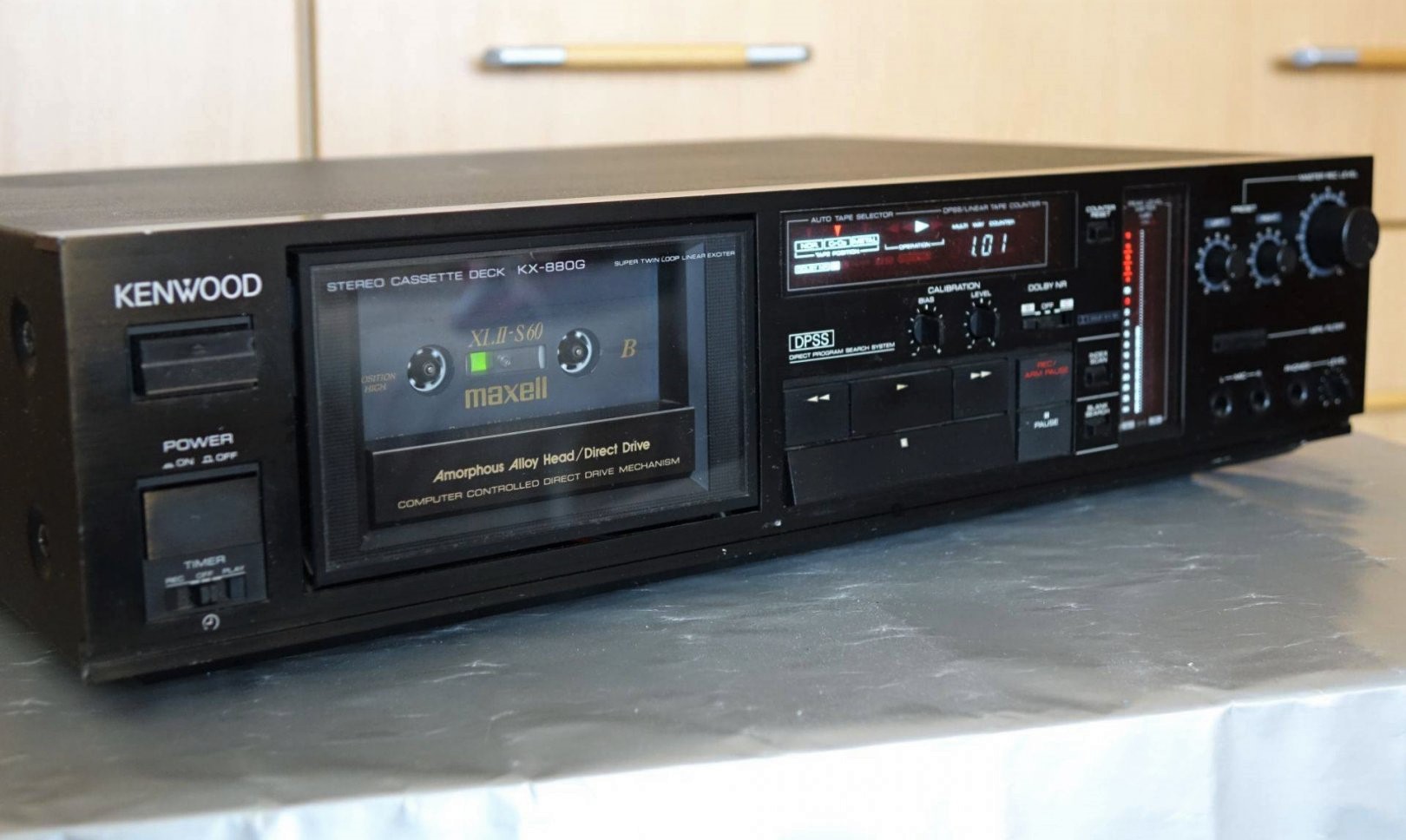
What does one do after making possibly the best sounding product of an era? Well, Kenwood like so many other companies, started introducing convenience features. You see, the Kenwood KX-880G and all it's others in the series managed to stay in production from 1982 to 1989, in any industry especially consumer products, 7 years product life span is a mighty long............ time. In 1990, a new decade, Kenwood introduced the new generation of KX series cassette decks, now modelled as 5010 & 9010.

Both KX-5010(a 2 head, single capstan transport) and it's top of the line model, the KX-9010(3 head, dual capstan transport), now comes with remote control, a large horizontal FL display, neatly integrating the tape counter, tape type & L/R peak level meters, in an attractive yet easy to read from a far design. Styling wise, this is the biggest improvement over the KX-880 & 1100 series design, while novelty was nice when it lasted, now seems so very dated, especially that vertical L/R peak level meter in which the fonts used were too small to be seen from a far. Most transport control buttons were carried over to save cost as by the 1990's CD players have began to dominate the music format as source & cassette starts to lose it's dominance. So new models with carry over parts bin was a logical and clever move, costing wise when launching a new product. Car manufacturers do it all the time!

The back panel also has system remote trigger jacks, if you're into an all singing & dancing Kenwood stack system

Extra features are always welcomed, and that includes the ability to make a one touch test recording of about 30 seconds after blank tape is inserted, then automatically rewinds and playback the result for your sound quality evaluation. one can repeat the process several times at a touch of the "Record" button, until satisfactory sound recording setting is achieved, before goin for the full tape recording. It's like having a 3 head tape deck feature with 2 heads only! Another feature which I absolutely love about the Kenwood KX-5010 is the Direct Drive transport, despite being a single capstan transport design, wow & flutter spec is only 0.25% low, which many dual capstan design transport probably also cannot match. I now find Direct Drive transport very good with pulling power, especially during playback of old and sometimes slightly sticky tapes. When other decks are struggling, the Kenwood continue to play with stable speed. By the way, the Direct Drive feature is not new, but carried over from the previous KX-880 series.

I think Kenwood KX-5010 had a strong foundation to build upon, being based loosely around it's very capable predecessor of KX-880HX. Will it sound as good, with added features?

The internals also looking very similar to the older KX-880G!

Opening the cassette door reveals the single capstan, 2 head transport

Let's find out! From the first tape playback, the performance similarity to it's predecessor, the KX-880G is obvious. Crystalline clear tonality, speed stability, punchy bass and highly extended treble all shines through. However, I have 2 doubts started developing after a few tape playback. First was bandwidth, with familiarity, I just felt that perhaps the band width of the KX-880 series was still better in the regards, because the highs were more liquid, had less white noise. Next, another area the predecessor also did better in terms of micro dynamics, especially in tracks where double bass, or bass guitar plucks & piano pings were prominent, the older model certainly offered much more clarity on the proceedings.  In other areas of the performance of the KX-5010, the sound was clearly cut from the same cloth as the KX-880 series, just with a few more rough edges only. Both shared a similar tonal quality, stable speed & dynamic overall sound. Maybe in some cases, if remote control, post modern styling & recording feature is your thing, then the Kenwood KX-5010 cassette deck is up your alley. 

This Kenwood KX-5010 unit is in great cosmetic condition and comes with per-programed after market remote, supplied by mu buddy, Oh. Please contact him if one is interested in purchase of this deck. His asking price is not high, for a fully reconditioned unit which looks & sounds good!

However, if one priorities cassette playback sound above all else, then the KX-880G in which I previously reviewed, is the much better defacto choice of the two. I have made my choice the moment I heard the KX-1100G, in which playback sound performance wise, opens up a whole new level of performance over both the KX-5010 or KX-880G. The 3 head machine just cost much more, that's all!

I am now really starting to believe a folklore amongst cassette deck communities, that the best golden age for really great sounding decks were made from 1978-1982!  This due to the fact that as I narrow down my to keep cassette decks to last 5 surviving, despite the many I have written about here, I just realized 2 out of 5 in my collection are from the 1982 year,  That's kinda significant. Don't you agree?

August 20, 2023

The Last Of A Kind, Teac V-7010 Cassette Deck

The Teac V-7010 finished in Champaign gold, and dark colored wood cheeks, tape counter window & transport buttons on the left, peak level meter display with recording level knobs and selector on the right! The whole fascia design is very elegant with this nice Champaign finish.


Teac was probably the last of the cassette deck manufacturers to issue Dolby S noise reduction system in their product line up, by 1993 in the V-8000 series. That makes the 1992 Teac V-7010 the last of the Dolby C equipped TOTL deck by then, which itself is a facelifted model of the V-7000 series launched in 1990. By the time of the Teac V-7010, ten years has passed since the Kenwood KX-1100G that I last reviewed. The newer Teac has broadly similar specs to the Kenwood, except for the motorized tape well door & remote control capabilities. By this time in 1992, the CD format already reigns supreme at home hifi front, but in the car audio world, CD players were still a novelty, as manufacturers were finding ways to isolate the CD transport from the car's suspension movements which adversely affected the playback smoothness of the CD transport. CD players in cars would only start become the mainstream just before year 2000. Hence the market for cassette deck at this stage, was shrinking fast.
  
The Teac V-7010 is a nice weighty machine at almost 10kg, thanks to it's real wood cheeks & multi compartment for rigidity chassis, which is distinctively divided in to 3 unequal areas, on the left is power supply & regulation board, the front middle section is where the 3 head, dual capstan, direct drive transport remains isolated in it's own compartment, and the rest of the area behind the transport compartment & right side of box is dedicated to audio recording & playback circuitry. While some people may comment that the Teac V=7010 looks very spartan inside, I think that was possibly in the design brief to make things as simple as possible for shorter audio signal path to good sound.   

Inside the copper shielded chassis, the Teac V-7010 was the last to get this premium treatment, as the Dolby S equipped V-8000 series released in 1993 no longer have this treatment. 


As I have just taken delivery of the Kenwood KX-1100G about 2 months ago, along came this Teac V-7010 in which I was offered first right of refusal by a buddy who no longer sees the need for it. It was a hard decision for me as I am still warming up to my new toy, and I had secretly harbored to someday get a Teac V-970X which is another TOTL cassette deck from another by gone era. So the Teac V-7010 didn't exactly fit in to my plans, but I went to see it any way, how could I not?

At first glance, I have fallen head over heels for the Teac V-7010, this example in mint condition, finished Champaign gold, dark wood cheeks & a look behind the back panel which still has the importer(Auvi Malaysia Sdn Bhd) warrantee sticker on it, really just blew my mind! I could remember I was just a young adult at the time, just starting my first job, marveling at what was possibly this very unit on display at Auvi's showroom in SS2(which later became the iconic Mungo Jerry BKT shop), which I could not afford it's grand asking price back then. The icing on cake was that my buddy said, "this unit just came back from service by Mr Oh!" and that statement, sealed my fate! I was a happy dandy walking out from my buddy's house, with the Teac V-7010 in my arms.

This remote is from the same vintage but made for the model Teac V-5000, which has a belt driven 4 DC motor transport supplied by Sankyo.  The V-7000 is a direct drive transport supplied by the same manufacturer.


I went straight home, unplugged the Kenwood from my system, swapped the Teac in with high anticipation, and from the first time I pressed the play button, heavenly sound was coming from the tape format. Coming from the Kenwood, The Teac immediately impressed with it's quiet transport, no clunky noise here or there. Next the high frequencies were well extended with good refinement, the mid range has a lower bloom, which makes vocals sound like it has more meat compared to the Kenwood, and the bass is as solid & as tuneful as the Kenwood. Speed stability is impressive as well , just like the Kenwood, is direct driven. I am beginning to see that direct drive transport designs do have their advantages over belt drive designs. Being direct drive doesn't mean there are no pesky transport rubber belts to deal with, but just lesser only.  However, in terms of sound stage, the Kenwood does throw a wider & deeper, plus more layered picture. For the Teac, this was was a slight downer, but it's OK, the V-7010 still sounds very good by the way.
An official photo release of the Teac V-7010 cassette deck. 


Due to the unit didn't come with the originally issued remote control as my buddy had lost it during his last home move, I felt the unit was some how incomplete. So I scour the www in search of hopping to find one for sale, and after 2 weeks, found at remote specimen for sale at Yahoo Auction Japan. While this was not the exact original, which has a few more buttons, it was close enough and the asking price was sensible, unlike those Sony ES series remotes. About a month later the remote arrived and works! I later found out the remote unit I bought was for the Teac V-5000/5010 was has the missing open/close function for the tape well.

In a way, getting this Teac V-7010 cassette deck made me forget about the Teac V-970X as an idea, as I am blissfully enjoying what I got now. Some times, I guess fate does not give you what you wanted, but even then when you've being given something else, you'd be thankful with the end result. For me, I am enjoying my cassette deck collection journey to the max now!

August 12, 2023

Glorious Past! Kenwood KX-1100G Cassette Deck

Kenwood KX-1100G is sold from 1982 till 1989 in various guises, last being KX-1100HX, which includes Dolby HX Pro for recording from radio, as per KX-880D and all the other guises

This was the cassette deck that virtually made the name for Kenwood back then in 1982, that's exactly 41 years ago, along with it's lower model, the KX-880G which I toyed with last year. It sounded so good that I was considering to buy the review sample, but I decided to hold out the purchase, in hope that one day, the top line KX-1100G would become available. Just my collection habit, that I will only keep 3 head decks.

Finally, more than a year later, Mr Oh, my trusted hifi repair guy and cassette aficionado, had restore 2 units of the KX-1100G and asked if I wanna toy with it? Hell yeah! A bit more about the Kenwood KX-1100G. It's a 3 head, direct drive, dual capstan, 3 motor Sankyo tape transport design, used in much like the high end Nakamichi's of the days gone by. Tape loading cover opens manually, via a push button on top of the power ON button on the left side of the fascia. The cassette well is biased towards the left, as per typical design of the time, followed by that distinctive dual fluorescent display, one horizontal to indicate tape type, Dolby and timer, pluas another vertical, to indicate peak level meters for L&R channels. Transport controls are located just below the horizontal display and towards the right side is the recording level setting knobs. The whole unit weights just 6.2kgs finished in satin black with faux audiophile feet, which looks nice. Build quality is not the best, due to it's medium weight design intentions, but everything works nicely, even if the tape transport is slightly clunky when being engaged & disengaged.  

Overall, the design is exactly the same as the KX-880G, except for that audiophile feet, and the "Amorphous Alloy Combination 3 Head" description printed on the cassette cover.

The back panel is generic cassette deck layout, with RCA input & output, and power cord on the other side of the case

Only this description and that big audiophile feet separates the KX-1100G from the KX-880G, the lesser sigbling!

From the very first tape I played with this Kenwood, I was totally smitten by the sound, which was tight, clean, fast & very powerful. It does really remind me that I am listening to CD like quality sound, but from a cassette source! Tape speed stability is first rate, which comparing to some of my higher end decks, which should be better, but not! Tape pulling power is exceptional, due to it's direct drive mechanism as some of my older tapes tended to be a bit sticky, and the Yamaha K-1X can occasionally give up half way, and stop playing, but not the Kenwood, which will continue to play to the end.

Due to that speed stability, bass notes are ultra clean and very punchy, not even the slightest hint of muddiness. The mid range is crystal clear, making the vocals & diction very easy to follow. If I could want more, I would like a bit more meat in that area, but then I am already nit picking. Highs are truly extended with the slightest of hiss, depending on the tape used. Overall, this deck has the musical chops of a digital medium. I must also point out that not many cassette decks have the capability to throw a sound stage quite like this Kenwood, which is wide and deep, and clear vocal projection in the middle. Not even some of the more expensive decks can do that!

AS I only used my decks for play back, I can't comment on the recording capabilities, but if you do Google a bit and ask folks on the cassette forums, They would rate this Kenwood somewhere between a Nakamichi CR-3 or CR-5. Considering the huge price difference between this Kenwood vs those Nakamichi, I can only shower praises on the Kenwood! Perhaps a poorman's Nakamichi it could be? Only you'll know once you've used it.  

Great with pre-recorded tapes too! Seen here playing the Footloose OST with excellent sound quality

While most 3 head cassette decks can give good sound with excellent chrome or metal tapes, not many deck will sound good playing pre-recorded tapes. And this area is where the Kenwood is KING! The difference in sound quality between those pre-recorded tapes vs those self recorded chrome or metal tapes has being narrowed considerably with the Kenwood. Most high end cassette decks will play chrome & metal tapes well, but ruthlessly expose the short comings in sound quality of the pre-recorded tape. With the Kenwood, 9 out of 10 ten pre-recorded tapes will sound very good still, maybe with or or two playing slightly blur. As I have quite a few of those pre-recorded tapes, being able to play them well certainly works in the Kenwood's favor.

I bought & paid for unit just 2 days after first listen, and I think that says a lot about the sound qualities of the Kenwood. I never really believed when someone told me the cassette deck golden years were between 1978 - 1982, with this Kenwood KX-1100G plus my Yamaha K-1X experience, I am starting to see maybe there's some truth to it after all?  

By the way, I think Mr Oh still have one or 2 more Kenwood KX-1100G under restoration, just in case you're keen, do contact him a.s.a.p.

June 26, 2022

A Worthy dbx Successor? Yamaha KX-1200 U Cassette Deck

The Yamaha KX-1200U sitting pretty in my usual rack. Love that titanium silver color scheme, if I have to choose a word for it, it would be CLASSY!

Since my experience with the Yamaha K-1X or KX-1020 depending if you're in the Japan or the rest of the world, I have a very different view in regards to Yamaha's credentials when it came to their hifi equipment. Oh, my buddy has a unit of the Yamaha KX-1200U cassette deck, the 1987 successor to the K-1X which is currently in my care. The KX-1200U  had a production run of 6 years, which lasted till 1993, demonstrating the sales success of the model in question. Oh said I should compare both the K-1X vs the KX-1200U to confirm his own observation.

Styling wise, the KX-1200U carries over the K-1X practically lock, stock & barrel, sans a small window at the bottom of eject button for remote sensor. Power up the unit and that bold red/blue fluorescent display typeface has given way to a more refined yet at the same time more generic typeface looking whitish fluorescent display. Like the K-1X, the KX-1200U comes in both titanium silver or satin black color scheme. I found the titanium silver color scheme on this unit very classy, and will almost certainly prefer it over the satin black. Weighting in at 7.9 kgs, the KX-1200U is exactly 1 kg heavier than it's predecessor. However, a simpleton audiophile likes to view on the subject of build quality by weight, that it seems heavier is better? 

Build quality is the same finely measured compromise between cost vs luxury build. On the front panel, that lovely all glass & aluminum sandwich cassette well door is nicely carried over but now with tint. The cassette well illumination is improved as well, now with a tape center back light and a top light, which is super useful when the need to perform tape head and capstan pinch roller cleaning. All other front panel layout remains exactly the same as it's predecessor, including the six major transport control keys & that flip down panel for recording control knobs and Dolby selection. This Yamaha still came with dbx NR system, but is now the simplified dbx type II prefix, which is deemed to be less extreme in effect compared to the earlier version. By the way, that chunky looking feet at the bottom is still decorative plastic, no ceramic or stainless steel here!

Either way you look, the Yamaha KX-1200U is very nice! 


There are some changes elsewhere too, such as the Sendurst tape head is now the harder wearing amorphous type for long service life. Did I mentioned a wireless remote is now offered with KX-1200U as optional or standard? By the way, the review unit didn't come with the original KX series remote, but nevertheless came with a compatible remote which worked for most transport function. Still on the mechanism, the KX-1200U also does track search, and program play sequence too! Stuff that I don't advocate to use as it may wear out tape head. Otherwise the 3 head, dual capstan transport is pretty much the same. Cassette eject is still non-motorized mechanical.

A close up of the 3 motor Sankyo supplied transport & amorphous tape head


So far so good, Yamaha seems to have added much more convenience feature in to the KX-1200U over the older K-1X, which is good. Moving over to sound quality however, there were also compromises compared to the former. The first thing one will notice, coming in straight from the K-1X is the reduced headroom & dynamic bandwidth. The highs less airy and mid range less sweet. The bass, less kick ass.

I would speculate that due to the need to cater to the older more extreme dbx NR system the K-1X super boosted all the attributes I mentioned above, especially the headroom and dynamic range. The KX-1200U sounds more comparable in character to my other reference, the Akai GX-95 MKII, i.e., is the cassette format sound character. I believe that the K-1X sounds the way it does is due to the dbx NR system it deploys. And with the KX-1200U, Yamaha has chosen to fall back in line with other cassette deck manufacturers. I know that from what is described above, it would seem that the KX-1200U sounds disappointing, but that is only if one is coming from the K-1X predecessor. If one is coming from something like the Akai GX-95 MKII, then the playing field begins to level. And the KX-1200U is a pretty good sounding deck. It got a super strong transport that plays certain tapes that other cassette decks have given up on. I love the refinement the new amorphous tape head brings along with a more neutral tone, compared to the K-1X. The KX-1200U is also more transparent sounding too, by the way. So it's not all bad, but compromises, clearly a few have been made.  

On the inside, noted that big potted power transformer, not many cassette decks feature that. Also note the dbx NR PCB standing up right from the main board on the left! 

Even the wireless remote is color coded to match either Satin black or Titanium silver color scheme 

There's even a deluxe version in Japan domestic market only, come with wood cheeks, whih to me at least, is a must have for all top of the line products!


The Yamaha KX-1200U is still a very good deck after all, otherwise it wouldn't have a 6 year production life span vs the 2 years that it's quirky predecessor enjoyed. The fact that I liked the quirky K-1X so much is because it's exactly the kind of kinkiness for my personal preference. The KX-1200U on the other hand, goes the more prudent & for the lack of better terms, generic direction. And I guess that's why the KX-1200U is the much more successful in the longer term. May be I sum it up this way, about the 2 sisters. Older sister is at once exciting to be with, totally punk style colorful and has wild character to match, you gotta see her quirks as an abject beauty. The younger sister is more traditional, girl next door type, which in the long run, probably make her easier to live with, once the initial excitement has worn off. 

In the used market, now going for about MYR 1,800 a piece, the choice is yours, and Yamaha being not all that popular back then, doesn't really offer much examples in the market.

June 5, 2022

"dbx" Wonder? Yamaha K-1X

The Yamaha K-1X is a Japan domestic model but also called KX-1020 in international export markets. I am not sure if the are any difference internally between them 

For some reason or another, I was never quite taken by Yamaha hifi components. Yes I do have a Yamaha AVR for my living area 5.1 HT system, and that's it. Even that is because I got it bundled with the Bose Acoustimas speaker system for a good price! So why is this in the cards? you asked. My buddy Mr Oh's influence!

This is good deck, you try, this one got dbx noise reduction system, otherwise you don't know what you're missing, he said! And so I did try with an open mind, plus I was curious about the dbx NR system. On spec, it seems to be great deal better than the generic Dolby B/C & HX Pro, which is now default features on most cassette decks. 

The Yamaha K-1X sitting in my audio rack, as usual just below the Aesthetix Janus Signature pre-amp 

The Yamaha K-1X is from 1985 vintage, it self is a further evolution from the K-2000 & K-1000 flagship decks from 1982. Key features of the K-1X includes 3 heads, dual captan transport, Sendurst tape head, Dolby B/C & HX Pro and lastly, dbx noise reduction system. Styling wise, the Yamaha looks chunky with it's rather deep width and tall box, and one peek inside shows why. While the box is compartmentalized inside, Yamaha doesn't go the whole 9 yards & copper coat it either. I see money being spent on the important things like a reliable and high spec transport with a bright green illumination, the Sendurst tape heads, detachable tape well cover made from real glass & aluminum, decent size PS transformer & thick, non detachable power cord. Yamaha chooses to go prudent with other things, like no remote, plastic face plate, no copper chassis coating as mentioned before. The tape well of the Yamaha is well designed for easy access to perform tape head and pinch roller cleaning.

The insides of the Yamaha K-1X. On the right there's 4 pcs of standing PCB for the dbx noise reduction system. With this system, there's a requirement for the audio circuitry to accommodate an extra headroom for signal to noise ratio. Weighting in at 6.9kgs the Yamaha K-1X is not the heaviest battleship around, but is solid enough nevertheless. If I have to rate it, may be at pocket battleship level? 

Another area that I love about the K-1X is the styling, this unit finished in stain brushed black has the usual tape well on the left, a recoding level slider on the right next to tape well, then flanked by an unusually long tape counter and peak level meter display. The display really sets this unit apart by use of bold typeface and very striking blue & red illumination. I think the extra long peak level meter is to accommodate the extra headroom of up to 60 db as required by the dbx noise reduction system. At the bottom of the display are six major transport control keys and a flip down flap on the right to hide all the recording adjustment knobs & noise reduction selectors for a clean facia appearance. On the whole, the styling reflects a image of bold power, yet classy altogether.  

That detachable tape well cover is made from real glass, sandwich at the bottom and insides with real aluminum frame. Very solid and chunky when removed for tape head and pinch roller cleaning 

The tape counter in red illumination has big chunky typeface, making easy viewing from near or far. The peak level meters is extra longer than usual, but does not have peak hold feature

All recording adjustment knobs & noise reduction selectors are hidden inside a flip down flap on the right side of the cassette deck

It all looks very neat on the facia when the flap is up, covering all the recoding functions, making the deck look less busy in comparison to others. The recoding level slider in use here is OK, but I much prefer a big master rotating knob for that purpose 

The sound of the Yamaha K-1X or KX-1020 in export markets is incredible, with or without dbx system in use! I used mostly pre-recorded & tapes recorded from my previous Teac V-670 and those tapes all sounded much better than I ever experienced them before. The sound is big scale, bold, and very dynamic to boot. The bass kicks ass with well defined kick drum, and clean note to note transfers, no woolly bass notes as normal cassettes. I think part of the credit goes to the strong dual capstan, 3 head transport. There's a certain kind of sweetness in mid range & highs. The highs in particular are airy & will bite if the music calls for. There's also a clarity and dynamic range that most other decks will find hard to match. In comparison, the Yamaha did lost out slightly on resolution, compared to my resident Akai GX-95 MKII deck.

I then made a CD recording using the dbx noise reduction, and on playback there was total silence in the back ground just like CD, with the dynamics and slight coldness all included. I would say this Yamaha makes the most true to source recordings one can ask for. I also tried play some of my previously recorded tapes with Dolby C on the dbx system, but the sound came out weird, very loud, and also seemingly boosted to the point of clipping. So Dolby B or C recorded tapes must be played without the dbx switched ON. But even then, the benefits of the extra headroom that this deck offers is highly evident, yes even without the dbx system. I just usually switch OFF all noise reduction during playback, yet this Yamaha is so engaging to listen to everytime, all the time!
 
In 1987, Yamaha introduced the KX-1200U, which looks almost identical to it's predecessor, but come with remote control, and other modern era tape deck functions such as track search 

 In the end, I told my poison buddy Mr Oh, that I don't want to return this deck to him! He was reluctant to sell to me because he wanted to keep it for his own "collection" of cassette decks! And yes, he has many top decks. In the end I managed to convinced him to let me continue to use the Yamaha K-1X, rather than see it sitting on his shelf as a collection.

Mr Oh also have another bullet in his amoury, he said I should try the newer version of the Yamaha K-1X, in the form of 1987's Yamaha KX-1200 U! Stay tuned for that to come next..........

May 13, 2022

Nakamichi Rival, Sony TC-K 555 ESX Cassette Deck

The Sony TC-K 555 ESX is a very smart looking unit with excellent ergonomics. On the right section are the function control buttons & tape counter display, and on the left are recording settings and peak signal display. The cassette well in in the middle, but in this case, it's not motorized. Later units from the ESL model onwards are motorized. 

Sony was in top form during the 80's and the Sony ES series hifi components represented their state of the art in audio philosophy, technology and execution maturity. The Sony TC-K 555 ES series had a long production run which started since 1982 - 1994 in various guises from the early ES, to the, ESG, ESX, ESR & the ESA plus ESJ are being the last 2 versions released in the early 1990's. The Sony TC-K 555ESX as seen here is made for 1987-1988 year, before being replaced by the ESR version in 1989. The last version, ESJ was released in 1992 and continued to be made well in to 1994.

The Sony TC-K 555 series is the state of the art of the Sony ES series cassette deck of the era, being on top of  TC-K 333 series in various guises over the span of 8 years in production. Both models share common design themes such as centrally mounted 3 head, dual capstan, 2 motor transport, made in house by Sony. A two display system is also used in the styling of the deck, the left window being a dedicated tape counter and a right window being peak level meters. The TC-K 555 builds on from there with remote control capability and a higher dynamic range(120db) audio circuitry design. Like the European range topper TC-K 700 from the same year, the tape door is dampened when ejected. Later models from ESL onwards in 1990 have motorized tape door. I must say the styling of the Sony ES series at that point has a serious business like look to it.    

The back panel is as per usual with line in and line out RCA jacks 

This is the original remote supplied by Sony at the time, as optional. So not many owners bought them with remotes back then. Hence the original remotes are super expensive these days. However if you get a unit from Oh, he has a compatible programmed remote supplied. Not very nice looking, but functional nevertheless!  

My own experience with Sony cassette players have been mixed over the years, as I loved my Sony Walkmans, car cassette stereos but with their hifi decks, not so great experience until now. My previous entry level Sony cassette deck, can't remember the model no. came with very high wow & flutter straight out of the box new! I rmembered sending it to the Sony service center & other repair shops many times It could never be fixed.

My buddy Oh told me that I had not experienced the best of Sony cassette decks, I should try an ES series unit. He offered me a TC-K 333 ES unit to play with, but I wanted something a little better, with remote! And so 2 weeks later I picked up this restored TC-K 555 ESX from Oh.

I plugged this unit in to my system, replacing the Kenwood KX-880G unit and from first music played, I heard a similar clarity in sound, slightly wider band width, more refined highs, with a neutral tonal quality, all hallmarks of a great hifi cassette deck. The Sony also had other less positive traits, the scale of music imaging was smaller, less big boned, or probably gave a presentation of mid hall perspective, compared to the rather forward sounding Kenwood, which gives a first row seat impression. The Kenwood also struck me as being more musical of the two, despite having slightly higher wow & flutter audible.

Both the Sony & Kenwood players are highly dynamic tape decks and both have tight bass lines which I like a lot. The Sony TC-K 555 ESX spent about 2 weeks in my audio cave and I never had a dull moment with it. Not sure why, but the Sony tape heads tend to require cleaning more often then my other tape decks. 
All Sony TC-K 333/555 ES models shared the same well spec Sony TCM 110 mechanism, which is a 3 head, dual capstan, 2 motor design unit. 

The Sony TC-K 555 ESX playing in my system, if only for 2 weeks!

Overall, the Sony TC-K 555ESX provides a very positive experience for cassette deck ownership, and has managed to redeemed it's past failings. If anything, it reinforces Oh's comment that if playing with Sony cassette decks, it must be ES series, not anything less. And so far, my experiences with Sony ES series components have not disappointed yet, be it CD player(my CDP-X7 ESD) or cassette deck, and now that makes me itching to try out their ES series amplifiers!

Currently in Malaysia, there are only 2 brands of cassette decks in which people would pay top dollar, (or should I say Ringgit?) without second thoughts. Hence in the context of today's used market place, the Sony ES decks do rival the Nakamichi units on offer. First the Nakamichi cassette decks in which the brand had built such a strong image & sound quality that it's almost bullet proof in resale value for a good working condition unit. 

Next up are the Sony ES series units. I know many who personally import these decks from Japan, despite being rated 100V for Japan domestic market voltage, instead of 240V for local Malaysia spec. This is due to the Sony ES deck's scarcity in the local market. In Malaysia, they were priced out of affordability back then in the 1980's. And if anyone had the money, they would've certainly gone for the well renowned Nakamichi then.  

My buddy Oh also brings them in from Japan, converts them to 240 V and restores them to original spec. At point of writing, he has already sold a couple of units, and he still has limited units left. So please contact him pronto at 012-206 0888 if you're keen to get your hands on a Sony ES cassette deck.

After being with me for 2 weeks, Oh tempted me with another top spec cassette deck, this time a Yamaha K-1X. Stay tuned for that one!  

April 9, 2022

Retro Giant Slayer, Kenwood KX-880G Cassette Deck

The Kenwood KX-880 G's unique & unmistakable 2 display styling feature! Looks a little weird at first, but with a little use, I certainly have learned to appreciate the separated peak recording meter from the other display parameters

While rather heavy for a 2 head spec deck, other than a high spec Sankyo direct drive transport, and a bigger than usual power supply tranny on the left, nothing on the inside would give a clue to it's build quality & sound performance! On the middle is the power supply regulator & control board, while partitioned on the right is the audio PCB board. The Dolby B & C noise reduction board is seen standing as an attachment board. That's smart design actually as the same audio board can accommodate a Dolby noise reduction board that incorporates HX Pro in the last of the KX-880 series 

Kenwood Corporation had a healthy reputation in the hifi industry in the 70's & 80's. Like many Japanese audio giants of the era, the late 90's was the start of the dark era. However 1985 was still fine vintage as far as Kenwood is concerned. The KX-880 series cassette deck started life in 1982, and had a seven year production run in various guises until 1989. It started as the KX-880, then as the KX-880 SR, followed by the KX-880 SRII, and the mid point evolution of KX-880 G as featured here, superseded by the KX-880 D  and lastly the KX-880 HX. Being a design from 1982, the Kenwood makes no concessions for an optional remote control feature, much like the Denon DRS-810 has.

The Kenwood KX-880 series was positioned as the top spec 2 head cassette deck, with the same unique 2 display styling as the top range KX-1100 3 head deck. Of the 2 display windows, 1 horizontal displays the tape counter, tape type & status. The other vertical display is for the wide range peak recording meter. As per it's high spec 2 head deck status, the transport is direct drive type from Sankyo, which is later adopted by Nakamichi for the CR-1 & DR-1 series. The back panel is standard cassette deck, with input & output RCA and a fixed power cord. The Kenwood being nicely, but not luxuriously built weights a decently hefty 5.9kg. However, once on the inside, nothing would indicate of it's heft or sound quality potential. 

I plug the Kenwood KX-880 G in to my system, in place of the Denon DRS-810 3 head deck, and upon pressing play, the sound just blew me away! Gone were that slightly muffled mid range sound typical of cassettes, the Kenwood sounded fresh, crystal clear like a wide open window, detailed(as much as the cassette format will allow), large scaling & wide dynamic range.  The Kenwood sounds like nothing of any 2 head spec deck(and probably some 3 headers too) can ever be! I never heard any wow & flutter during it's time here, perhaps due to it's direct drive tape mechanism, but the funny thing is that very same transport used in my previous Nakamichi DR-1 had some degree of wow & flutter, even if it's just every now & then. I also thought the Kenwood in comparo, sounded much better than the much more up market Nakamichi.

This is a highly recommended buy or keeper if one just wants to listen to the best possible sound quality cassette tapes has to offer. I am sure the recording quality is equally fine, sans the off tape monitoring feature, meaning you don't know what you'll get until the end. However, should one be very familiar with tape bias settings and type types, then the results can be predictable too, caveat being this for experienced users only. For the Kenwood KX-880 series asking price of sub MYR1k, it's really a retro giant slayer!

March 20, 2022

Retro Remote Joy For Denon DRS-810

Denon Remote Control Unit RC-102, which is suitable for all Denon cassette decks with remote sensor function

I love to complete my collection, period! Somehow that cheap compatible China remote works, I still crave for the original Denon item to complete the pairing. As written in last month's Denon DRS-810 cassette deck which I plan to keep, even if the sound quality is not so on par as expect of a 3 head tape deck.

I came across this remote in ebay and subsequently bought it and waited almost a month for shipping to arrive. The remote was pristine and functional as it should be, but most importantly, it completes the pairing with the cassette deck, when on sale during new, the remote was cost option. 

Remote with cassette deck in back ground!


February 2, 2022

Retro Cassette Joy, Denon DRS-810

The Denon DRS-810 cassette deck is unique as it uses a CD tray like drawer to load, rather than a standard cassette well

In the late 80's till sometime in the mid 90's cassette decks with a CD tray design for cassette loading was all the rage. I even had one from Sony installed in my car! So when I saw pictures of this Denon DRS-810 on the www, I was all smitten! Better yet, this Denon DRS-810 is a top spec deck too!

It comes with 3 heads, closed loop dual capstan 3 motor transport & non-slip reel drive. As with most  CD drawer design decks, the casing is premium slim line, but I didn't quite like the smallish fluorescent display for time elapse, status & db meter, especially that cyan/red tone graphics color. What I really like though is the CD drawer like tray in which you have to press the Open/Close button on the right side of the tray to load a cassette! My, my......... after 30 years or so in service, the cassette tray still glides in & out smoothly & reliably. My unit came finished in typical Japanese satin black face plate, but the DRS-810 does have a version in Champaign gold color scheme that also comes with wood side cheeks as option. Now that would really desirable, and that's called the Denon DRS-810 G as pictured below.

The back panel

The back panel of the Denon DRS-810 is pretty standard cassette deck, with one pair of RCA in & out for recording & playback on the left, followed by power cord on the right. Build quality is decent & sturdy enough, but not battleship quality like as my Akai GX-95 MKII. The Denon weights in at 6.6kgs, not too shabby for a cassette deck, after all this unit lasted at least 30 years or so, and still very much alive & kicking. Like most hi-end cassette decks of the time, it comes with a remote too, but that was missing with my unit, but our resourceful Mr Oh did managed to get the remote codes and cloned an after market remote for my use.


With the drawer opened for cassette loading

I was happy man when I brought this unit home, hook it up to my system and just let there be sound! The sound took a while to bloom, as I think the previous owner seldom used it as he had too many decks to play with. However once the sound start to come together, I got a very stable, super low wow & flutter quality playback, the Denon has a chocolaty dark tonality, however that darkness doesn't mean rich or sugary sweetness either, and if compared to most entry level hi-end deck like my Teac V-670, would not disappoint but the Teac does sound way more open, less closed in. The Denon claws back points for having a more stable transport though. However, as I was coming in from the Akai GX-95 MKII, and it immediately shown the Denon to have limited dynamic range. The Denon can kick & rock hard, mind you, but the whole presentation just felt somewhat compressed by comparison. Otherwise, the Denon DRS-810 sounds pretty decent and enjoyable even. 

Like all tape decks, the sound quality depended a lot on the cassette type & recording quality. With the Denon, the playback quality of normal type I tapes was decent, and naturally chrome type II tapes sounds way better, but the sound quality gap between chrome type II vs metal type IV tapes is somewhat limited. However, insert a well recorded chrome type II tape made from my Teac V-670 and the Denon does sound very nice indeed, with smooth highs, a prominent mid range and kick ass bass to boot.


The Denon DRS-810 G version shown here, minus the wood cheeks, seen here with the bottom flap opened to reveal the Dolby NR selection buttons and bias fine tuning knobs with headphone jack & volume control

The insides of the Denon DRS-810, like the CD transport, once the cassette is loaded inside, there is a ceramic clamp that locks & stabilizes the cassette during playback. The most un-appealing aspect of this design is when one needs to clean the tape heads & pinch rollers, one has to remove the top cover to do so, unless one is using a cassette tape head cleaner. The PCB used is typical 80's - 90's thru hole type which for me is much preferred, especially if repairs are needed

My verdict of this deck, is the top quality transport, somewhat let down by the audio output circuit which could be better implemented coming from a company of Denon's stature, which is a bit disappointing. I wonder if there's anything I could do to make it sound better on the audio board side?Only a long hard look will tell if some thing is possible at this point. However, this is what it is, an entry level hi-end deck with 3 heads for superior recording function and decent playback quality. And this Denon does it all with some unique style and flair typical of it's era. Worthy keeper for nostalgic reasons.  

October 3, 2021

Remote Bliss, Akai RC-G95 Remote Control For Akai GX-95 MKII Cassette Deck


Oh what joy it is to have finally found my Akai RC-G95 remote control, a perfect match for the Akai GX-95 MKII cassette deck. 2 weeks after getting my cassette deck, I set out to look for the original Akai remote to pair with the cassette deck.

I was looking at Yahoo Japan Auctions as that was the most likely place I could find it, but no luck. Salvation came from Ebay Germany. With one gentleman selling this remote, however he was reluctant to ship overseas, especially Malaysia. Willing buyer, willing seller but un-willing shipping?

For some reason, many Ebay sellers don't like dealing with Malaysian buyers. After 3 weeks of persuading him ship to me, he relented but wanted a premium for shipping. I agreed and after almost 2 weeks, the item arrived my door step via DHL.

What are the odds? both manufactured in Japan, then sent to different parts of the world, a cassette deck from China & a remote from Germany, finally coming together in my custody as a pair in Malaysia, to be paired for my joy!   

September 16, 2021

Reference Master, Akai GX-95 MKII Cassette Deck


Akai GX-95 MKII cassette deck, it's big, bold, yet luxurious


My hifi appetite can be insatiable! There is always an aspiration for top tier stuff if I am ever serious about something. And if you've been reading this blog, you'll notice my craze for cassette decks lately!

In my exploration, I came across this Akai GX-95 MKII model, which was made between 1991-1993 and available only in Japan, Europe and US markets. As part of the Akai Reference Master series components, the line up also includes a matching CD player, tuner & integrated amp. The original GX-95, a 3 head, 3 motor, dual capstan closed loop designed with real time recording monitor function as most top dog models do, was developed by Akai to be a Nakamichi killer in 1988, so to speak, and Akai made it the best they could muster, in every way possible. Then in 1991, Akai gave it a MKII facelift, with a slight improvement to specifications.

Let's look at the build quality, it's as luxurious as cassette decks comes, with that brutish, big and bold body in all satin black aluminum facia and side wood cheeks. It feature 4 bunkers inside the 2U all metal box, yep just built like the Yamato class battleship. Each bunker or compartment houses different sections of circuitry for best possible isolation. The top left bunker contains the power supply transformer & power supply board behind the cassette mechanism. The top right bunker contains all the operations and logic circuitry. The bottom left bunker contains power regulator board for audio only circuitry which is located in the bottom right bunker. With such construction method, the 2U box becomes super stiff, whilst achieving isolation for each circuitry. 

On the outside, the styling is plain classy restraint and functional to boot. The cassette well door is motorized and can be operated by wireless remote, as per most playback functions. Most body screws and the bottom panel are copper coated for EMI/RFI screening purposes. Those metallic Champaign footers are the real deal, where they feature glazed ceramic underneath. The back panel has an extra pair of RCA CD direct input for recording, other than the usual input & output. All this build leads to a rather heavy 10.2kgs cassette deck, 12.2kgs shipping weight, if came together with original packaging foam & box like mine!  

The back panel, note the copper coated screws and that funny grey power cord! My unit is a 220V unit from Europe, but somehow ended up in China, and now Malaysia....... 

The front facia is typical cassette deck design, but good ergonomics 

The bottom panel is copper coated on the out side, and look at those big, heavy real glazed ceramic feet! 

The top panel with wooden side cheeks visible, typical of Japanese high end audio in the 1990's. Somehow, Akai as a audio company faded away shortly after making their best stuff, along with a few other big Japanese brands!

Compatible remote sourced from Mr Oh. Doesn't look very good, but functional nevertheless!


I was looking around to source for a unit of Akai GX-95 MKII for sometime, then a buddy of mine whom I asked to look out in China found this unit in Foshan, Guangzhou for sale. A very quick deal and airfreight saw this unit arrived at my door step 3 weeks later. Alas! this unit came without remote as it was lost by the previous owner in China. So I managed to source a compatible remote from my hifi repair buddy Mr Oh! My search continues for an original matching remote to complete my quest.

The bottom end with it's 2 bunkers, on the left in this picture which is up side down, is the audio circuitry, and on the right is the power supply regulator for the audio PCB. Surprisingly, it's not copper coated on the inside of the chassis!

Seen here from top view and right side up, is the 3 motor, direct drive cassette mechanism is front, with power supply transformer & regulator board. On the right side is logic control PCB

Cassette dampening pad to keep stable pressure on the cassette in play back & recording mode 

The cassette mechanism, which is 3 head. The GX(glass permalloy) heads are proprietary to Akai


The Akai GX-95 MKII was swiftly plugged in to my system to check for function and sound quality. I am lucky to have got a fully functional deck. As for sound quality, it was a total opposite in character compared to my Nakamichi DR-3. The Akai brought out every last musical nuance & detail with every  type of tape used, and obviously for a deck of this status, sounded best with type IV metal tapes. With metal tapes, the Akai sounds full bass bloom and attack, with nicely focused mid range, and extended, yet airy treble & spatial cues. The Akai is able to project a  convincing 3D imaging trick, just like the best CD players can.

With lesser tapes types, such as type II chrome and type i normal ferric, the sound quality gets thinner & thinner, each with lesser bass bloom & energy, depending on recording quality, some type I normal tapes even sounded harsh. I think the Akai deck is just separating the rough stuff from the diamonds, due to it's SOTA of the time status as any respectable hifi piece should do. Also with this Akai deck, it made me realized that I don't have a pair of good enough high end RCA to match! While the beer budget Gotham RCA interconnects that I used all this while sounds decent with the Nakamichi DR-3 & Teac V-670 decks, the Akai just screams for a better pair of interconnects. Not wanting to spend too much hard earned money on what is a low-fi medium, I then procced to try a pair of Van Damme RCA interconnects. The mid centric Van Damme suited Akai much better, but was left wanting in the resolution department, for which I knew the JVC could just do better.

Salvation came in the form of an old friend, a pair of well used Audioquest Sky RCA interconnects. With it's 36V DBS die electric alignment system, the AQ Sky really brought noise floor down by a couple of notches, and with that, more tape resolution capability, and a smooth, wide open space heavenly high frequency reproduction! This is the 4th pair of AQ Sky to be residing in my system! I know, this is a 20 year old cable technology and surely there are better cables out there by now, but at what cost? What ever your opinion, I still hold the AQ Sky in the highest regard amongst all other cable-dom "king" contenders. The AQ Sky, just simply matches the Akai GX-95 MKII like a dog's best friend, that they are meant to be together!

Looking at the 3 cassette decks in my possession at point of writing, I find the Nakamichi to be the warmest of the lot, the Akai at the opposing end of the sound spectrum, and the Teac is just there, hanging on somewhere in between the 2 extremes. The Nakamichi's warm sound character is easy on the ear, sympathetic to system matching, that's why it's universally loved, but at times with poorer recordings, can venture in to the MCC(Mong Cha Cha) territory. The Teac is well balance and very in the neutral sounding character, which can also endear it self in a quite a few systems. The Akai on the other hand, is somewhat analytical, full of details, if slightly lean sounding, and will expose the weakness or lack or synergy in the hifi chain ruthlessly, if not addressed. That could be the reason, that the Akai is just not quite there as a Nakamichi killer, if feed back in the various www.forums indicate. But for me, it's the best deck so far and a keeper for sure. Sort of a last stop to cassette audio nirvana I guess.

Now back to ebay, Yahoo auctions and China buddies to source for that illusive matching remote...........
And do enjoy the video below of the Akai GX-95 MKII play back!