Showing posts with label Classic Hifi. Show all posts

September 21, 2023

A Post Modernist? Kenwood KX-5010 Cassette Deck

The Kenwood KX-5010 with it's accompanying original remote at press photo

What does one do after making possibly the best sounding product of an era? Well, Kenwood like so many other companies, started introducing convenience features. You see, the Kenwood KX-880G and all it's others in the series managed to stay in production from 1982 to 1989, in any industry especially consumer products, 7 years product life span is a mighty long............ time. In 1990, a new decade, Kenwood introduced the new generation of KX series cassette decks, now modelled as 5010 & 9010.

Both KX-5010(a 2 head, single capstan transport) and it's top of the line model, the KX-9010(3 head, dual capstan transport), now comes with remote control, a large horizontal FL display, neatly integrating the tape counter, tape type & L/R peak level meters, in an attractive yet easy to read from a far design. Styling wise, this is the biggest improvement over the KX-880 & 1100 series design, while novelty was nice when it lasted, now seems so very dated, especially that vertical L/R peak level meter in which the fonts used were too small to be seen from a far. Most transport control buttons were carried over to save cost as by the 1990's CD players have began to dominate the music format as source & cassette starts to lose it's dominance. So new models with carry over parts bin was a logical and clever move, costing wise when launching a new product. Car manufacturers do it all the time!

The back panel also has system remote trigger jacks, if you're into an all singing & dancing Kenwood stack system

Extra features are always welcomed, and that includes the ability to make a one touch test recording of about 30 seconds after blank tape is inserted, then automatically rewinds and playback the result for your sound quality evaluation. one can repeat the process several times at a touch of the "Record" button, until satisfactory sound recording setting is achieved, before goin for the full tape recording. It's like having a 3 head tape deck feature with 2 heads only! Another feature which I absolutely love about the Kenwood KX-5010 is the Direct Drive transport, despite being a single capstan transport design, wow & flutter spec is only 0.25% low, which many dual capstan design transport probably also cannot match. I now find Direct Drive transport very good with pulling power, especially during playback of old and sometimes slightly sticky tapes. When other decks are struggling, the Kenwood continue to play with stable speed. By the way, the Direct Drive feature is not new, but carried over from the previous KX-880 series.

I think Kenwood KX-5010 had a strong foundation to build upon, being based loosely around it's very capable predecessor of KX-880HX. Will it sound as good, with added features?

The internals also looking very similar to the older KX-880G!

Opening the cassette door reveals the single capstan, 2 head transport

Let's find out! From the first tape playback, the performance similarity to it's predecessor, the KX-880G is obvious. Crystalline clear tonality, speed stability, punchy bass and highly extended treble all shines through. However, I have 2 doubts started developing after a few tape playback. First was bandwidth, with familiarity, I just felt that perhaps the band width of the KX-880 series was still better in the regards, because the highs were more liquid, had less white noise. Next, another area the predecessor also did better in terms of micro dynamics, especially in tracks where double bass, or bass guitar plucks & piano pings were prominent, the older model certainly offered much more clarity on the proceedings.  In other areas of the performance of the KX-5010, the sound was clearly cut from the same cloth as the KX-880 series, just with a few more rough edges only. Both shared a similar tonal quality, stable speed & dynamic overall sound. Maybe in some cases, if remote control, post modern styling & recording feature is your thing, then the Kenwood KX-5010 cassette deck is up your alley. 

This Kenwood KX-5010 unit is in great cosmetic condition and comes with per-programed after market remote, supplied by mu buddy, Oh. Please contact him if one is interested in purchase of this deck. His asking price is not high, for a fully reconditioned unit which looks & sounds good!

However, if one priorities cassette playback sound above all else, then the KX-880G in which I previously reviewed, is the much better defacto choice of the two. I have made my choice the moment I heard the KX-1100G, in which playback sound performance wise, opens up a whole new level of performance over both the KX-5010 or KX-880G. The 3 head machine just cost much more, that's all!

I am now really starting to believe a folklore amongst cassette deck communities, that the best golden age for really great sounding decks were made from 1978-1982!  This due to the fact that as I narrow down my to keep cassette decks to last 5 surviving, despite the many I have written about here, I just realized 2 out of 5 in my collection are from the 1982 year,  That's kinda significant. Don't you agree?

August 23, 2023

Old Gold! Denon DCD-3500RG CD Player

The official release photo of Denon DCD-3500RG CD player back in 1989, that's 34 years ago!


As you keen followers have noticed, I have gone in to reverse gear when it comes to hifi since the last couple of years. I usually do not go too far back, but have stuck to the time line of 80's & 90's classics, that's like 30 or 40 years ago, which I felt hifi was at it's last golden age. This Denon DCD-3500RG CD player is probably one of the flagships made by the company over the years. I've had various Denon products over the years, and they are always technically correct in sound, but just never really hit my heart strings. However, this Denon CD player promises to be something different, and I've been waiting for my chance to find out since like 25 years ago. I was always eyeing for a good condition pre-owned unit for sale, but either I was always too late or just got distracted when one became available.

This unit belongs to a friend and as he was getting bored with it, fancied my proposal for a swap with my Teac VRDS-20 CD player, he wanted a small top up but that's fine, since I was bored with the Teac too. For me after a while the Teac with it's VRDS transport should have shined, but never got me emotionally wowed with music. Maybe it wasn't meant to be for me..........   

The CD loading tray come with built in suspension! A feature that is deemed redundant by now.

The Denon DCD-3500RG was launched in 1989, just towards the start of 2nd generation of CD players and it still have many features from the first generation machines deemed un-necessary today, like the suspended CD loading tray, the top Sony KSS-151A CD transport with magnetic rails, track programing calendar and best of all not only wooden cheeks, but the whole top & side panels are real wood finished in dark tone Urushi lacquer, which is very classy. Now a days, if you want your hifi equipment to come with that Urushi lacquer, be prepared to spend at least 6 figures or more! However, for the unit that came to me, that Urushi wood panels were termite infested and I had to sadly remove, throw away, and make new Nyatoh hard wood panels for it! The results, while not glossy like the original Urushi lacquer, came with it's own unique hard wood surface texture charm which is still nice. I can't get anyone to do Urushi lacquer restoration for me locally. Lastly this Denon uses a theoretical 18 bit decoding, courtesy of 4 units Burr Brown PCM58P-K, 2 per channel for balanced circuitry linearity. 

The Denon is another satin gold(not Champaign gold, as the tone is less rich, and a bit pale in comparison), battleship build quality CD player that weights in at 22kgs, came with all round copper coated 2 compartment chassis, which on the left was 2 power supply transformers(1 for audio & 1 for digital, so it says) at the back and the Sony KSS-151A transport in front, with the right compartment holding the dual mono audio PCBs. Very nicely organized. The front fascia is relatively clean with just a few buttons flanking the big CD tray & FL display, all other lesser used buttons are buried inside a flap below.  The back panel has the usual digital output, RCA & XLR audio outs.


The insides of the Denon DCD-3500RG CD player. Nice, right?

 
To reduce fascia design clutter, only the most frequently used buttons are left on the outside, all other buttons are hidden behind a drop down flap below. 

The back panel outputs.


My Denon DCD-3500RG after the wood panel changed, looks quite different doesn't it? Some may say the different wood panels will color the sound differently, but I didn't really heard that.


So far so good, however for a Denon, this CD player is really sounding something else! From the first CD play, I was transfixed by the sound. The bass was strong, bold and tuneful. The mids are slightly recessed, a little laid back but still very engaging. The highs are super refined, very airy but will bite if the music calls for it. The sound stage is big, but very laid back. Overall this CD player certainly has the PRAT factor, which make music very enjoyable. So far all is good, but comparing to my stable of CD players, this Denon does not sound as dark in tonality vs the Sony CDP-X7 ESD, it self a 1988 product. Then comparing to the Accuphase DP-70V which is a more aspirational product and priced(at least double?) to match in 1992, the Accupahse offers slightly more clarity, less digital haze(compared to both Sony & Denon), gives better mid range texture and just maybe slightly better micro dynamics and transient. If there's any comparison I would say both the half priced Sony & Denon offered possibility 85-90% of what the Accuphase can do. However, with most pop & rock recordings it's not easy to tell them apart. Only certain high quality recordings that truly allows the Accuphase to shine, put it on the pedestal, so to speak!

An area I do not like about the Denon is that it doesn't play CD-Rs & scratched disc too well. Only well kept original CDs will do here. But for me, this is no limitation, as I have the other 2 CD players in my stables that will play any disc any condition, especially the Accuphase. I strongly suspect the Sony KSS-151A transport laser in the Denon to be in it's last legs(since 1989!) and it will be a costly affair to source for replacement once dead. However, I feel this Denon is worth saving and to keep it going if the worst should happen. 

Even then, the Denon DCD-3500RG has been in my stables for over a year, and I must say that I've totally enjoyed it's musical company so far, and will be in my stables for a long time to come.

August 20, 2023

The Last Of A Kind, Teac V-7010 Cassette Deck

The Teac V-7010 finished in Champaign gold, and dark colored wood cheeks, tape counter window & transport buttons on the left, peak level meter display with recording level knobs and selector on the right! The whole fascia design is very elegant with this nice Champaign finish.


Teac was probably the last of the cassette deck manufacturers to issue Dolby S noise reduction system in their product line up, by 1993 in the V-8000 series. That makes the 1992 Teac V-7010 the last of the Dolby C equipped TOTL deck by then, which itself is a facelifted model of the V-7000 series launched in 1990. By the time of the Teac V-7010, ten years has passed since the Kenwood KX-1100G that I last reviewed. The newer Teac has broadly similar specs to the Kenwood, except for the motorized tape well door & remote control capabilities. By this time in 1992, the CD format already reigns supreme at home hifi front, but in the car audio world, CD players were still a novelty, as manufacturers were finding ways to isolate the CD transport from the car's suspension movements which adversely affected the playback smoothness of the CD transport. CD players in cars would only start become the mainstream just before year 2000. Hence the market for cassette deck at this stage, was shrinking fast.
  
The Teac V-7010 is a nice weighty machine at almost 10kg, thanks to it's real wood cheeks & multi compartment for rigidity chassis, which is distinctively divided in to 3 unequal areas, on the left is power supply & regulation board, the front middle section is where the 3 head, dual capstan, direct drive transport remains isolated in it's own compartment, and the rest of the area behind the transport compartment & right side of box is dedicated to audio recording & playback circuitry. While some people may comment that the Teac V=7010 looks very spartan inside, I think that was possibly in the design brief to make things as simple as possible for shorter audio signal path to good sound.   

Inside the copper shielded chassis, the Teac V-7010 was the last to get this premium treatment, as the Dolby S equipped V-8000 series released in 1993 no longer have this treatment. 


As I have just taken delivery of the Kenwood KX-1100G about 2 months ago, along came this Teac V-7010 in which I was offered first right of refusal by a buddy who no longer sees the need for it. It was a hard decision for me as I am still warming up to my new toy, and I had secretly harbored to someday get a Teac V-970X which is another TOTL cassette deck from another by gone era. So the Teac V-7010 didn't exactly fit in to my plans, but I went to see it any way, how could I not?

At first glance, I have fallen head over heels for the Teac V-7010, this example in mint condition, finished Champaign gold, dark wood cheeks & a look behind the back panel which still has the importer(Auvi Malaysia Sdn Bhd) warrantee sticker on it, really just blew my mind! I could remember I was just a young adult at the time, just starting my first job, marveling at what was possibly this very unit on display at Auvi's showroom in SS2(which later became the iconic Mungo Jerry BKT shop), which I could not afford it's grand asking price back then. The icing on cake was that my buddy said, "this unit just came back from service by Mr Oh!" and that statement, sealed my fate! I was a happy dandy walking out from my buddy's house, with the Teac V-7010 in my arms.

This remote is from the same vintage but made for the model Teac V-5000, which has a belt driven 4 DC motor transport supplied by Sankyo.  The V-7000 is a direct drive transport supplied by the same manufacturer.


I went straight home, unplugged the Kenwood from my system, swapped the Teac in with high anticipation, and from the first time I pressed the play button, heavenly sound was coming from the tape format. Coming from the Kenwood, The Teac immediately impressed with it's quiet transport, no clunky noise here or there. Next the high frequencies were well extended with good refinement, the mid range has a lower bloom, which makes vocals sound like it has more meat compared to the Kenwood, and the bass is as solid & as tuneful as the Kenwood. Speed stability is impressive as well , just like the Kenwood, is direct driven. I am beginning to see that direct drive transport designs do have their advantages over belt drive designs. Being direct drive doesn't mean there are no pesky transport rubber belts to deal with, but just lesser only.  However, in terms of sound stage, the Kenwood does throw a wider & deeper, plus more layered picture. For the Teac, this was was a slight downer, but it's OK, the V-7010 still sounds very good by the way.
An official photo release of the Teac V-7010 cassette deck. 


Due to the unit didn't come with the originally issued remote control as my buddy had lost it during his last home move, I felt the unit was some how incomplete. So I scour the www in search of hopping to find one for sale, and after 2 weeks, found at remote specimen for sale at Yahoo Auction Japan. While this was not the exact original, which has a few more buttons, it was close enough and the asking price was sensible, unlike those Sony ES series remotes. About a month later the remote arrived and works! I later found out the remote unit I bought was for the Teac V-5000/5010 was has the missing open/close function for the tape well.

In a way, getting this Teac V-7010 cassette deck made me forget about the Teac V-970X as an idea, as I am blissfully enjoying what I got now. Some times, I guess fate does not give you what you wanted, but even then when you've being given something else, you'd be thankful with the end result. For me, I am enjoying my cassette deck collection journey to the max now!

August 12, 2023

Glorious Past! Kenwood KX-1100G Cassette Deck

Kenwood KX-1100G is sold from 1982 till 1989 in various guises, last being KX-1100HX, which includes Dolby HX Pro for recording from radio, as per KX-880D and all the other guises

This was the cassette deck that virtually made the name for Kenwood back then in 1982, that's exactly 41 years ago, along with it's lower model, the KX-880G which I toyed with last year. It sounded so good that I was considering to buy the review sample, but I decided to hold out the purchase, in hope that one day, the top line KX-1100G would become available. Just my collection habit, that I will only keep 3 head decks.

Finally, more than a year later, Mr Oh, my trusted hifi repair guy and cassette aficionado, had restore 2 units of the KX-1100G and asked if I wanna toy with it? Hell yeah! A bit more about the Kenwood KX-1100G. It's a 3 head, direct drive, dual capstan, 3 motor Sankyo tape transport design, used in much like the high end Nakamichi's of the days gone by. Tape loading cover opens manually, via a push button on top of the power ON button on the left side of the fascia. The cassette well is biased towards the left, as per typical design of the time, followed by that distinctive dual fluorescent display, one horizontal to indicate tape type, Dolby and timer, pluas another vertical, to indicate peak level meters for L&R channels. Transport controls are located just below the horizontal display and towards the right side is the recording level setting knobs. The whole unit weights just 6.2kgs finished in satin black with faux audiophile feet, which looks nice. Build quality is not the best, due to it's medium weight design intentions, but everything works nicely, even if the tape transport is slightly clunky when being engaged & disengaged.  

Overall, the design is exactly the same as the KX-880G, except for that audiophile feet, and the "Amorphous Alloy Combination 3 Head" description printed on the cassette cover.

The back panel is generic cassette deck layout, with RCA input & output, and power cord on the other side of the case

Only this description and that big audiophile feet separates the KX-1100G from the KX-880G, the lesser sigbling!

From the very first tape I played with this Kenwood, I was totally smitten by the sound, which was tight, clean, fast & very powerful. It does really remind me that I am listening to CD like quality sound, but from a cassette source! Tape speed stability is first rate, which comparing to some of my higher end decks, which should be better, but not! Tape pulling power is exceptional, due to it's direct drive mechanism as some of my older tapes tended to be a bit sticky, and the Yamaha K-1X can occasionally give up half way, and stop playing, but not the Kenwood, which will continue to play to the end.

Due to that speed stability, bass notes are ultra clean and very punchy, not even the slightest hint of muddiness. The mid range is crystal clear, making the vocals & diction very easy to follow. If I could want more, I would like a bit more meat in that area, but then I am already nit picking. Highs are truly extended with the slightest of hiss, depending on the tape used. Overall, this deck has the musical chops of a digital medium. I must also point out that not many cassette decks have the capability to throw a sound stage quite like this Kenwood, which is wide and deep, and clear vocal projection in the middle. Not even some of the more expensive decks can do that!

AS I only used my decks for play back, I can't comment on the recording capabilities, but if you do Google a bit and ask folks on the cassette forums, They would rate this Kenwood somewhere between a Nakamichi CR-3 or CR-5. Considering the huge price difference between this Kenwood vs those Nakamichi, I can only shower praises on the Kenwood! Perhaps a poorman's Nakamichi it could be? Only you'll know once you've used it.  

Great with pre-recorded tapes too! Seen here playing the Footloose OST with excellent sound quality

While most 3 head cassette decks can give good sound with excellent chrome or metal tapes, not many deck will sound good playing pre-recorded tapes. And this area is where the Kenwood is KING! The difference in sound quality between those pre-recorded tapes vs those self recorded chrome or metal tapes has being narrowed considerably with the Kenwood. Most high end cassette decks will play chrome & metal tapes well, but ruthlessly expose the short comings in sound quality of the pre-recorded tape. With the Kenwood, 9 out of 10 ten pre-recorded tapes will sound very good still, maybe with or or two playing slightly blur. As I have quite a few of those pre-recorded tapes, being able to play them well certainly works in the Kenwood's favor.

I bought & paid for unit just 2 days after first listen, and I think that says a lot about the sound qualities of the Kenwood. I never really believed when someone told me the cassette deck golden years were between 1978 - 1982, with this Kenwood KX-1100G plus my Yamaha K-1X experience, I am starting to see maybe there's some truth to it after all?  

By the way, I think Mr Oh still have one or 2 more Kenwood KX-1100G under restoration, just in case you're keen, do contact him a.s.a.p.

June 21, 2023

Legacy Digital Playback

Back in the 80's , the media of Compact Disc (CD) are introduced. It has large influence over the technology world and pretty much everyone would probably own some CD in the life. That is how popular CD as a media is to world until the 90's when Sony came out with a small version of the disc which is know as Minidisc (MD). The media is pretty much the same but smaller in size and still hold the same among of information. In the audio world is the standard 70 mins play time on the CD. MD is not just smaller in size but also encase in a shell not like CD which is a plastic disc expose and can be damage. Sony being known in the audio world has large customer based which is almost a guarantee for success. Unfortunately , despite all the fact MD did not really get popular. It was use mainly in Asia and some part of Europe and not so popular in the States. Ironically during the 90's hard disk and other media like Ipod is getting popular. Not a good timing for the MD and with 2 - 3 years after MD was launch it also quickly died out. 

Myself being the kids from the 70's, I have my fair share of cassette, tapes, and CD. When MD was around, I am pretty fascinated by it. Although very much into but is still not kind of affordable to own a MD player and getting the disc is not also not as much as CD back then. Honestly, for the beginning of the journey was much into movies and therefore Home Theater is the thing for me starting around 2007. Along the journey, kind of switch things towards music. By now, digital is the most common playback for music. With streaming of music it has now become the main stream. The old school head of me still very much into physical media. Even in Home Theater I will prefer the Bluray Disc than streaming. Naturally, I have been playing with CD mostly and some Vinyl along the way. I have always been eyeing for MD which is hard to come by this days. One fine day, out the blue I have chanced a upon a seller of pre-loved item to be selling this TASCAM MD player. The brand itself is well known during its day. With RM700 price tag, I am more than willing to jump into. The downside is the unit doesn't come with a remote control. Quite a bummer but, I thinking I will be able to find a replacement remote.


From the front look is kind of like a CD player except the loader is size is smaller. The front panel consist of quite many controls. Remote can be really optional. The usual button for play, stop, search and eject. The other control is for selection of input which is not quite common for player which usually has output. One key feature of MD player is the ability to record. On the left side of the player has a big knob to set the input volume. This is use to control the volume during record. On the right side of the player has a smaller knob which is selector where the knob can be press to "select". This is to control the function of deleting the disc, labelling the content of the disc. 

On the bottom right corner has a keyboard input. Of course this is the old fashion P/S2 keyboard which doesn't exist anymore. The purpose of this is to connect a keyboard to the player so is easier to type in the name of the song or album for each track. Is far easier than using the knob or even remote control. Very thoughtful design considering back in the 90's there is no touch screen.


Taking a look at the back of the player is the usual power cable which is not detachable. It uses a 2 pin plug. On the far left is the analog (RCA) input and output. Than follow by the optical output and optical input. Next is the analog (XLR) input and analogu (XLR) output. This unit can be switch between 120V and 240V. Is a good feature to have. I have to say this player has all the necessary input and output. What I think is nice to have is the Coaxial connection. That will be really a complete package. Is really nice to have output for both balanced and unbalanced.


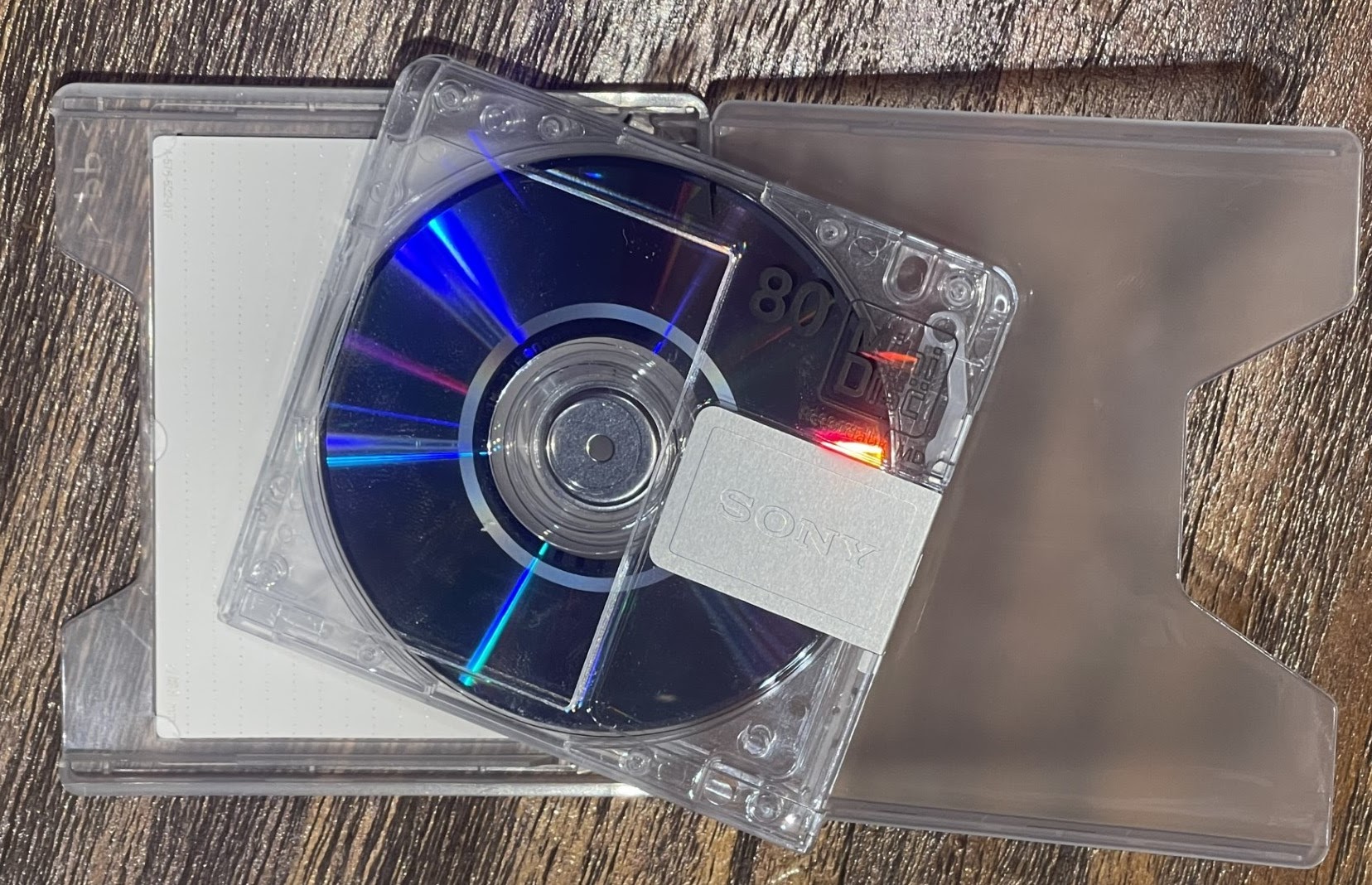
The standard MD is 72x68x5mm. The typical disc store about 70 min of music. The one I have is the 80 min. In term of quality both 70 min and 80 min disc has no difference. Surprisingly the disc can still be purchase from online platform like Lazada. The price is about RM30 a piece. Is exactly like a re-writable CD. It comes with cover like a CD case. 


As this unit doesn't comes with a remote, I have search for it online for after market remote. Is really not hard to find one online to be purchase but it costed quite a pretty penny. Is roughly about USD20 + USD5 for shipping. That comes to about RM130 for this remote. Considering the player only cost RM700, I was pretty doubtful to get it but without a remote can be annoying if you want to select next song while seated. After some contemplating, decided to go with it. I am really I have got it. The after market remote works perfectly, almost like the original remote.


The player itself is pretty simple, just plug it in and pretty can start playing like a CD player. Of course what I have is just blank disc. I will have to record some songs / music to start listening to it. The nice thing about the player, it has various input of RCA, XLR and optical. It can pretty much record from any sources that can output with RCA, XLR and optical. For my setup, I have connected it from the preamp RCA output to the input of the MD player. This makes is easy to play any kind of source and able to record to the MD player. With the connection setup, firstly tested to record from a CD player. It work flawlessly. Pretty easy with just a push of the record button while the CD is playing to record. After that also tried recording from my Volumio player running on Asus Tinker board. WAV, FLAC and DSD is able to record flawlessly. One last thing, was recording from the Rega turntable. It works as well without a hitch. The only downside of this all is the time need to spend. Is old school, for 80mins disc will need to play 80 mins of songs / music to record. Is time consuming but I guess the positive side is you are able to select anything you want to be recorded to make your favourite playlist.


For playback, the MD output from optical to Wadia DAC. I have this connection, it sounded more natural to me than output from the RCA or XLR. The output of the RCA is quite reasonable but the sound is a bit lean. Whereas, the XLR is a lot more punchy but is also with its harshness. I will assume the DAC inside the player is pretty outdated. With the optical to bypass the internal DAC, the outcome is more natural and smooth sounding with the Wadia DAC. 

Among all the different format being recorded to the Minidisc, the one that sounded neutral and more musical is from the recording of the DSD file. Is a bit surprising as I might initial thought will be it will work better with older tech like the CD player. If I have to rank it for all the format, this is how I will put it:

1. DSD

2. LP

3. CD

4. WAV

5. FLAC

6. Streaming

On and all the outcome from playback on the MD is really enjoyable. Is really comparable with current quality of audio. With the 80 mins disc, approximately able to store about 20 songs / music. Is a good amount without having to change the disc as often. Overall my experience with MD is a pleasant one. I will recommend this to anyone who are looking into MD. 

June 26, 2022

A Worthy dbx Successor? Yamaha KX-1200 U Cassette Deck

The Yamaha KX-1200U sitting pretty in my usual rack. Love that titanium silver color scheme, if I have to choose a word for it, it would be CLASSY!

Since my experience with the Yamaha K-1X or KX-1020 depending if you're in the Japan or the rest of the world, I have a very different view in regards to Yamaha's credentials when it came to their hifi equipment. Oh, my buddy has a unit of the Yamaha KX-1200U cassette deck, the 1987 successor to the K-1X which is currently in my care. The KX-1200U  had a production run of 6 years, which lasted till 1993, demonstrating the sales success of the model in question. Oh said I should compare both the K-1X vs the KX-1200U to confirm his own observation.

Styling wise, the KX-1200U carries over the K-1X practically lock, stock & barrel, sans a small window at the bottom of eject button for remote sensor. Power up the unit and that bold red/blue fluorescent display typeface has given way to a more refined yet at the same time more generic typeface looking whitish fluorescent display. Like the K-1X, the KX-1200U comes in both titanium silver or satin black color scheme. I found the titanium silver color scheme on this unit very classy, and will almost certainly prefer it over the satin black. Weighting in at 7.9 kgs, the KX-1200U is exactly 1 kg heavier than it's predecessor. However, a simpleton audiophile likes to view on the subject of build quality by weight, that it seems heavier is better? 

Build quality is the same finely measured compromise between cost vs luxury build. On the front panel, that lovely all glass & aluminum sandwich cassette well door is nicely carried over but now with tint. The cassette well illumination is improved as well, now with a tape center back light and a top light, which is super useful when the need to perform tape head and capstan pinch roller cleaning. All other front panel layout remains exactly the same as it's predecessor, including the six major transport control keys & that flip down panel for recording control knobs and Dolby selection. This Yamaha still came with dbx NR system, but is now the simplified dbx type II prefix, which is deemed to be less extreme in effect compared to the earlier version. By the way, that chunky looking feet at the bottom is still decorative plastic, no ceramic or stainless steel here!

Either way you look, the Yamaha KX-1200U is very nice! 


There are some changes elsewhere too, such as the Sendurst tape head is now the harder wearing amorphous type for long service life. Did I mentioned a wireless remote is now offered with KX-1200U as optional or standard? By the way, the review unit didn't come with the original KX series remote, but nevertheless came with a compatible remote which worked for most transport function. Still on the mechanism, the KX-1200U also does track search, and program play sequence too! Stuff that I don't advocate to use as it may wear out tape head. Otherwise the 3 head, dual capstan transport is pretty much the same. Cassette eject is still non-motorized mechanical.

A close up of the 3 motor Sankyo supplied transport & amorphous tape head


So far so good, Yamaha seems to have added much more convenience feature in to the KX-1200U over the older K-1X, which is good. Moving over to sound quality however, there were also compromises compared to the former. The first thing one will notice, coming in straight from the K-1X is the reduced headroom & dynamic bandwidth. The highs less airy and mid range less sweet. The bass, less kick ass.

I would speculate that due to the need to cater to the older more extreme dbx NR system the K-1X super boosted all the attributes I mentioned above, especially the headroom and dynamic range. The KX-1200U sounds more comparable in character to my other reference, the Akai GX-95 MKII, i.e., is the cassette format sound character. I believe that the K-1X sounds the way it does is due to the dbx NR system it deploys. And with the KX-1200U, Yamaha has chosen to fall back in line with other cassette deck manufacturers. I know that from what is described above, it would seem that the KX-1200U sounds disappointing, but that is only if one is coming from the K-1X predecessor. If one is coming from something like the Akai GX-95 MKII, then the playing field begins to level. And the KX-1200U is a pretty good sounding deck. It got a super strong transport that plays certain tapes that other cassette decks have given up on. I love the refinement the new amorphous tape head brings along with a more neutral tone, compared to the K-1X. The KX-1200U is also more transparent sounding too, by the way. So it's not all bad, but compromises, clearly a few have been made.  

On the inside, noted that big potted power transformer, not many cassette decks feature that. Also note the dbx NR PCB standing up right from the main board on the left! 

Even the wireless remote is color coded to match either Satin black or Titanium silver color scheme 

There's even a deluxe version in Japan domestic market only, come with wood cheeks, whih to me at least, is a must have for all top of the line products!


The Yamaha KX-1200U is still a very good deck after all, otherwise it wouldn't have a 6 year production life span vs the 2 years that it's quirky predecessor enjoyed. The fact that I liked the quirky K-1X so much is because it's exactly the kind of kinkiness for my personal preference. The KX-1200U on the other hand, goes the more prudent & for the lack of better terms, generic direction. And I guess that's why the KX-1200U is the much more successful in the longer term. May be I sum it up this way, about the 2 sisters. Older sister is at once exciting to be with, totally punk style colorful and has wild character to match, you gotta see her quirks as an abject beauty. The younger sister is more traditional, girl next door type, which in the long run, probably make her easier to live with, once the initial excitement has worn off. 

In the used market, now going for about MYR 1,800 a piece, the choice is yours, and Yamaha being not all that popular back then, doesn't really offer much examples in the market.

June 5, 2022

"dbx" Wonder? Yamaha K-1X

The Yamaha K-1X is a Japan domestic model but also called KX-1020 in international export markets. I am not sure if the are any difference internally between them 

For some reason or another, I was never quite taken by Yamaha hifi components. Yes I do have a Yamaha AVR for my living area 5.1 HT system, and that's it. Even that is because I got it bundled with the Bose Acoustimas speaker system for a good price! So why is this in the cards? you asked. My buddy Mr Oh's influence!

This is good deck, you try, this one got dbx noise reduction system, otherwise you don't know what you're missing, he said! And so I did try with an open mind, plus I was curious about the dbx NR system. On spec, it seems to be great deal better than the generic Dolby B/C & HX Pro, which is now default features on most cassette decks. 

The Yamaha K-1X sitting in my audio rack, as usual just below the Aesthetix Janus Signature pre-amp 

The Yamaha K-1X is from 1985 vintage, it self is a further evolution from the K-2000 & K-1000 flagship decks from 1982. Key features of the K-1X includes 3 heads, dual captan transport, Sendurst tape head, Dolby B/C & HX Pro and lastly, dbx noise reduction system. Styling wise, the Yamaha looks chunky with it's rather deep width and tall box, and one peek inside shows why. While the box is compartmentalized inside, Yamaha doesn't go the whole 9 yards & copper coat it either. I see money being spent on the important things like a reliable and high spec transport with a bright green illumination, the Sendurst tape heads, detachable tape well cover made from real glass & aluminum, decent size PS transformer & thick, non detachable power cord. Yamaha chooses to go prudent with other things, like no remote, plastic face plate, no copper chassis coating as mentioned before. The tape well of the Yamaha is well designed for easy access to perform tape head and pinch roller cleaning.

The insides of the Yamaha K-1X. On the right there's 4 pcs of standing PCB for the dbx noise reduction system. With this system, there's a requirement for the audio circuitry to accommodate an extra headroom for signal to noise ratio. Weighting in at 6.9kgs the Yamaha K-1X is not the heaviest battleship around, but is solid enough nevertheless. If I have to rate it, may be at pocket battleship level? 

Another area that I love about the K-1X is the styling, this unit finished in stain brushed black has the usual tape well on the left, a recoding level slider on the right next to tape well, then flanked by an unusually long tape counter and peak level meter display. The display really sets this unit apart by use of bold typeface and very striking blue & red illumination. I think the extra long peak level meter is to accommodate the extra headroom of up to 60 db as required by the dbx noise reduction system. At the bottom of the display are six major transport control keys and a flip down flap on the right to hide all the recording adjustment knobs & noise reduction selectors for a clean facia appearance. On the whole, the styling reflects a image of bold power, yet classy altogether.  

That detachable tape well cover is made from real glass, sandwich at the bottom and insides with real aluminum frame. Very solid and chunky when removed for tape head and pinch roller cleaning 

The tape counter in red illumination has big chunky typeface, making easy viewing from near or far. The peak level meters is extra longer than usual, but does not have peak hold feature

All recording adjustment knobs & noise reduction selectors are hidden inside a flip down flap on the right side of the cassette deck

It all looks very neat on the facia when the flap is up, covering all the recoding functions, making the deck look less busy in comparison to others. The recoding level slider in use here is OK, but I much prefer a big master rotating knob for that purpose 

The sound of the Yamaha K-1X or KX-1020 in export markets is incredible, with or without dbx system in use! I used mostly pre-recorded & tapes recorded from my previous Teac V-670 and those tapes all sounded much better than I ever experienced them before. The sound is big scale, bold, and very dynamic to boot. The bass kicks ass with well defined kick drum, and clean note to note transfers, no woolly bass notes as normal cassettes. I think part of the credit goes to the strong dual capstan, 3 head transport. There's a certain kind of sweetness in mid range & highs. The highs in particular are airy & will bite if the music calls for. There's also a clarity and dynamic range that most other decks will find hard to match. In comparison, the Yamaha did lost out slightly on resolution, compared to my resident Akai GX-95 MKII deck.

I then made a CD recording using the dbx noise reduction, and on playback there was total silence in the back ground just like CD, with the dynamics and slight coldness all included. I would say this Yamaha makes the most true to source recordings one can ask for. I also tried play some of my previously recorded tapes with Dolby C on the dbx system, but the sound came out weird, very loud, and also seemingly boosted to the point of clipping. So Dolby B or C recorded tapes must be played without the dbx switched ON. But even then, the benefits of the extra headroom that this deck offers is highly evident, yes even without the dbx system. I just usually switch OFF all noise reduction during playback, yet this Yamaha is so engaging to listen to everytime, all the time!
 
In 1987, Yamaha introduced the KX-1200U, which looks almost identical to it's predecessor, but come with remote control, and other modern era tape deck functions such as track search 

 In the end, I told my poison buddy Mr Oh, that I don't want to return this deck to him! He was reluctant to sell to me because he wanted to keep it for his own "collection" of cassette decks! And yes, he has many top decks. In the end I managed to convinced him to let me continue to use the Yamaha K-1X, rather than see it sitting on his shelf as a collection.

Mr Oh also have another bullet in his amoury, he said I should try the newer version of the Yamaha K-1X, in the form of 1987's Yamaha KX-1200 U! Stay tuned for that to come next..........

May 13, 2022

Nakamichi Rival, Sony TC-K 555 ESX Cassette Deck

The Sony TC-K 555 ESX is a very smart looking unit with excellent ergonomics. On the right section are the function control buttons & tape counter display, and on the left are recording settings and peak signal display. The cassette well in in the middle, but in this case, it's not motorized. Later units from the ESL model onwards are motorized. 

Sony was in top form during the 80's and the Sony ES series hifi components represented their state of the art in audio philosophy, technology and execution maturity. The Sony TC-K 555 ES series had a long production run which started since 1982 - 1994 in various guises from the early ES, to the, ESG, ESX, ESR & the ESA plus ESJ are being the last 2 versions released in the early 1990's. The Sony TC-K 555ESX as seen here is made for 1987-1988 year, before being replaced by the ESR version in 1989. The last version, ESJ was released in 1992 and continued to be made well in to 1994.

The Sony TC-K 555 series is the state of the art of the Sony ES series cassette deck of the era, being on top of  TC-K 333 series in various guises over the span of 8 years in production. Both models share common design themes such as centrally mounted 3 head, dual capstan, 2 motor transport, made in house by Sony. A two display system is also used in the styling of the deck, the left window being a dedicated tape counter and a right window being peak level meters. The TC-K 555 builds on from there with remote control capability and a higher dynamic range(120db) audio circuitry design. Like the European range topper TC-K 700 from the same year, the tape door is dampened when ejected. Later models from ESL onwards in 1990 have motorized tape door. I must say the styling of the Sony ES series at that point has a serious business like look to it.    

The back panel is as per usual with line in and line out RCA jacks 

This is the original remote supplied by Sony at the time, as optional. So not many owners bought them with remotes back then. Hence the original remotes are super expensive these days. However if you get a unit from Oh, he has a compatible programmed remote supplied. Not very nice looking, but functional nevertheless!  

My own experience with Sony cassette players have been mixed over the years, as I loved my Sony Walkmans, car cassette stereos but with their hifi decks, not so great experience until now. My previous entry level Sony cassette deck, can't remember the model no. came with very high wow & flutter straight out of the box new! I rmembered sending it to the Sony service center & other repair shops many times It could never be fixed.

My buddy Oh told me that I had not experienced the best of Sony cassette decks, I should try an ES series unit. He offered me a TC-K 333 ES unit to play with, but I wanted something a little better, with remote! And so 2 weeks later I picked up this restored TC-K 555 ESX from Oh.

I plugged this unit in to my system, replacing the Kenwood KX-880G unit and from first music played, I heard a similar clarity in sound, slightly wider band width, more refined highs, with a neutral tonal quality, all hallmarks of a great hifi cassette deck. The Sony also had other less positive traits, the scale of music imaging was smaller, less big boned, or probably gave a presentation of mid hall perspective, compared to the rather forward sounding Kenwood, which gives a first row seat impression. The Kenwood also struck me as being more musical of the two, despite having slightly higher wow & flutter audible.

Both the Sony & Kenwood players are highly dynamic tape decks and both have tight bass lines which I like a lot. The Sony TC-K 555 ESX spent about 2 weeks in my audio cave and I never had a dull moment with it. Not sure why, but the Sony tape heads tend to require cleaning more often then my other tape decks. 
All Sony TC-K 333/555 ES models shared the same well spec Sony TCM 110 mechanism, which is a 3 head, dual capstan, 2 motor design unit. 

The Sony TC-K 555 ESX playing in my system, if only for 2 weeks!

Overall, the Sony TC-K 555ESX provides a very positive experience for cassette deck ownership, and has managed to redeemed it's past failings. If anything, it reinforces Oh's comment that if playing with Sony cassette decks, it must be ES series, not anything less. And so far, my experiences with Sony ES series components have not disappointed yet, be it CD player(my CDP-X7 ESD) or cassette deck, and now that makes me itching to try out their ES series amplifiers!

Currently in Malaysia, there are only 2 brands of cassette decks in which people would pay top dollar, (or should I say Ringgit?) without second thoughts. Hence in the context of today's used market place, the Sony ES decks do rival the Nakamichi units on offer. First the Nakamichi cassette decks in which the brand had built such a strong image & sound quality that it's almost bullet proof in resale value for a good working condition unit. 

Next up are the Sony ES series units. I know many who personally import these decks from Japan, despite being rated 100V for Japan domestic market voltage, instead of 240V for local Malaysia spec. This is due to the Sony ES deck's scarcity in the local market. In Malaysia, they were priced out of affordability back then in the 1980's. And if anyone had the money, they would've certainly gone for the well renowned Nakamichi then.  

My buddy Oh also brings them in from Japan, converts them to 240 V and restores them to original spec. At point of writing, he has already sold a couple of units, and he still has limited units left. So please contact him pronto at 012-206 0888 if you're keen to get your hands on a Sony ES cassette deck.

After being with me for 2 weeks, Oh tempted me with another top spec cassette deck, this time a Yamaha K-1X. Stay tuned for that one!  

April 19, 2022

VRDS Dreams, Teac VRDS-20 CD Player

Teac VRDS-20 CD player. The bottom footer at the bottom of the four corner pillars are adjustable for height and compensate for stability if one uses a spirit level

I've always wanted an Esoteric or Teac VRDS series CDP. So when this Teac VRDS-20 unit appeared in the classifieds, I wasted no time making it mine! Amongst the Teac VRDS series CDPs, I feel the VRDS-20 is a bit of an odd ball, styling wise. It just looks like a VRDS-7 or 10 but with 4 pillars on each corner which comes with adjustable metal cone feet! I guess a bit of audiophile touches here & there wouldn't hurt. The funny part is the next in line, the VRDS-25, reverted back to the generic square box of the VRDS-10 looks! Otherwise the Teac VRDS-20 share all the family looks of the VRDS series CDPs from Teac of the early 90's era. The Teac VRDS-2- was sold from 1992-1997, and that was era of the TDA-1547 Bitstream DACs from Philips, which this unit uses a pair for it's balance output configuration and also technically, to give a more linear frequency response on both L & R channels.

This Teac has a very brutish business look, and the chassis is at least double layer copper coated in no less than 8 internal compartments. The internal construction has a no expense spared look, which I like. This unit is using the mid tier VRDS mechanism, essentially a heavily modified Sony KSS-151 transport. As a mid tier VRDS, there are some compromises to be made, but overall I feel this is still acceptable as an engineering solution. The transport is not copper coated, the bridge holding up the VRDS clamp is not die cast metal, but some kind of bulk mould compound with enough solidness to anchor the VDRS clamp, which is again a compromised solution of compound coated metal, instead of copper coated aluminum of the most premium of VRDS.  My personal view is to disregard the later economy versions of  VRDS transports with bulk mould compound bridge & plastic CD clamp, like those that currently resides in the Esoteric K-05 series CDPs. The Teac VRDS-20 was available in Champaign gold or Satin black back then. I like that little quarter window on the top casing panel to allow viewing of the VRDS CD clamp at work.


The back panel is simple digital out, which includes Toslink & Co-axial on the left, a acptive power cord in the center, and analog outputs(RCA & XLR) on the right

My Teac VRDS-20 came with this OEM remote, but is functional enough with a matching Champaign gold color scheme

I plugged the Teac VRDS-20 in to my system, in place of my usual Sony CDP-X7 ESD, using it's balanced, XLR output. all else remains the same in the system. From the very first disc I spin, the tonality of the Teac was rather flat, with a slight mid range centric emphasis which make vocals stand out slightly in from of the sound stage. The Sony by comparison, while had a warmer tonal color, has a flatter less mid range centric presentation. The Teac also sounds slightly less detailed by comparison. 

Overall, the Teac has a very agreeable sound when listened on it's own merits. The highs are polite & laid back, the mid range as I have mentioned, and bass for my preference, could be snappier. Where it falls a little short is the emotional connection or musicality as normally referred as. At this level, I think the Teac has a slightly more dynamic sound compared to my very previous Marantz CD-16D which is a machine of similar sound specifications but only slightly more musical in presentation.

Form the 2 comparison above, i.e. Teac VRDS-20 vs Sony CDP-X7 ESD or Teac vs Marantz CD-16D, I feel the latter is more of a fair comparison as both are Bitstream implementations CDP clad in copper chassis, both are closer in price point, but both using different transport & other audio parameters of CD player build up. If just looking by the eye, the Teac looks the winner with it's more impressive transport, multi layer/compartment chassis & internal layout. The Marantz however do sound somewhat better musically if judge using one's ear. I think what could've being the final arbiter? The KI(Ken Ishiwata) factor I guess, the man's not considered in the industry a "Golden Ear" for no reason!


The impressive innards of the Teac VRDS-20

Too bad the Teac VRDS-20 coaxial out didn't managed to signal lock with the input of the Teac UD-501 DAC, otherwise another sound dimension may have been possible!  

After playing the Teac VRDS-20 for a few weeks, I thought I'd try plugging the VRDS transport to my newer Teac UD-501 DAC using a co-axial digital cable, to see how the great transport can compliment a newer design DAC. The UD-501 is using the much newer AKM DAC design capable of DSD decoding, which itself is the manifestation from the continuous development from Bitstream. Unfortunately, for some reason, the Teac UD-501 DAC refused to lock in to the VRDS co-axial digital signal output once the cable was connected. I tried a couple of times but to no avail. You've gotta give up at some point, right?

Finally after like more than a decade of lusting after a Teac or Esoteric VRDS type CDP transport, my dreams came thru with this but only with a slightly underwhelming feelings on the musicality factor. Perhaps a slightly more musical cable can elevate the Teac VRDS-20? one only has to try.........