Showing posts with label Shunyata. Show all posts

April 19, 2012

Magic, O!

We gathered that our local Magico dealer, Audio Image, had delivered a few pairs of Magico Q3 and Q5 so far. We were very interested to listen to a Magico Q3 or Q5 based system, and as luck would have it, we received an invitation from a new Q5 owner, whom we shall refer to as ST, to have a listen to his system. What a pleasant surprise! It is not common that a highend audiophile opens his door to strangers like us, so we are very grateful for ST's generosity.

And so it was, a few of us descended on ST's bungalow on a Saturday afternoon. After the introduction, we were promptly led up a few flights of stairs into his listening room. ST appreciates the finer things in life, he told us that in addition to excellent sound quality, he also wanted his hifi system and his hifi room to look good, as after a long hard day, when he comes into the room to wind down and relax, he wants to enjoy not just glorious music but also beautiful sight, as such the equipment and the room deco must be pleasant too. Well, after my time in ST's listening room, I am certain he has achieved what he wanted on both counts - hifi and eye-fi.

I'll let this series of photos do the talking:

The system view.
Due to the number of equipment in the system, ST has positioned them in two layers. The front layer, which you can see in this shot, consists of the frontends and pre-amp. The second layer behind, hidden from view, consists of the monoblocks and power conditioner.
The room was designed and constructed by Centre Circle Audio. It has a nice and warm ambiance. It is acoustically treated with wood panels and Auralex's acoustic treatment material, both nicely incorporated into the design itself. In the photo above, the wood panel behind the loudspeakers with its uneven surface acts as a nice acoustic diffuser. Auralex bass traps are installed at the corners, together with Auralex sound absorbing foams at the sides of the loudspeakers (the burgundy coloured material).


A wood panel acting as diffuser is installed on the ceiling. If you look closer, you'd notice that each square in the panel has different depth, following the quadratic residue sequence approach used in many sound diffuser products.

The digital frontend is a Simaudio MOON Andromeda top loading CD player with separate power supply (not shown)

The analog frontend is a Clearaudio Innovation turntable...

...with a Clearaudio Universal tonearm and a Transfiguration Orpheus MC cartridge...
...and Simaudio MOON 310LP Phono Amp & 320S Power Supply
The pre-amp is the 2-piece Simaudio MOON 850P, the top dog in Simaudio's line-up

The monoblocks are the best that Simaudio offers - the MOON 880M, which give out 800w per channel into 8ohm, double into 4ohm.
Doing powerline conditioning and protection duty is a Shunyata Triton, seen above at the centre of the shot, flanked by the 2 monoblocks.
At the end of the chain is the majestic Magico Q5, 176kg/387lbs of aluminium chassis and more

To match his top notch equipment, ST does not skimp on cables. He uses mainly JPS Aluminata. Seen here are the Aluminata powercord, interconnect and speaker cable which go in and out of the Simaudio MOON 880M monoblock.
Other than JPS Aluminata, there are a couple of Shunyata powercords, the Python Helix and Anaconda Helix, which you can spot in the monoblock-powerline conditioner photo before (the ones with green and red plugs)
The JPS Aluminata speaker cable that goes into the Magico Q5

ST also uses hifi accessories to fine tune the sound. Here we see the Harmonix Tuning Spike Base under the Magico Q5. In fact, ST is so big with Harmonix Tuning Spike Base that he has 12 sets in his system, installed under almost every piece of his equipment
ASI's resonators are used to tweak the acoustic property of the room. This one is placed at the top corners of the room

More resonators from ASI. These are installed at the centre of the front wall

The more eagle-eyed among you would notice that ST prefers to stick to the same brands for his equipment - almost all his electronics are from Simaudio, and almost all his cables are from JPS. He told us that he preferred such an approach because he could be confident that there would be no mismatch issue with equipment coming from the same brand. I cannot fault such a philosophy, it will indeed take away much guesswork when putting together a system.

After just a short listening, I loved the tonal beauty of this system already, which I recognized as a beguiling quality common to the Magico line. I heard the same beautiful tonal colour from other Magico models, such as the V2 and V3, in the local dealer's showroom too. Just that the Magico Q5 in this system conveyed this quality more clearly and more prominently than the dealer's system. The system also sounded dynamic, fast and detailed. Both ends of the frequency spectrum were very extended. Bass featured prominently in the mix, it brought much exceitement to the listening experience though it could be just a bit overwhelming at times. The overall sound was not the thin and analytical kind, instead it had excellent body, a nice bloom and sounding simply musical. The sound was also non-fatiguing for long hours of listening.

Listening to this system is a joy. ST, thank you for your hospitality, we had a truly memorable weekend.

January 23, 2012

Best Power Line Gear 2011.

These were the few power line conditioners we managed to lay our hands on in 2011. While I had tested the Torus Power RM8A AVR sometime in 2010, I didn't felt that the improvements in sonic qualities to be tangible enough for me to up grade. However something changed in the power supply grid in my area since and the Torus made a comeback!

Torus Power RM8A AVR is the best all in one power solution for me.


Torus Power RM8A AVR.

It's the ultimate all in one box power supply solution, for people residing in areas where their power supply lines are not only soiled with EMI/RFI interference, but also huge voltage swings. While EMI/RFI interference is generally agreed by consensus to degrade sound quality of a given hifi system, voltage swings can shortened lifespan of all electronics. Personally, I do feel that it's a factor that does effect a given system's sonic signature too. Too low a supply voltage(below230V)  and the sound gets all mushy, lethargic, and a general lack of drive in the music. Too high the supply voltage(above 250V) and the sounds turns harsh, with tizzy highs and vocals sing like as if they're screaming at you! Usually accompanied with a strong, dense white hash in the quiet musical passages, which mask away low level details. I am a happy Torus Power user, enuff said.

Runimg Springs Audio Duke is design exclusively for power amps!


Running Springs Audio Duke.

This is a passive power filtration designed to restore transient and dynamics losses in a given system, by working on the power amps. With the RSA Duke in Odoislueth's system, the musical canvas achieved a jet black state of nothingness and we felt that perhaps that contributed to faster transient response and stronger dynamic swings. It just made orchestral crescendos peaked just that much higher, and rock music rendered more energetic. However, the Duke's additional qualities did not take away the suppleness, sweetness and organic qualities that were already part of Odiosleuth's system vocabulary. Here's a no compromise approach to passive power conditioning.

Shunyata Hydra V-Ray II is an improvement in passive power filtration of past versions.

Shunyata Hydra V-Ray II.

Odiosleuth has been a Shunyata fan for a few years now. With each update, we felt Shunyata is moving away from the warm, cuddly effects introduced by the use of their PLC equipment in a given system. With the latest Hydra V-Ray II, the move to neutral sonic grounds is complete. While I felt the move is in line with current high end standards, some may miss the older style Hydra sound characteristics. By the way, the new generation Shunyata Hydra Triton series is now here, and we hope to try them out pretty soon.

I can't think of any other PLC products to mention here. Next, we look at some Best Cables 2011.

November 18, 2011

Listening at CMY

One purpose of my visit to CMY's showroom in 1 Utama (you can get a tour of the place here) a couple of weeks ago was to have a listen to its main system.

This system was a scaled-down version of the big system CMY demo'ed in this year's KLIAV show (see here). All the main components came from the same brands as the KLIAV system - Wadia, Jeff Rowland, Dynaudio, except that they were one model below the ones in the KLIAV system.

Doing the frontend duty was Wadia's 571 CD transport (RM 33,680) and 521 Decoding Computer (i.e., a DAC) (RM29,500). Note also the very new Shunyata Hydra Triton power line conditioner (RM20,590) on the bottom shelf.

Amplification was Jeff Rowland's Corus pre-amp (RM54,550), which has won praises from us when we had it for review here a few months ago, and Jeff Rowland's Model 312 power amp (RM68,850), which could give out 500w per channel into 8 ohms, double into 4 ohms.

The loudspeakers were the Dynaudio Confidence C4 (RM90,550), its handsome look very much a follow-on from the awesome Dynaudio Evidence Temptation used in the KLIAV show. When we entered the demo room, our gaze was immediately attracted by the slim and tall profile. Standing at 175cm (5'9"), the Confidence C4 was as tall as an adult. The elegant glossy veneer on this pair was a special finish, we were told, and came with extra cost.

The Dynaudio Confidence C4 looked majestic, my photos don't do them justice. You have to see them in person to understand the visual impact they can have on you.

Being the local distributor for Acoustic System International (ASI), CMY also used ASI's resonator products in its listening room. Here you can see ASI's tuning wood blocks (called SugarCubes) and resonator cup installed on the front wall.

The back of the system, as expected, was full of cables. There were a mixture of Siltech, Shunyata and ASI. First glance gave the impression that it was all a spaghetti soup. But if you were to look again, you'd notice that the cables were nicely dressed. They were kept away from each other, never touching; and where close proximity was unavoidable, they were separated with Shunyata Dark Field Minis. All cables were also lifted off the ground with Shunyata Dark Field cable lifters.

The performance of this system echoed the immaculate care that went into its setup. It was one of the better dealer demo's I had the good fortune to sit through. Given the more conducive listening environment compared to the KLIAV show, this system indeed sounded better, except in term of scale, the bigger system did sound even bigger.

As I am not personally familiar with every component in the system, much less the room, I'd attempt to describe the sound from the system as a whole, instead of dissecting the sound of each piece of equipment.

As expected, the sound from this big system was, well, big. The system conveyed an excellent sense of scale, with a cavernous soundstage conjured up in front of the listener, perfectly formed just behind the loudspeakers. Width, height, depth were all very good. Listening to Nils Lofgren's 'Acoustic Live' CD could get us to believe the illusion that we were sitting in front of the stage, listening to the performance together with the live audience.

This is a very transparent system. Nothing in the music escaped its analytical capability. The music threads were cleanly delineated and clearly portrayed, never blurred. The listener could choose to zoom into any part of the performance and follow it through. The good thing was that the musical details were not thrown in your face, the system never degenerated into aggression like it was force feeding you the information. I did not feel pressured or fatigued listening to it, a good sign of a system that would allow long term listening enjoyment.


To use an analogy, I'd say the system cruised along just like a big Merc, no matter what we played with it. It certainty had the poise and composure as experienced in the big sedan. Nothing could unfaze it. This system will not go 'crazy', sound frenetic or worse, falling apart with any music. If anything, I felt that just the very last ounce of emotion in the music was not fully released perhaps, as the system always maintain a grip throughout the proceedings.

A further highlight of this system was its dynamic expression, both macro and micro. It scaled the entire dynamic range with ease and without compression, even when the goings got tough. This was amply demo'ed with some Chinese orchestral music that CMY's Steve played for us. The sound appropriately 'exploded' when the big crescendos came, while at the quieter passages, the sound was kept bouncy and lively. There wasn't one dull moment.

The high-mid-low of the system was all of very high quality. Bass was punchy and well defined, the mid was rich and clear, and the high was grainless and nicely extended. They were well balanced and and well integrated together. Probably a sign of the quality of the drivers used in the Dynaudio.

This big system is an excellent example of what a modern, high end system could achieve. If you visit CMY 1 Utama, make a point to listen to it.

Contact Steve, CMY 1 Utama, 03-77266893 / 012-6535703.

February 2, 2011

A Big Step Forward - Shunyata V-Ray v.II & Black Mamba-HC CX 20A

I am a Shunyata fan. My love affair with Shunyata started 3-4 years ago when I was looking for a power line conditioner and came across a Hydra 8 (version 1) unit. The Hydra 8 produced a beguiling midrange, added a little warmth to the bass, and imbued the whole sound with a musical energy which made it attractive for long hours of fatigue-free listening. I have been living with it since.

You could also call the Hydra 8’s sound a little rose-tinted or a little golden hued. After listening to a number of other power line conditioners, I found the others indeed may sound more neutral. I know, my meat could be someone else’s poison. However, if one fell for the Shunyata’s colours, it is not easy to pull away.

After the Hydra 8, I tried a Shunyata Taipan Helix power cord on my source component, a Copland CD822 CD player. The energy and poise the power cord added transformed that CD player’s performance. I liked it so much that I went the whole nine yards, changing all my power cords to Shunyata Taipan Helix and Python Helix.

Among the lot, the biggest contributor to the overall sound is the Python Helix 20A from the wall to the Hydra 8 unit and another Python Helix from the Hydra 8 to my current frontend, the Ayre C-5xeMP universal player. It is also my experience that Shunyata power cords shine best in a complete Shunyata system; having one or two pieces of Shunyata in an array of other brands would not allow the full Shunyata flavour to come out, in my opinion.

So, given my affinity for Shunyata, when Big E told me that CMY has taken over the Shunyata distributorship in Malaysia and the Hydra V-ray v.II, the top dog in Shunyata’s power line conditioner hierarchy, was available for a listen, I was extremely interested to say the least.


The Hydra V-ray v.II comes in with a list price of RM20,590. The construction is similar to the Hydra 8 (now also upgraded to v.II status), which is basically a very sturdily built rectangular box slightly bigger than a loaf of bread. It has an aluminium fascia, and comes with a power switch and 8 American style outlets at the back. Shunyata says that the outlets are individually filtered. The ‘magic sand’ inside the box is there, Shunyata calls it ZrCa-2000, a noise reduction compound. Therefore when you pick up the box and give it a shake, it sounds like sand sloshing inside the box. As a bonus, the V-Ray v.II comes with a free SR-Z1 wall outlet, the same kind as the ones on the V-Ray v.II itself.

The V-Ray v.II is rated for a power throughput of 2,400 watt, unregulated, and a 20 amp continuous / 50 amp peak current capability. The V-ray also has surge protection of 40,000 amp and an electromagnetic breaker for over-current.


I started by plugging the V-Ray v.II to the wall with my Shunyata Python Helix Alpha 20A power cord. I plugged all my components into the V-Ray v.II, just like I did with the Hydra 8. In my new room, I did try plugging the more power hungry monoblocks directly into the wall outlets. Initially, the sound seem to have become more revealing, however, long term listening showed that it was noisier and harsher, it was not comfortable to listen to beyond 20-30 minutes. So, at the end I preferred to plug the monoblocks into my Hydra 8. I had the same result with the V-ray v.II.

How did the V-Ray v.II performed? Let me just not beat around the bush, the performance of the V-Ray v.II is streets ahead of the old Hydra 8!

The first difference I noticed was pronounced – the frequency response of the system was much further extended, it went way low in one direction and way high in the other.

An excellent example is from a jazz piece - Sonny Rollins’ ‘Way Out West’ from the album of the same name. The double bass notes were energetically thumping away from the woofers, each pluck packing a little punch, going lower than I heard before from my system. Noteworthy too was the way the V-Ray v.II made the notes sound more distinct from one other, the tune in the double bass playing was heard much more clearly, and the rhythm it carried was simply infectious.

On the same track, the cymbals and high-hat were much improved on, there was much less of the feeling of ‘a cloud of high frequencies’, each hit was more cleanly delineated. They also had the spread-in-air and illuminating-the-space qualities.


In addition to the improved extension at the frequency extremes, the V-Ray v.II brought with it a much lower background noise, instruments and vocals were playing on a cushion of velvety blackness. Clarity and details improved further, focus was better. The vocal from Pop Pop Music’s ‘Brasileiro Z Yan’ album was locked in between the speakers and rendered a couple of feet further in from the speakers’ plane, the staging was also very dimensional. Despite all these improvements in details and focus, the sound did not lose its good body, which Shunyata is well known for. It did not become thin.

As a further improvement, Shunyata pulled the V-Ray v.II away from the old Hydra 8’s rendering of tonal colours. If you think the old Hydra sound was too ‘flavourful’ for your taste, sort of a little too much ajinomoto, then you’ll find the V-Ray v.II not having much of such folly. The V-Ray v.II takes a big step towards neutrality.


At the tail end of the listening period, I replaced my older Python Helix Alpha 20A on the V-Ray v.II with the new Black Mamba-HC CX 20A (HC stands for High Current). I was pleasantly surprised, the musical performance did not diminish one bit. This is despite the fact that the Black Mamba is the replacement for the Taipan, which was one rung lower than the Python, its price is also lower than the Python by 20-30%. For a 2m cord, the Black Mamba lists for RM3,100. The Black Mamba also took a step towards neutrality compared the old Python Helix, which I think is now the new general trend for Shunyata products.


The Shunyata V-Ray v.II and the Black Mamba-HC CX impressed tremendously. Those who love Shunyata and have the requisite deep pocket, you have my envy.

Shunyata is carried by CMY Audio & Visual, contact John, tel: 03-21439206

January 18, 2011

Shunyata Research Moves To CMY Audio & Visual.


It's a new 2011 year and CMY Audio & Visual starts of with a new brand acquisition. The highly popular Shunyata Research range of power line conditioners and power cords are now available at all CMY showrooms.

An enthusiastic Odiosleuth is already on the ball! He is currently test driving the latest top of the range Shunyata V-Ray II PLC and Black Mamba HCCX 20 amps power cord. Watch out for his review to come soon.

The full range of Shunyata power line products can be experienced on demo in all CMY Audio & Visual showrooms. Or contact John at 03-21418552 for more info.

August 2, 2009

Elevated Tales, Shunyata Darkfield vs Elite Acoustic MSI.

This is an old post of ours in the blog we previously contributed to.

Elite Acoustic MSI on the left, and Shunyata Darkfield on the right. Let the games begin!

Until the arrival of the Shunyata Darkfield, I was a cable elevator skeptic. However, with Shunyata in the game for cable elevators, being company whose products are non voodoo science by nature(well at least their "white paper" theories seemed plausible), I figured they must be up to something good. And since I had one product on hand, which coincidentally Sound Precision brought about their latest product, Elite Acoustic MSI, amongst which include a cable elevator.

Since Hifikaki already post earlier about the Shunyata Darkfield in detail, I'll do a little explaining on the Elite Acoustic MSI(Magnetic Shock Isolator). It's elevated by means of two opposing magnets of the same polarity facing each other, not unlike the Clear audio Magix 2 reviewed on 4th March 2009. I must confess that however, the Clear audio Magix 2 is more well thought out in execution and better built. Another area of concern is the Elite Acoustic MSI is non-shielded, which means if you put 2 of the cables elevators close to each other, they'll wanna stick together! Does that also means another possible source of stray magnetic interference?

However I am happy to report that none of those concerns affected the subjective sonic reproduction out come as far as my ears are concerned. So are we ready to start the cable elevator shoot out?

Shunyata Darkfield, lifting Cardas Golden Presence interconnect.

First up, I'll mostly concur to Hifikaki's observation about the sonic observation of the Shunyata Darkfield. I found that placing the Darkfield under speaker cables to give most gentle of intrusions, meaning, it's sonic effect on speaker cables are most minimal compared to, say the power cords and interconnects, in the order of severity. I also found that you can't use too many pieces of Darkfield in your system either! I started with 4 pcs under my Straight wire Maestro II speaker cable, which made the back ground very silent, dark and brought about a new level of imaging focus to the overall sonic picture. I later added one piece at a time, to various power cords and interconnects, as I had a box to play with. With each piece added, the sound was getting darker, and the imaging focus seemed sharper in contrast. It was until the 9th piece, when I noticed the sound coming from the system took on a certain hardness in the high mids. At this point the whole sound stage also took on a rather constricted quality, like as if all the instruments are tied up with strings, just as in a puppet staged musical event. That, I did not like.

I also noticed that during it's time with me, some cables, like the Siltech G5 LS88 Classic speaker cable, did not respond well to the Darkfield. With only 4 pcs of Darkfield supporting both the left and right chanel speaker cables, the sound was already edgy and bright. I just couldn't wait to take the Dark field off! In the end, I found with just 3 pcs under my Cardas Golden Presence interconnect(4 meter in length connecting my pre to power amps) and a piece of Darkfield supporting my JPS Inwall power cord connecting from the Torus Power to my power amps, the sound was most well balanced between the background silence, darkness, and imaging focus.

Elite Acoustic MSI(Magnetic Shock Isolator) supporting the same Cardas Golden Presence interconnect.

Next, I replaced the Shunyata Darkfield with the Elite Acoustic MSI. Just like the I discovered earlier with the Darkfield, you can't use too many of these stuff. I also found the MSI to be weight sensitive, the heavier the cable the more effective it is. To achieve this, one can use less MSIs on a given cable length, that means like if I had use 4 pcs Darkfield earlier, I can now use only 3 pcs of MSIs to support the same cable. Once you dialed in the correct amount of MSIs to use on each cable, now you're rolling.

As per my experience with the Darkfield, 3 pcs of MSIs under the same Cardas Golden Presence interconnect gave excellent results. The MSIs never darkened the back ground like the Darkfields did. Instead, it fills the back ground with audiophile air, if a little hazy translucent like quality(I am trying my best to describe the sonic effect heard in lay man's term, hopefully it makes sense to you as an audiophile). Whatever it is, it's not white noise either. With the MSI, I feel the vocals and voices are projected with more density. This makes voices sound more complete and real, with chest and lungs. However, as you add more and more pcs of MSI, you'd find that the vocal imaging projected a little further and further forward in to the room, making the voice a little detached from the musical instruments in the back ground! I also subjectively found the MSIs more PRAT friendly to the tempo of the music, comparatively to the Darkfield.

In summary, the two cable elevators work in different sonic directions. I would say if your system is looking for a little more back ground silence, better imaging focus, the Darkfield is the more suitable candidate. Should your system crave for a little more audiophile "air" and dimensionality, with increased vocal density projection, then the MSI is a treat. At RM$100/pc, the Shunyata Darkfield is no doubt, the better value option. However, if it clicks with your system, as it did with mine, at RM$256/pc the Elite Acoustic MSI is my preferred cable elevator device, in the context of my system and musical preference.

In the end, your system and musical preference will ultimately sway your purchase decision. Like all tweaks of this nature, try before you buy is the order of the day.


Shunyata is sold by Valve & Vinyl, contact Mr Ng, tel:016-3302049

Elite Acoustic is sold by Sound Precision, contact Mr Chan, tel:019-3825937

The Force Is Strong On The Dark Side!

This is an old post of ours in the blog we previously contributed to.

That I went to ask V&V Audio for the Shunyata Dark Field Cable Elevator for trial was actually Panzer's idea. So this last Saturday when we met up, I took down the 4 pieces I had and passed on to him for a listen.
Later, I listened to my system without the Dark Fields. It sounded all right, almost indistinguishable from when the Dark Fields were around. So I thought, no big deal, I knew the Dark Field's effect was minor, though positive, anyway.

I listened to my system again Saturday night, then a couple more times on Sunday. Hey, what happened? I did not enjoy the music as much as before, there was a slight loss of coherence (but it did not become incoherent), there was some mechanical-ness in the music re-production while previously the music was more fluid. I also had to strain somewhat to distinguish minor details that I knew were there, because I heard them quite clearly the last few days. I was less relaxed listening.

All these were the areas that the Dark Fields improved upon. In my last post I said that their effects were small. I still think they were small, but what I did not realize was how critical they were. It was like that few drops of soy sauce that made a dish complete; or like that putt that put the golf ball into the hole after you have driven it for 400 yards.

Then, Panzer texted me about the Dark Fields in his system, he said, "The system... with the dark field elevators reached a whole new level of Sophistication! It brought the whole musical emotional intent to the fore. The slight dryness noticed yesterday totally gone. I want (the Shunyata Dark Field). Ha! Ha!".

So there he went with me to the Dark Side too.

I went back to V&V Audio and requested more Shunyata Dark Field Cable Elevators (an entire box of 12 pieces in fact) for Panzer and myself to check out.


Putting 4 back into my system brought back the smile a couple of hours later. I'd pass the rest on to Panzer, he wanted more so he could try them on his interconnects and powercord too. Let's see how his journey would turn out.

I have a conjecture based on my experience - it may not be possible to do quick A-B comparisons with the Shunyata Dark Field. When I first put them on, I needed to wait a day for them to bloom; when I took them off, I thought everything still sounded ok only to hear things progressively changed over a day plus. IF the Dark Field is really doing what it is suppose to do, this makes sense, as, I believe, draining static electricity and having static to build-up do take time (though I am not sure in our high humidity and carpet-less environment how severe the problem would be).

Topics on tweaks like this are likely to polarize opinions. However, the most important is one's own listening experience. So if you are interested, try them out in your own system to decide (remember to let them sit for a day or two under your cables first).

Ok, now where is that light sabre to complete my cross over? :-)

List price for the Shunyata Dark Field Cable Elevator is RM100 per piece.
Shunyata is carried by V&V Audio - 016-3302049 Mr. Ng.

Dabbling In The Dark Side - Shunyata's Dark Field Cable Elevator

This is an old post of ours in the blog we previously contributed to.

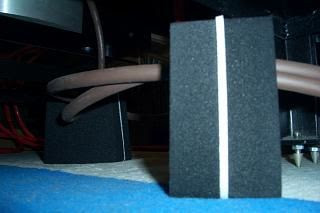
The Shunyata Dark Field is a support used to lift a cable off the floor. Shunyata says that the Dark Field will drain away static electricity build-up and also control vibration in the cable (aah..... that vibration / resonance control thingy again). It is made of foam-like materials, but of a rather hard variety. Shunyata does not reveal the exact material make-up on its website though.


I took home 4 pieces from V&V Audio, Shunyata's local distributor, to try out. I was told that while the Dark Field's effect could be heard immediately, it needed some time to 'run-in' for the full effect to come through, especially if a lot of pieces were used. Honestly, I took it with a pinch of salt initially. :-)

I put the Dark Fields under my speaker cables, they felt quite sturdy in use. I chose the speaker cables because all the other cables - interconnects and powercords, were too crammed together for me to get the Dark Fields in. I had only 2 pieces of Dark Fields per cable, I placed them closer to the speaker end, as such not the entire speaker cable's length was elevated.

The Shunyata Dark Field under my speaker cable

In the first hours of listening, I could hear that the Dark Field Cable Elevators did have an effect on the sound. These initial effects could be described as having a more 'saturated colour' for the sound, while shaving a bit off the highs. Though these changes were not night and day, I could not agree to them entirely, it did not sound natural to me. So I decided to let the Dark Fields sit over night.

The next morning, I listened again. The first effect that I caught was from Jennifer Warnes' "Famous Blue Raincoat" track (Famous blue raincoat 20th Anniversary Edition 826663-10490), there were fewer of the ear-poking moments I got with the trumpet on this track in my system, however the trumpet still retained the requisite bite, which was good. The next effect that I caught was that minute details became better defined and more apparent. Only later on did I find that background noise also receded, each music note was heard coming off from a quieter background. I also thought that the sound had a little more bloom added to it, though I can't be sure whether it was the effect of the Dark Field, or the effect from my Shunyata Hydra 8 coming off more due the lower noise floor.

The overall feeling was that it was slightly more relaxed for me to listen to music.

While these changes could be described as small or subtle, I thought they were quite beneficial at the end of day.


I do not know how cumulative the effect will be if one were to go beyond 4 pieces. I don't plan to add more as I am already satisfied with the effect I got. Conceivably, the sound may become darker with more, just like what their name says :-). However, since that is not the direction I need for my system, I decided not to go down that way.

Tweaks such as this would be system independent, so one needs to experiment with their placement and especially the quantity used. I'd advise that the Dark Field Cable Elevators be added incrementally into the system and the owner going back and forth to find the eventual balance.

This quartet will stay in my system.
Looks like more and more tweaks are being added to my hifi now. Yes, I am going over to the Dark Side! :-)

List price for the Shunyata Dark Field Cable Elevator is RM100 per piece.
Shunyata is carried by V&V Audio - 016-3302049 Mr. Ng.