Showing posts with label Cassette. Show all posts

July 19, 2020

Fun With Cassettes!

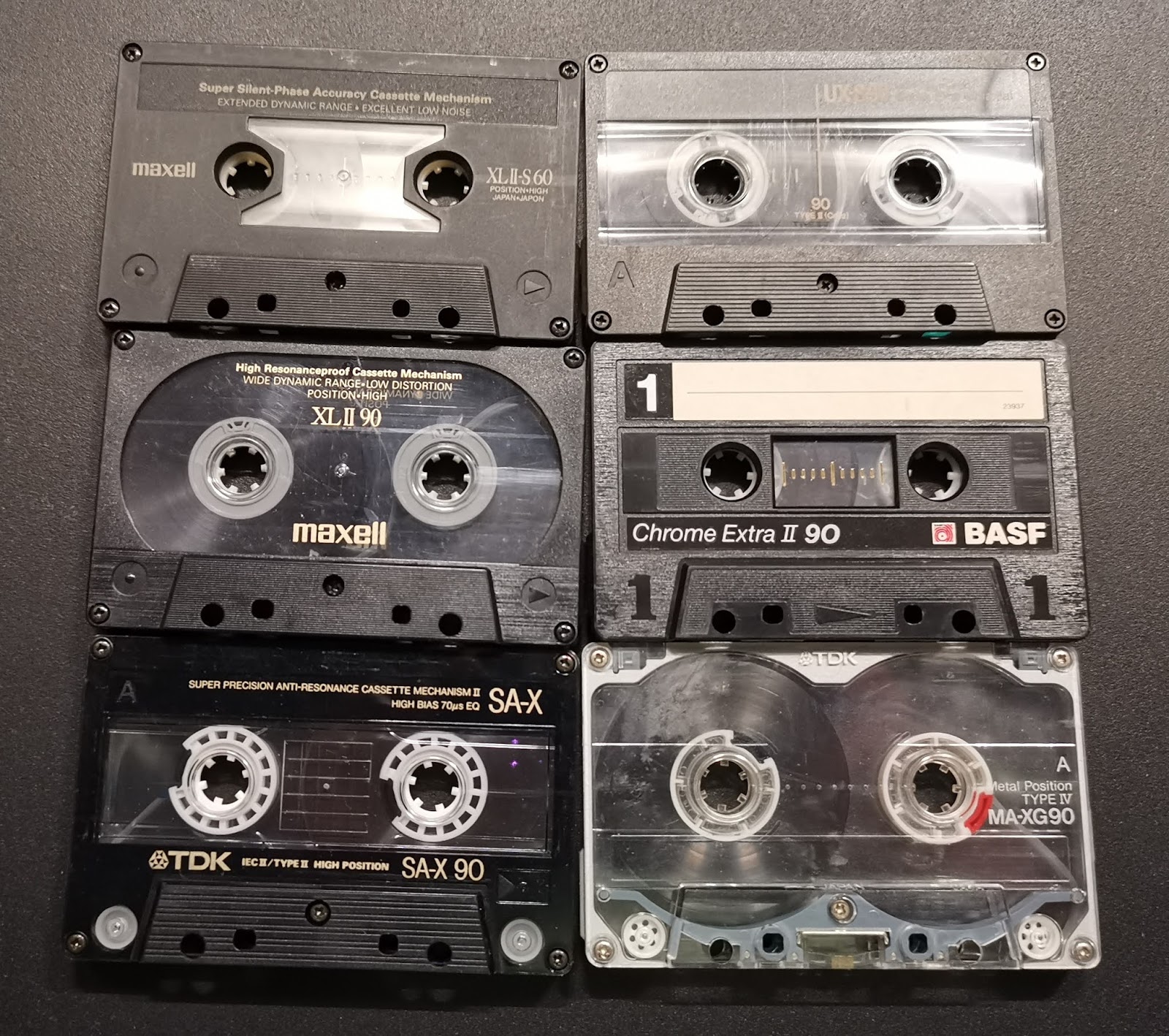
Some of my cassette tape collection, from clockwise: Maxell XLII-S60, Sony UX-S90, BASF Chrome Extra II 90, TDK MA-XG90, TDK SA-X 90, Maxell XL II-90.

Since restoring my Teac V-670 cassette deck, I've been having much fun exploring my whole cassette collection again. As shown above are just a fraction of my collection of mixed tapes with I recorded with the Teac V-670 deck. I still have a small collection of original pre-recorded tapes back from the 80's till 90's period.

With this post, I will share just how each tape type typically sounds like and their inherent characteristics:

Type I - Normal: This is the most commonly used tape, and usually comes as standard when you buy original pre-recorded tapes. Quality can vary a lot with Type I tapes and sound performance can go from pretty hissy to good overall. For my minimum sound quality requirement, I think the TDK D series Type I cassette is a good place to begin with. The TDK D series tape offers a good balance between hiss noise level to overall recording clarity in sound. Typically Type I tapes do not stand re-recordings well, unlike the Type II Chrome & Type IV Metal tapes, which can be re-recorded over at least 2-3 times.

This is where it all begins! Type I Normal tape.

This is common pre-recorded cassette you can buy.

Type II - Chrome: From here on, things start to get interesting. Sound quality goes up a whole new level of clarity, much lower noise floor, increased band width and better bass response. With certain tape brands on the higher range like TDK SA-X series you could actually hear "airiness" in the recordings! The TDK SA_X series Chrome tapes were my reference at this level. There is a wide range of Type II tapes at various price levels. My favorite Type II tape at the time was the BASF Chrome Extra II series because I felt it offered the best price to performance ratio. It was fairly affordable, yet sounded very good, only down side is Wow & Flutter was slightly higher with this tape. At one brief point in the 80's, you could actually by original pre-recorded music on Type II tapes(available in limited titles only). 

This is where things get serious, Type II Chrome tape.

You can still get original pre-recorded Type II Chrome tapes if you want near audiophile sound quality. 

Type IV - Metal: Now we are at audiophile level recording tapes, where tape his is almost non existent, almost CD like band width & clarity, and with solid bass quality. If you've got a 3 head tape deck, it would be most beneficial to use Type IV Metal tapes for recording. With a 3 head tape deck, you can instantaneously hear the playback quality of your recording as you record. One thing is for sure though, there are NO cheap Metal tapes out there, with some costing nearly 2/3 of the price of an original pre-recorded CD, the TDK MA-XG 90 comes to mind. However that TDK MA-XG series tapes are built to a whole new different standard of quality. The tape it self is really housed in a metal shell, sandwiched in low resonance resin full window panel on both side. The tape reel itself is made of ceramic material! Now that's fanatical attention to quality! And sure, the TDK MA-XG series Metal tapes are THE BEST sounding tapes your money can buy, EVER! CD recordings made on Type IV tapes offers CD level sound quality, but retains the mid range texture of best analog source, it's really the best of both worlds! TDK MA series Type IV tapes offer the value for money, as they can sound very close to the much pricier MA-XG series, at half the cost. Guess what? I just saw a brand new TDK MA-XG 60 tape on sale in Ebay, with a bidding start of USD $99.00!!!

The ultimate cassette experience, Type IV Metal tape, a must have if one is using 3 head recording decks.

I am glad I had taken the path to restoring my Teac V-670 tape deck. The last sold cassette was in year 2001, just barely 20 years ago. Now, the cassette revival is real and very happening!

July 12, 2020

Another Classic Revival, Teac V-670 Cassette Deck

The Teac V-670 Cassette Deck, sitting below my Aesthetix Janus pre-amp.

I've been playing with cassette decks since the 70's, as it was my first music medium experience, when it comes to hifi. Vinyl medium experience came a good decade later, followed by CD medium experience after that. There's something nostalgic about a cassette player since my student days. Back then, to make a mix tape for someone with songs you think they would like, to show how much you cared for that person. Not to mention the Sg Wang hey days in the 80's where one could walk in to any of the many music stores and ask for a mixed tape be made for you. You simply select the song on their available song list and choose the tape type(Type I, II & IV) you wanna record on to. The tape Type I means normal or standard tape, Type II means Chrome tape & Type IV means Metal tape. Chrome & Metal tapes means hi-end in the cassette world.

I had many Sony Walkman units as a student, and when I finally had enough money(I worked part time as a student), I splurged on a 3 head tape deck to reward my self. It was a Teac V-670 that you see here, bought in 1988! Yes, this tape deck is 32 years old.  Like everyone else back then, Nakamichi decks were the rage, and the still rock to this day. Budgetary concerns means I have to consider other brands, such as Teac, which is still good as they have good representation in the professional side of things.
Inside the Teac V-670. Note the plastic molded chassis instead of the usual 2U metal. Left side top is the power supply and transport mounted to front panel, on the whole right side is the power supply regulators and audio circuits. 

As a student and later as an young working adult, I had much fun with cassette deck. As a student, I made many recordings for my Walkman use and also mixed tapes for my friends, and when working, I made many CD & turntable recordings for my car stereo. You see, I still feel cassette was the perfect medium for people on the move. Of course that role now is done by our smartphones!

As car CD players became the standard, my Teac V-670 deck was boxed up in storage. I never saw it again until 2018, when I packed up to move. Seeing this cassette deck brought back much memories, but all I could do at that point is to box it up again and wait again for another opportunity to unbox. And by the end of 2019, that opportunity came calling, as I was setting up my hifi again.

I check the deck condition and it powered up, must basic functions still works, but only barely. So I decided to get it serviced, do a little DIY, so to speak. Upon opening up the chassis, the first thing spotted was four leaky caps in the power supply section of the main PCB board. I proceed to pull up the PCB board from the main plastic chassis, to extract the old caps, clean up the brownish oil stains off the PCB with IPA, then proceed to insert and solder the new caps in to it's original place.
See the laeky cap stains on the PCB board?

All cleaned up and caps changed.

Next up was the transport section of the cassette deck. The whole transport assembly was removed from the back off the front panel with 5 Philips screws. the transport is a 2 motor design, one for the tape pulley, the other for the rubber capstan. The are 2 rubber belt that drives from motor to pulley to the capstan idler gear. All the dried oil in the transport was cleaned and re-greased. Now everything was re-assembled, and ready for the final stage.
The 3 head, 2 motor transport module awaiting removal.

Working on the idler gear & pulley and rubber belt replacement.

Since I didn't have the calibration equipment required to do the fine tuning job, I sent the Teac to bro Azeem at Cheras. Azeem is a fine lad I met on FB, and have since helped me in other hifi restoration projects. With a Wow & Flutter test tape. the cassette deck hooked up to an oscilloscope, the fine tuning of Wow & Flutter can be completed.
Wow & Flutter test tape.

Wow & Flutter of both Left & Right channels.

Now both channels are well aligned.......

After the Wow & Flutter tuning is complete, we proceed to play some pre-recorded tapes. The cassette deck never sounded so wonderful! I brought the Teac home, hook it up to my system, and have been playing tape after tape since. Like the wonderful turntable, there's still much life left in cassette as a format. However, the big question is can the cassette revival be as strong as the vinyl revival? Only time will tell.
Test play with pre-recorded tape in progress.

This 1988 Teac V-670 cassette deck is an UK model I am told, hence there's very little information about it on the internet. As far as I know, the V-670 is the entry level 3 head tape deck with HX-Pro certification & Dolby-C noise reduction filter. As an entry level 3 head, 2 motor tape transport design, it does sport some cost saving features compared to it's similar looking flagship V-870 model. The whole chassis is plastic molded rather than 2U steel or copper coated. The transport is 2 motor only compared to the 3 motor V-870 model. And the Eject button mechanical, rather than a motorized solution. The V-900 sport extra recording adjustment parameters and also an IR remote.

As a cassette playback and recording medium, the sound is very good, despite it's obvious budgetary design compromises. It playback & records best with Type II Chrome & Type IV Metal tapes, so investing is high quality blank tapes pays off! My favorite high end tape is the all aluminium bodied TDK MA-XG series. In 1988 MYR price it was a cost of nearly 50 bucks a piece! For comparison a common branded Type I Normal rated tape would retail about MYR 8.00-10.00 a piece. I did most of my recordings from either a CD player or turntable as source, utilizing the Dolby-C noise reduction for a super quiet background. I would playback without using the Dolby-C though as I preferred the airier sound without the Dolby masking effect.

With this restoration, I can again enjoy many years of fun with cassette tapes!