August 12, 2023

Glorious Past! Kenwood KX-1100G Cassette Deck

Kenwood KX-1100G is sold from 1982 till 1989 in various guises, last being KX-1100HX, which includes Dolby HX Pro for recording from radio, as per KX-880D and all the other guises

This was the cassette deck that virtually made the name for Kenwood back then in 1982, that's exactly 41 years ago, along with it's lower model, the KX-880G which I toyed with last year. It sounded so good that I was considering to buy the review sample, but I decided to hold out the purchase, in hope that one day, the top line KX-1100G would become available. Just my collection habit, that I will only keep 3 head decks.

Finally, more than a year later, Mr Oh, my trusted hifi repair guy and cassette aficionado, had restore 2 units of the KX-1100G and asked if I wanna toy with it? Hell yeah! A bit more about the Kenwood KX-1100G. It's a 3 head, direct drive, dual capstan, 3 motor Sankyo tape transport design, used in much like the high end Nakamichi's of the days gone by. Tape loading cover opens manually, via a push button on top of the power ON button on the left side of the fascia. The cassette well is biased towards the left, as per typical design of the time, followed by that distinctive dual fluorescent display, one horizontal to indicate tape type, Dolby and timer, pluas another vertical, to indicate peak level meters for L&R channels. Transport controls are located just below the horizontal display and towards the right side is the recording level setting knobs. The whole unit weights just 6.2kgs finished in satin black with faux audiophile feet, which looks nice. Build quality is not the best, due to it's medium weight design intentions, but everything works nicely, even if the tape transport is slightly clunky when being engaged & disengaged.  

Overall, the design is exactly the same as the KX-880G, except for that audiophile feet, and the "Amorphous Alloy Combination 3 Head" description printed on the cassette cover.

The back panel is generic cassette deck layout, with RCA input & output, and power cord on the other side of the case

Only this description and that big audiophile feet separates the KX-1100G from the KX-880G, the lesser sigbling!

From the very first tape I played with this Kenwood, I was totally smitten by the sound, which was tight, clean, fast & very powerful. It does really remind me that I am listening to CD like quality sound, but from a cassette source! Tape speed stability is first rate, which comparing to some of my higher end decks, which should be better, but not! Tape pulling power is exceptional, due to it's direct drive mechanism as some of my older tapes tended to be a bit sticky, and the Yamaha K-1X can occasionally give up half way, and stop playing, but not the Kenwood, which will continue to play to the end.

Due to that speed stability, bass notes are ultra clean and very punchy, not even the slightest hint of muddiness. The mid range is crystal clear, making the vocals & diction very easy to follow. If I could want more, I would like a bit more meat in that area, but then I am already nit picking. Highs are truly extended with the slightest of hiss, depending on the tape used. Overall, this deck has the musical chops of a digital medium. I must also point out that not many cassette decks have the capability to throw a sound stage quite like this Kenwood, which is wide and deep, and clear vocal projection in the middle. Not even some of the more expensive decks can do that!

AS I only used my decks for play back, I can't comment on the recording capabilities, but if you do Google a bit and ask folks on the cassette forums, They would rate this Kenwood somewhere between a Nakamichi CR-3 or CR-5. Considering the huge price difference between this Kenwood vs those Nakamichi, I can only shower praises on the Kenwood! Perhaps a poorman's Nakamichi it could be? Only you'll know once you've used it.  

Great with pre-recorded tapes too! Seen here playing the Footloose OST with excellent sound quality

While most 3 head cassette decks can give good sound with excellent chrome or metal tapes, not many deck will sound good playing pre-recorded tapes. And this area is where the Kenwood is KING! The difference in sound quality between those pre-recorded tapes vs those self recorded chrome or metal tapes has being narrowed considerably with the Kenwood. Most high end cassette decks will play chrome & metal tapes well, but ruthlessly expose the short comings in sound quality of the pre-recorded tape. With the Kenwood, 9 out of 10 ten pre-recorded tapes will sound very good still, maybe with or or two playing slightly blur. As I have quite a few of those pre-recorded tapes, being able to play them well certainly works in the Kenwood's favor.

I bought & paid for unit just 2 days after first listen, and I think that says a lot about the sound qualities of the Kenwood. I never really believed when someone told me the cassette deck golden years were between 1978 - 1982, with this Kenwood KX-1100G plus my Yamaha K-1X experience, I am starting to see maybe there's some truth to it after all?  

By the way, I think Mr Oh still have one or 2 more Kenwood KX-1100G under restoration, just in case you're keen, do contact him a.s.a.p.

July 26, 2023

Eversolo DMP

The name Eversolo sounds like this is the one. Its a good name for Android media player. That is right, this is an Android media player by the famous Zidoo (China) in some of the highest end Android player today which cost over RM10,000 being the top of the line (Zidoo Alpha) which is well known in the home theater world. With success of Zidoo in the home theater segment, the company is venturing into the stereo world. Eversolo is not new in the line of Zidoo's product line up. It started of with the Eversolo Z6 and Z8 DAC which is quite a hit in the market. With the success of their DAC, it comes with the latest product of DMP A6 which is a streamer and media player (audio only). 


It comes with 2 different edition or models. The standard edition and the master edition.


Standard Edition

                                                                           Master Edition


The difference of the unit other than the gold batch in front of the master edition, is the internal clock of master edition is upgraded version . Two accusilicon femtosecond oscillator. The op amps is also upgraded to OPA1612. In simple summary the upgrade reduce noise and with low distortion. 


The video of unboxing is the standard edition. In terms of packaging, both standard and master have the same boxing. The box itself is pretty good looking. Inside of the box packing is definitely top notch and the player itself wrap within a beg. Out of the beg the unit itself is aluminium chassis. Well build of the casing, pretty solid and quite weighty of 3kg for such a small unit 187mm x 270mm x 90mm. 


Looking at the back of the unit, this one media player that covers all kinds of connection you can think of. There are 3 antenna on this unit for wifi and also bluetooth. It can support ethernet as well. The HDMI is has the ARC feature will be useful for connecting to TV. 2 x USB3.0 for external storage connection and also output to external DAC. It has digital input as well if someone will like to use it as a DAC. Optical, coaxial and USB C input can be use to connect computer or any other external player to the Eversolo. The player also support optical and coaxial output. Finally the analog output has the RCA and XLR. The only connection not available on this unit is AES. 


The front LCD touch screen is really a good size (3 inch) which is good to enough to see the wordings from about 3 feet away. As per picture above the lay out is good enough and not too pack. The meta data is download from internet as soon as the music starts playing. 

At the home display of the LCD panel is pretty standard look of an Android. I will describe it similar to a mobile phone (Android). Additional apps can be installed into the player like any other Android system. Anyone familiar with Android will be easily navigate around. At least it doesn't take any kind of computer know how to get it working.  The Eversolo apps can also be download into mobile for Apple or Android for remote control.


The apps is quite user friendly. Simple layout, which is pretty much the same kind of standard Android type of user interface. Streaming or playing directly from player and pretty much any kind of configuration can be done from the apps itself. This is pretty useful while seating some distance away and able to control the entire unit. Having said that, this unit does not comes with remote control like a traditional player. With this interactive remote apps, really do not need anything else. The unit can also be access remotely from web browser by accessing the IP address.


Now is time to give the unit a go. First try out with the USB connected to external drive. The playback is pretty straight forward after the files are display in the screen and playing it back. The downside here is the time it takes for the unit to build the list (depend on storage size) can be quiet long. First song tried out on Ed Sheeran  "How Would You Feel". Its a FLAC file being use. The vocal is pretty sharp but I will say is a little over the top. The lower end is pretty solid but a little boomy. Sound stage is pretty good overall in covering the listening area of 200 sq feet room. Definitely can feel the energy of the song. Next tried out with Eagles "Hotel California". Definitely the bass is pronounced and tight but still a bit boomy. A little bit lacking on the mid bass. The electric guitar play back is like the vocal, sounded sharp and a little over the top. The overall DSD compare to FLAC playback is a little smoother and more musical. 

One plus point on the player, is the display can be turn on with VU meters. During playback is quite nice to watch one. Pretty cool. Definitely makes me thinking of HIFI ROSE minus the high price tag. 

The streaming apps support Tidal, Spotify and Apple Music. Pretty meet all the needs of most users at least here in Malaysia. The apps can be install at the main menu and after installation is done just have to sign in with your account and ready to play. Only able to test it with Apple Music which I have subscripted. The sound quality of streaming is pretty average. Nothing to shout about but is definitely convenient to let it play especially if the unit is at living room or bedroom for casual listening. If you have an external USB drive, can be connected to it and be use like any CD player with direct playback. This is another useful feature to save some cost. All in all this unit is feature pack, has all kind of connection and pretty plays almost anything from streaming to files playback. For anyone who is about to get into Hifi digital world, I will think this a great choice to choose from. 


July 14, 2023

TAD Technical Audio Devices and Innuos Launch Event at AV Designs

Posted by Tan 

AV Designs recently held a launch event for new products from TAD and Innuos.

For TAD, the primary focus was on its flagship loudspeaker, the TAD-R1TX, which was the first pair AV Designs brought into Malaysia. The TAD flagship loudspeakers are now in their third iteration, from the first-generation TAD-R1 to TAD-R1mk2 and now the TAD-R1TX. The TAD-R1TX largely retained the key design features of the series, being a 3-way design using a concentric mid-tweeter driver made of Beryllium and dual 10-in woofers, but also went through internal design improvements and subtle changes to its look.

The woodwork of the TAD-R1TX enclosure, which feels luxurious and looks excellent even on very close inspection, is now a collaboration with Tendo Mokko, a renown Japanese furniture maker, who on its website says that “when we at Tendo consider excellence in furniture, we imagine family assets original owners can hand down to the next generation. Tendo delivers furniture that parents will want to pass on to their children, who will in turn leave it to their own children”. So now TAD loudspeakers can also be considered heirloom.

In the case of Innuos, a digital music server and streamer brand from Portugal that AV Designs took on as distributor, we saw the introduction of its top-of-the-line Statement music server. AV Designs also put some of its entry level models on display. The Statement is a beautifully made 2-piece machine, consisting of the streaming electronics in one chassis and the power supply in another. The Statement is idiosyncratic as it is an all-USB affair, it does not provide RCA or XLR input or output.


The supporting cast of the demo system was no less impressive. It consisted of the TAD-D1000TX DAC, TAD-D700 CDP, TAD-C600 pre amp and TAD-M700S power amp, wired throughout with Wywires Diamond series cables. The TAD-M700s power amplifier was perched on a massive hifi stand from made by Bassocontinuo of Italy, called Gargantua. I believe we’ll hear more about the Bassocontinuo line when the full range arrived in the near future.


Joki leading the attendees through the varied music selection in the demo session

This listening session confirmed with no doubt for me that moving up TAD’s product hierarchy consistently brought added sonic improvements. You can name any hifi performance parameter, such as details and resolution, frequency extension, dynamic range, soundstage size, loudness capability etc. the higher in the range you go, the more you’ll get. The performance envelope simply expands in all directions.

At the end of the listening session that saw music of multiple genres played, I was left with one simple word in my head. That word was ‘COMPLETE’. The music I heard from this system did not require my brain to have to work to fill in any blanks, nor the sound I heard needed me to, consciously or subconsciously, interpret as to what it is. I enjoyed the musical presentation tremendously at the same time. This was a realization that I hardly ever had in any listening session with any other systems in the past. Absolutely impressive!

Innuos Pulse and Zen Series on display

TAD Evolution Series on display

Sharing a couple of video clips from the demo session (videos taken on an iPhone SE):

Nicki Parrott's "Fever" 

Jeff Beck's "Space for The Papa"

Call AV Designs James Tan at +603 62411237 to arrange a listening session.

July 9, 2023

Alexandria Audio The Monitor Loudspeakers

Posted by Tan.

A chance encounter with Uniq Fidelity Sdn Bhd's (website link here) head honcho, Mr. Gan, landed me the opportunity to do a review on Alexandria Audio's The Monitor loudspeaker. Alexandria Audio piqued my interest more than other regular HiFi brands as it is new to our shore and it has an unconventional place of origin - Bali, Indonesia, a place we would normally associate with beautiful beaches and enchanting culture rather than HiFi. So, what is better than getting some exposure on HiFi coming out from our close neighbour?

The Monitor loudspeaker bucks the trend of small bookshelf and slim floorstander. It is a bookshelf loudspeaker but it is larger than almost all other bookshelf loudspeakers I came across. It is chunky looking by today's norm, more reminiscent of the classic midsize British 2-way box speakers from the houses of Harbeth and Spendor. As such, The Monitor's footprint would require a speaker stand that have a bigger top plate than usual, to ensure stability. The 4-pillar stands that I have, more suitable for small speakers like the Proac Tablette, were too small for my liking with The Monitoring perching on them, but I had to make do. I think It would be great if Alexandria Audio could come up with matching stands for these beautiful loudspeakers.   

For the specifications and design philosophy of of these loudspeakers, you can refer to the Alexandria Audio's website here. The Monitor measures 28cm X 45cm X 33cm (WHD) and weigh 14kg each. They are rated for 90dB (I assume it is /w/m) and indeed I did find them do sound louder than my lower sensitivity loudspeakers at the same volume dial setting. 

The Monitor retails for RM22,688 a pair, so I though that they should go into my main system rather than me mucking around with them with my entry-level gear. It turned out that, true to their name, these loudspeakers' performance reflected the quality and capability of the gear they were paired with, the better your system is, the greater they will sound. 

I started by positioning them between my resident loudspeakers and thought that I would move my speakers away if they required more space. It turned out that I did not have to, a distance of ~8ft or 2.5m between the pair of loudspeakers was enough, a wider placement thinned out the sound a bit too much for my liking. At their final positions, they were ~4ft (1m+) from the side walls and ~7ft (2m+) from the front wall. 

I needed to do one other adjustment in my room acoustic treatment to accommodate them. Their bass performance was a touch lean initially for my liking though what was there was always agile and tuneful. I need just to reduce some of the bass dampening treatment I did in my room to restore the bass balance. 

Also, no toe-in was required for The Monitors to conjure up well-defined images and well-formed soundstage. 

All in all, I don't think these are fussy loudspeakers, but they are also revealing and responsive, which, in my books, are the hallmarks of well designed loudspeakers.

These are well balanced loudspeakers, with no obvious character or colouration. But, as implied by their name, they will also reveal what’s wrong rather than cover things up. Equipment matching, room treatment and speaker positioning are relatively more critical compared to other more forgiving and coloured loudspeakers. If you found The Monitor's sound wanting, I'd suggest you look into equipment matching and system set up further, rather than placing the blame on them.

Let's start with the all important performance area for a lot of audiophiles, i.e., female vocal. The female voice, played through The Monitors, sounded natural and unforced, little nuances and inflections in the voices were clearly resolved. Listen to Stacey Kent singing "I've got a crush on you" in the video clip below, The Monitor's portrayal allowed the music's emotional content to be fully expressed (all videos recorded with a iPhone SE):


1. Stacey Kent, "I've got a crush on you"

Moving on to larger scale music, in this case David Oistrakh's rendition of Max Bruch's Scottish Fantasia, my reference for this beautiful composition. The violin tone showed excellent details and clarity, it was also well served with brilliance and richness, attesting to The Monitor/s very fine quality in the upper mid and the highs. The ebb and flow of the orchestra and the ambiance of the venue were also very well handled. The Monitor's drivers especially the tweeter are fine units indeed. Oistrakh's expression of this music through his violin always held my attention to hear through from beginning to end. Through these loudspeakers the same held true, which is a testament to their ability as a music maker par excellence. 


2. David Oistrakh, "Scottish Fantasia" 1st Movement

I also threw some fast and dynamic music at these loudspeakers to see how they fared. The result was toe-tapping, head-bobbing enjoyment. I believe this recording of Fourplay's Max-O-Man expressed The Monitors' PRAT capability very well. 


3. Fourplay, "Max-O-Man"

In conclusion, these Alexandria Audio loudspeaker sounded balanced and revealing, they can do details and musicality at the same time, which will satisfy both sides of the listener's brain simultaneously. Scale, dynamic and loudness capabilities are all very good. As long as your listening space is not too large and you pair them with quality gear I am sure you'd have a lot of enjoyable listening hours. Due to their responsiveness, neutrality and revealing nature, they will demand more in terms of system matching and loudspeaker positioning from the owner, but handsome reward awaits when you get there!

Alexandria Audio is carried by Uniq Fidelity Sdn Bhd, contact Mr Gan +60-11-31347900.

June 21, 2023

Legacy Digital Playback

Back in the 80's , the media of Compact Disc (CD) are introduced. It has large influence over the technology world and pretty much everyone would probably own some CD in the life. That is how popular CD as a media is to world until the 90's when Sony came out with a small version of the disc which is know as Minidisc (MD). The media is pretty much the same but smaller in size and still hold the same among of information. In the audio world is the standard 70 mins play time on the CD. MD is not just smaller in size but also encase in a shell not like CD which is a plastic disc expose and can be damage. Sony being known in the audio world has large customer based which is almost a guarantee for success. Unfortunately , despite all the fact MD did not really get popular. It was use mainly in Asia and some part of Europe and not so popular in the States. Ironically during the 90's hard disk and other media like Ipod is getting popular. Not a good timing for the MD and with 2 - 3 years after MD was launch it also quickly died out. 

Myself being the kids from the 70's, I have my fair share of cassette, tapes, and CD. When MD was around, I am pretty fascinated by it. Although very much into but is still not kind of affordable to own a MD player and getting the disc is not also not as much as CD back then. Honestly, for the beginning of the journey was much into movies and therefore Home Theater is the thing for me starting around 2007. Along the journey, kind of switch things towards music. By now, digital is the most common playback for music. With streaming of music it has now become the main stream. The old school head of me still very much into physical media. Even in Home Theater I will prefer the Bluray Disc than streaming. Naturally, I have been playing with CD mostly and some Vinyl along the way. I have always been eyeing for MD which is hard to come by this days. One fine day, out the blue I have chanced a upon a seller of pre-loved item to be selling this TASCAM MD player. The brand itself is well known during its day. With RM700 price tag, I am more than willing to jump into. The downside is the unit doesn't come with a remote control. Quite a bummer but, I thinking I will be able to find a replacement remote.


From the front look is kind of like a CD player except the loader is size is smaller. The front panel consist of quite many controls. Remote can be really optional. The usual button for play, stop, search and eject. The other control is for selection of input which is not quite common for player which usually has output. One key feature of MD player is the ability to record. On the left side of the player has a big knob to set the input volume. This is use to control the volume during record. On the right side of the player has a smaller knob which is selector where the knob can be press to "select". This is to control the function of deleting the disc, labelling the content of the disc. 

On the bottom right corner has a keyboard input. Of course this is the old fashion P/S2 keyboard which doesn't exist anymore. The purpose of this is to connect a keyboard to the player so is easier to type in the name of the song or album for each track. Is far easier than using the knob or even remote control. Very thoughtful design considering back in the 90's there is no touch screen.


Taking a look at the back of the player is the usual power cable which is not detachable. It uses a 2 pin plug. On the far left is the analog (RCA) input and output. Than follow by the optical output and optical input. Next is the analog (XLR) input and analogu (XLR) output. This unit can be switch between 120V and 240V. Is a good feature to have. I have to say this player has all the necessary input and output. What I think is nice to have is the Coaxial connection. That will be really a complete package. Is really nice to have output for both balanced and unbalanced.


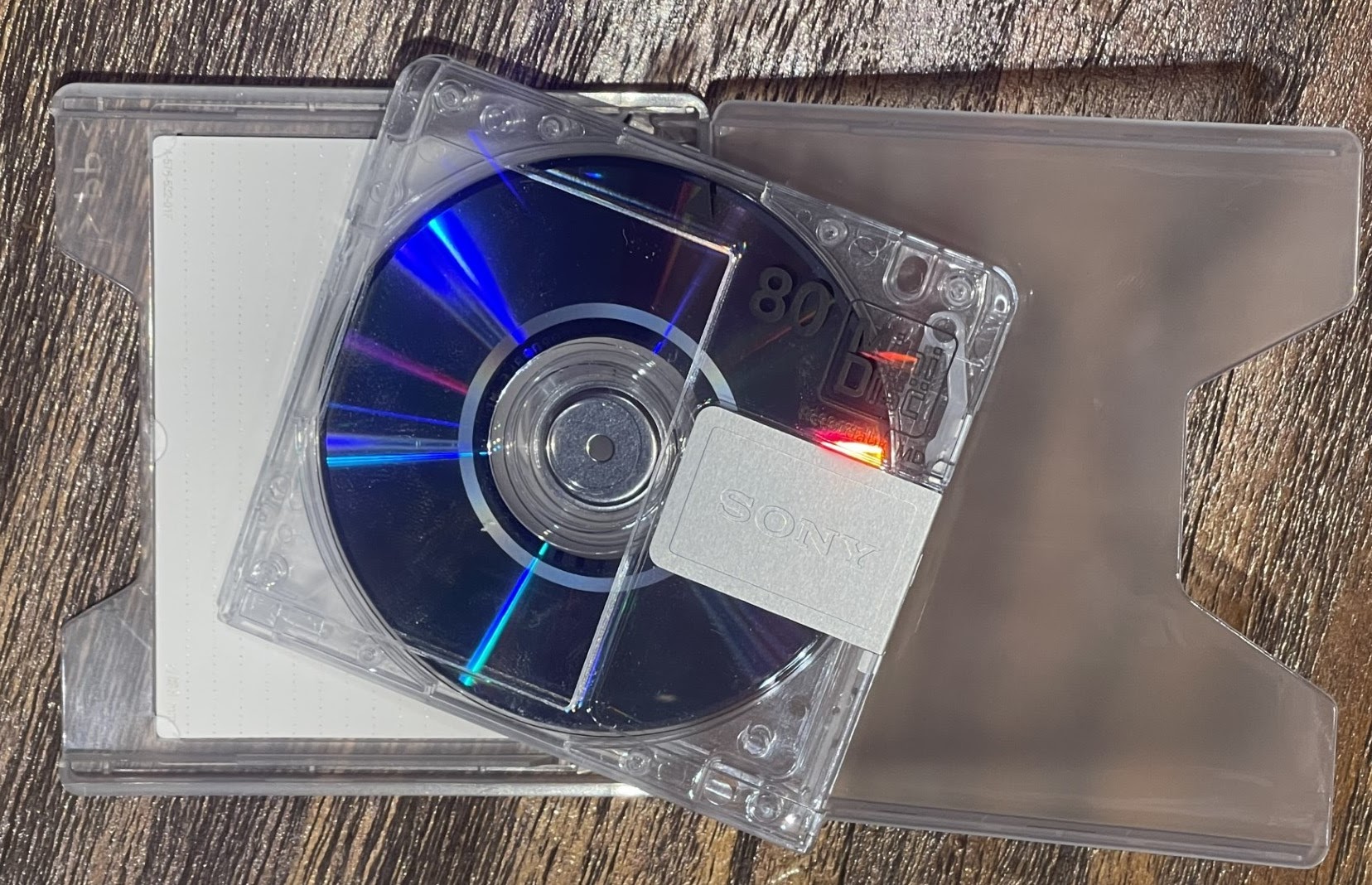
The standard MD is 72x68x5mm. The typical disc store about 70 min of music. The one I have is the 80 min. In term of quality both 70 min and 80 min disc has no difference. Surprisingly the disc can still be purchase from online platform like Lazada. The price is about RM30 a piece. Is exactly like a re-writable CD. It comes with cover like a CD case. 


As this unit doesn't comes with a remote, I have search for it online for after market remote. Is really not hard to find one online to be purchase but it costed quite a pretty penny. Is roughly about USD20 + USD5 for shipping. That comes to about RM130 for this remote. Considering the player only cost RM700, I was pretty doubtful to get it but without a remote can be annoying if you want to select next song while seated. After some contemplating, decided to go with it. I am really I have got it. The after market remote works perfectly, almost like the original remote.


The player itself is pretty simple, just plug it in and pretty can start playing like a CD player. Of course what I have is just blank disc. I will have to record some songs / music to start listening to it. The nice thing about the player, it has various input of RCA, XLR and optical. It can pretty much record from any sources that can output with RCA, XLR and optical. For my setup, I have connected it from the preamp RCA output to the input of the MD player. This makes is easy to play any kind of source and able to record to the MD player. With the connection setup, firstly tested to record from a CD player. It work flawlessly. Pretty easy with just a push of the record button while the CD is playing to record. After that also tried recording from my Volumio player running on Asus Tinker board. WAV, FLAC and DSD is able to record flawlessly. One last thing, was recording from the Rega turntable. It works as well without a hitch. The only downside of this all is the time need to spend. Is old school, for 80mins disc will need to play 80 mins of songs / music to record. Is time consuming but I guess the positive side is you are able to select anything you want to be recorded to make your favourite playlist.


For playback, the MD output from optical to Wadia DAC. I have this connection, it sounded more natural to me than output from the RCA or XLR. The output of the RCA is quite reasonable but the sound is a bit lean. Whereas, the XLR is a lot more punchy but is also with its harshness. I will assume the DAC inside the player is pretty outdated. With the optical to bypass the internal DAC, the outcome is more natural and smooth sounding with the Wadia DAC. 

Among all the different format being recorded to the Minidisc, the one that sounded neutral and more musical is from the recording of the DSD file. Is a bit surprising as I might initial thought will be it will work better with older tech like the CD player. If I have to rank it for all the format, this is how I will put it:

1. DSD

2. LP

3. CD

4. WAV

5. FLAC

6. Streaming

On and all the outcome from playback on the MD is really enjoyable. Is really comparable with current quality of audio. With the 80 mins disc, approximately able to store about 20 songs / music. Is a good amount without having to change the disc as often. Overall my experience with MD is a pleasant one. I will recommend this to anyone who are looking into MD.