November 17, 2009

Roger Wang and JZ8


I have met Roger Wang, the guitar maestro, twice. Once in a performance in NBT and later in Tutti Studio. He strikes me as an easy-going and humble chap with absolutely no air, considering the fame he has. Considered one of the best finger-style guitarists in the country, you have to really see how Roger plays his guitar to understand why he is what he is today.

I just found out about Roger's blog today... check out how this guitar man talks about his involvement in his latest c0llaboration with Maggielurva and his latest toy, the harp guitar.

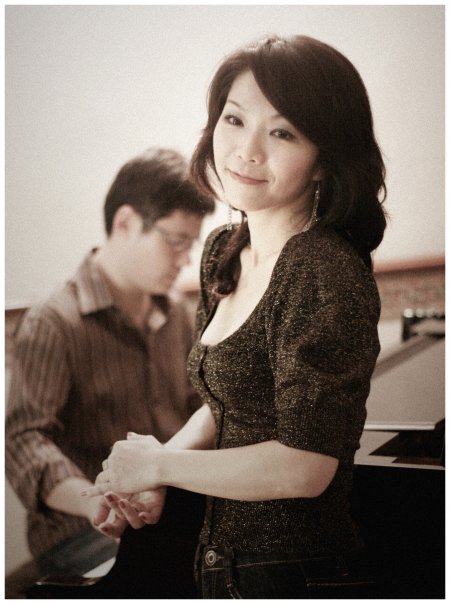
Also, I went to Tutti Studio last night to watch JZ8's practice. Finally, I get to meet Lydia Chew, the female vocalist. Lydia is small in frame but a very attractive and chatty lady. I love her voice! She can goes deep and has a tonal character that is very unlike the typical Chinese pop female singers which tend to be high-pitched and amusical. She has a poise which comes with many years of singing for big artistes like Jenny Tseng, Jacky Cheung and Sheila Majid, to name a few. If you like RegineTai and Winnie Ho (of 2V1G) for their youthfulness and exuberance, you will like Lydia Chew for her maturity and class.

I watched in amazement how Tay Cher Siang flirted with the piano. This man is amazing; he can play some amazing chords which are out of your imagination! His playing reminds me of George Winston, the American pianist.

Some of the songs they recorded included "The Beach" (Sha Tan) by David Tao, "I Have A DateWith Spring" (Ngo Wo Chun Tin Yau Gor Yuat Wui) by Alice Lau Ngah Lai and "Hang Fook Mo Tin Lun" by Eason Chan. In particular, I was mesmerized with Lydia's rendition of "I Have A Date With Spring". You know, to sing this song well, you must have a deep voice. Recently, I went for the Dama Ochestra musical adaptation of the same name and was hugely disappointed with Tan Su Suan's rendition of the same song towards the end of the musical. Don't get me wrong, Su Suan is a great singer but she is a soprano and she sang way too high! Lydia's bass tone is just perfect for this great great song.

JZ8 is vastly different from 2V1G, both have its appeal to different class of listeners. If you ask me, I love both.

According to Chow Kam Leong, the producer, he aims to release JZ8 before CNY next year. Maggie said he will definitely consider HQCD this time, as the recording this time will definitely be better than Love's Tapesty (which is already a milestone), as more Stage III cables are added coupled with more power conditioners.

You bet I will the first one to get an autograph, or maybe a hug :-( from Lydia Chew!

November 16, 2009

Tear Down These Walls. PMC OB1i Speakers.

The PMC OB1i speakers takes up residence in my audio cave.

I was a little apprehensive about receiving the PMC OB1i speakers in to my audio cave. It just seemed a little too big for the room. James of AV Designs re-assured me, "they'll be alright!, plus they're the smallest PMC's to have that mid range dome that you so lusted after". It was a time after I had listened to Mr S's formidable Bryston, PMC based HT/music system(see home visit, featured in September). Ohh... that kinda puts everything in to perspective.

That mid range dome in the middle is special, it sounds special!

James thoughtfully arrived with the speakers, helped me to haul them two flight of stairs up to my audio cave and aided in initial set up. These PMCs are heavy. Moving them about is really a two man job. But once in place, minor adjustments are do able on my own. Speaker reviews are really hard work, and they take up a lot of set up time too.

The PMC OB1i standing tall. The listening position ideally should place ear height in between the tweeter and the mid range dome.

I hook up the PMCs to my Pass Aleph 0 mono blocks and away we played some music. It sounded very promising already. James remarked that it could only get better, he then left me to my own devices. I played around with speaker placement trying to reduce the effects of my room's 48Hz excitation mode. I eventually settled at 4o inches from back wall and 18 inches from side wall, measured on the outside corner at the back of the speaker box. I then played around with toe in, but just like my earlier experience with the GB1i, I thought the OB1i sounded best without toe in, just firing straight a head in to the room. Once the speaker position is confirmed, I then attach the speaker base spikes on the out riggers and put the spike coasters under them to protect my wood flooring. Just in case you're wondering, my room measures 10 x 12 x 9 ft(W x L x H).


The PMC OB1i allows tri-wiring or tri-amping, i.e. has 3 pairs speaker cable binding post per speaker. I did not have the cables to exploit this option, but what I did was that I could use this flexibility to further fine tune the speaker's tonality. I first opted to have the speaker cable connected to the high's binding post, bearing in mind to lean out the bass response in my room, by boosting the treble just a bit. However, subsequent listening had me settling for a more even tonality cross speaker wiring, i.e. the negative to the high's binding post and the positive to the mid's binding post(see picture below). A word on the speaker binding post, for a speaker of it's stature, WBT style binding post would be preferred.

The speaker cable binding post used are of generic variety. Priced at RM$25k, WBT style ones would be nice!

With the final position and wiring options taken care of, I proceeded with some serious listening. Coming to the PMC OB1i from the Marten Design Form is a very drastic change in sound. The PMCs have reasonably sweet and extended treble, just like the GB1i. The mid range has warm open clarity, yet solid density and very stable imaging properties. The bass, from a transmission line tuned enclosure is effortless, dives deep, yet remain articulate.

The unique ATL, or Advance Transmission Line tuned bass port.

The OB1i does sound stage in my room as laid back as the Marten Design Form. However the stage width extends way, way away from the speaker's side wall. Combining that width extension with the laid back presentation gave an impression of the walls of the room has been torn down. The musical event happening in time and space just outside the room's boundaries. These big boys really do disappear in to the room, sonically speaking, despite their bulk.

The veneer finish is excellent. Note the out riggers at the bottom, where spikes are attached for stability.

The OB1i is highly transparent yet reasonably forgiving to poor sources, i.e. recordings. For me, this is a positive trait as I have many poorly recorded but good enjoyable music, like pop/rock recordings. Having said that, the PMC OB1i doesn't short change excellent audiophile grade materials either. There's also a certain PRAT factor going here, which makes every CD, an enjoyable listening experience.


The OB1i, being the biggest speaker to yet entered service in to my room for the past 2 weeks or so have made me feel the smaller speakers that I was using to sound edgy all the time by comparison. It'll be hard to revert to those smaller speakers.


I later hooked up the Krell S300i integrated amp(review to come next) to power the PMCs. Rated at 150W @ 8 ohms, the Krell was truly up to the job of powering the 87db sensitivity OB1i. With the Krell amp, I found the perfect synergy for the PMC OB1i. The speakers were already performing admirably with the Pass Aleph, now truly comes to spectacular life. The bass was immediately tighten, to the point that when compared to the Pass Aleph, which the bass notes does tend to miss a note here, and lag a bit there. Only in direct back to back comparison with the Krell, that I realised the Achilles heel of the Pass Aleph. With the Krell amp, the transient response and dynamics headroom was a major sonic draw card. I found myself looking for all the most dynamic sounding CDs to play on this system. The PMCs can take a lot of punishment with no complains.


One thing I really enjoyed with the Krell/PMC combo was the kick drums and percussion instruments. The kick drums really have the realistic kick ass, rocking quality that will please even the hardest of rockers. Having said that, the PMCs can also sound sublime with more sentimental paced music. All said and done the PMC is an all round performer of the highest order, irregardless of music genre. It just gets to the heart of the music and allows it to flow out naturally.

Another look at the PMC OB1i.

I am really impressed by the PMC OB1i. They're big, yet comfortably fit in to small rooms and bring down the wall boundaries. They can sonically disappear almost like a mini monitor and when partnered with a grippy amp(i.e. amps that have high damping factor) the PMCs really come in to it's own. The OB1i is also sonically transparent enough not to favour any music genre, which means excellent musical all rounder.


If you've RM$25k to burn on nearly full range speakers, and plan to house them in to small or medium sized rooms, I really think the PMC OB1i is a top contender indeed, based on my experience of it in my small audio cave. I highly recommend it.


PMC speakers sold by AV Designs, contact James, tel no:03-21712828

November 15, 2009

ModWright Arrives At Centre Circle Audio

Centre Circle Audio has acquired the agency for ModWright Instruments' line of electronics.

ModWright, founded in 2000, started life as popular and reputable modifier for a number of digital players. As time goes, it has built up a line of amplification products too, consisting of preamps, power amps and a phono stage.

Their first batch of products, consisting of a pre-power amp combo, has arrived at Centre Circle Audio and are ready for audition.
The LS36.5 is a tube linestage (2 6H30 Russian Super Tubes and 1 5AR4 rectifier) and comes with a host of features and conveniences including XLR inputs and outputs, remote control, home theatre bypass and a phase switch. It can be upgraded further with an external dual-mono power supply, also tubed, called the PS36.5. The LS36.5 comes in at 27lbs (12kg).
The KWA150 power amp is a purely solid state affair, but ModWright says that it combines both the virtues of tube and solid state products, The KWA150 gives out 150w @8ohms, 250w @4ohms - and wait for this - it can be bridged for 450w @8ohms and 650w @4ohms, all rated at 0.05% THD. Weight is a back breaking 84lbs (38kg).

The KWA150 has both single-ended and balanced inputs, and has a special feature for the user to choose high or low bias current - ModWright did not specify how many watts of class A power the KWA150 will put out at each bias setting, but when I was at Centre Circle Audio yesterday, the KWA150 was set at high bias and it was running much hotter than my 60watt class A Pass Labs.

A friend and me had a very brief listen with the ModWright combo driving Thiel 3.7 loudspeakers, the frontend was the eminently musical Pathos Endorphin CD player. It was a very good first impression - the KWA150 had no problem driving the Thiel, the sound was extended and very open, the soundstage was dimensional and big. There was a lot of musical details, everything was presented clearly and without brightness, even though the amps were out of their boxes for just a couple of days.

Prices are yet to be fixed. Go and take a listen at Centre Circle Audio!

Contact Centre Circle Audio, Ph: 03-77282686; Nelson Chia 012-2876807; Sky Wong 012-3371787

Marantz CD7 Takes A Break, Copland CDA-822 To The Rescue.

My beloved Marantz CD7 takes break, not for too long, I hope.
Yes, my dear readers, the inevitable just happened and sooner than I had expected too. The transport and tracking laser assembly of my beloved work horse CDP, Marantz CD7 has given up the ghost! After more than 8 years of faithful service, it's decided to call it a day.

Most of my friends have been encouraging me to change or see an upgrade opportunity, and a group just suggested to me that it's time to give up on CD, and move on to music servers. There's 2 reasons why I need to restore the CD player to it's original working condition.

1) Whilst waiting for music servers to mature in terms of user interface and sound quality, I still need to rely on a CD player until the day I decide to take the music server route to hifi dom.

2) I really love the Marantz CD7 dearly for it's magical sound, and for all that I know, a relic of it's kind, the last and quite possibly, the best of the 16 bit machines. I am sentimentally attached to it too.

So if any one here reading can be so helpful to point me to contacts where I can get a complete Philips VAM1252 transport assembly, I'd appreciate your help very much.
I've tried many places and none can help me to source for one so far. And don't ask me to go to the local Malaysian Marantz distributor just yet. I've asked them and they are trying to help. I am still hoping they'll try harder.

In the mean time, the excellent Copland CDA-822 is called in to service, courtesy of Odiosleuth. Thanks man!
In the mean time, my dearest partner in crime, Odiosleuth as kind as ever, offered me the services of his standby CDP, the Copland CDA-822. So from here onwards, until the full restoration of the Marantz, all reviews will be covered with the Copland as the source. Sound wise, the Copland is just as musical as the Marantz, if it digs out even just very slightly more information from those antiquated 5 inch disc. The Copland does not have as low a noise floor as the current crop of top grade CD spinners. However, just like the Marantz, it was a truly formidable CD player for it's time.

In case you've missed out my plea earlier, please let me know if you've got contacts to source for the complete Philips VAM1252 transport assembly. Thanks for reading.

November 11, 2009

Wonder Wood? - Cardas Golden Cuboid


The Cardas Golden Cuboid is an unassuming looking piece of rectangular solid wood. Its only distinguishing mark is the Cardas nautilus logo engraved on it. It comes in 2 sizes - 0.618"x1" x 1.618" and 1" x 1.618" x 2.618" (I'll just call them 'small' and 'big'). Those in the know will instantly recognize the golden ratio applied in the measurements immediately, i.e., 1 to1.618 (read wikipedia for more on the golden ratio if you are interested).

The big & small Golden Cuboids contrasted for size with a ballpoint pen

Cardas' advocacy is that the golden ratio dampens resonance. In fact it also advocates speaker placement and hifi room dimensions based on the golden ratio, you can read more on their website. The Cardas Golden Cuboid is made from myrtle wood, a rare American hardwood according to Cardas. Ayre also offers their own version, apparently sourced from Cardas too.

Now, I believe some of you who see the picture of these wood blocks would think, "Why should I pay for them, I can fashion them myself." Hmmm... that should be interesting, I wonder too whether wood blocks made from local hardwood such as chengal would have a similar or better effect than myrtle. However, I am the lazy kind, at RM32 per piece for the big Golden Cuboid and RM23 for the small one , I would spend my leisure time listening to music rather than on wood cutting. I tried my hands many years ago trying to saw chengal for some diy carpentry, it was no walk in the park really, I gave up. :-) However, some might want to apply the dimensions to, say, mdf, which is easy to work with, I'd love to hear your result here.

These myrtle wood blocks are to be used as support, like cones, under your components, three as a set. Do they have any effect in my system? Yes, certainly. I'll describe it later. The effect of the Cardas Golden Cuboids is, let's say, not day and night in my system, though clearly discernible and, more importantly, musically significant. Please keep this in mind when you read on, I'd suggest you add the word 'slightly' in front of my every description of their sonic effects. :-)

I also wonder whether my finite elemente signature rack has reduced much of the resonance problem in my system, such that the myrtle blocks have less to do, so this may very much be a 'you mileage may vary' kind of scenario.

I first tried a trio of the small ones under my Ayre C-5xeMP universal player. On first listen, I blurted out a disbelieving 'huh?'. After a few more tracks, a quite surprised 'wow' (ok, this is a 'wow', not a 'WOW', but it is a wow nonetheless :-) ). The sound became calmer and more stable, the images better defined. I could hear more low level details in the music, more pronounced were the nuances in vocals - breathing, control, vibrato, etc.. I was listening to my favourite tracks, 'Shenandoah' and 'India Song', from Youn Sun Nah's album "Voyage", I got pulled into the music more readily than before and there were more toe curling moments. It worked also on 'bigger' music - with the Chinese drum troupe track "Poem for Chinese drum" from Hugo's "The Dreams of Chinese Butterfly" CD, the drum beats were more solidly felt, and the atmosphere was also more readily apparent.

Cardas Golden Cuboid under the Ayre C-5xeMP

I was a skeptic, but I am now sold. I was thinking why should a RM26k player need a few wood blocks to improve its performance. Well, I don't know, but for the price of the small Cardas Golden Cuboids, I am not going to complain too loudly. I think the performance on their equipment is what gotten Ayre into having their own myrtle wood blocks too. I still need to emphasize that the effect was not night and day, like I said earlier, but it was an improvement significant enough to me personally. And for that kind of price, I think they are punching way above their weight.

After longer listening over a few days, during which I took them out and put them back twice, I still liked what I heard, so there they shall stay under the Ayre.

Over time I got a better understanding of the effect of the Cardas Golden Cuboids. They seem to also take away some brightness or some shine from the highs, you can look at it either way, depending on your existing system balance. There may also be a slight lift on the mid-bass. See whether such characteristics would benefit you. But be a little careful if your system is already on the warmish or slightly dark side. If you have some brightness in your system that you need to cure, I think you should definitely check out the Cardas Golden Cuboids.

For my next experiment, I moved to my Shunyata Hydra 8 powerline conditioner. Putting a trio of the small Golden Cuboids under it did not seem to have any effect. It could be that the Hydra 8 was sitting on the bottom shelf of my finite elemente rack, an already hefty chunk of solid wood, which is also sitting on 4 pieces of finite elemente cerapuc. Or possibly too that the Hydra 8 was a passive component, so it was less affected by resonance.

Then, I wanted to try the big Cardas Golden Cuboids under my monoblocks, but their chassis were raised too tall by the feet to fit the big cuboids under. I could lay the blocks on their sides instead of laying them flat to lift the monoblocks, but thought against it. It would not be stable and I was afraid the monoblocks would come 'crashing down' on the floor. :-)

So, instead, I decided to swap the small Golden Cuboids under the Ayre with the big ones. Well, there was a difference. The effects I described with the small Golden Cuboids were still there, and now there was an even more enhanced sense of control and stability to the sound. For my personal taste, I preferred the slightly more lively presentation with the small Golden Cuboids. However, this result showed that the big Golden Cuboids had a greater effect, if your system needed greater resonance control, the big ones might be a better bet.

The last item left for me now was to try the Golden Cuboids on my pre-amp. My Pass Labs X2.5 was sitting on 3 finite elemente Ceraballs, which were more than 5 times dearer than the Cardas Golden Cuboids. I liked the Ceraballs' effects on the X2.5, they opened up the sound, rendered a bigger soundstage and improved focus and resolution, music flowed better too. Changing the Ceraballs to Golden Cuboids pulled the sound the other direction, it became slightly more warmish, soundstage was less grand but felt more intimate, resolution was not as good though. However, comparing the Cardas Golden Cuboids underneath or having the pre-amp sitting directly on the rack, I still preferred to have the Cuboids under the pre-amp.

finite elemente Ceraballs and the small Cardas Golden Cuboids

Horses for courses, these results seem to show. I tried the Ceraballs on the Ayre player before the Cardas Golden Cuboids came. The Ceraballs expanded the soundstage and sharpened the imaging, but I lost some solidity in the sound, it became slightly diffused. So I preferred to have the Ayre placed directly on the rack. When the Golden Cuboids came along, I preferred to have the Ayre put on top of them. Whereas with the Pass Labs pre-amp I much preferred the Ceraballs to the Golden Cuboids.

I said before that tweaks to me are like flavourings in cooking, like a dab of soy sauce in your porridge, or a pinch of salt in your stir fry. Without them, you may not get the right flavour, the key is to use the right kind and the right amount.

On Cardas' website, they also showed notched version of the Golden Cuboids, these are meant as cable lifters (to lift your cables off the floor), Hi-Way Laser did not bring in the cable-lifter version, but these wood blocks could conceivably be used for this purpose too (which offers a cheaper alternative to Shunyata's Darkfield that I am using). I did not have the time to check it out, but you can.

The Cardas Golden Cuboids aren't that expensive, you can get a pack of six in a nice black velvet pouch and share the fun with your hifi buddies! I am keeping them myself. :-)

Cardas is available from Hi-Way Laser. Contact Kenny 03-7873.8325; 019-281.3399 .