February 3, 2011

Signed, Sealed And Delivered! PMC TB2i Signature Loudspeakers.

A close up of the PMC TB2i Signature. The dark and gorgeous Palissandre Rose veneer looks nicer by the day.

The PMC TB2(the original, + and i) series speaker has been around for as long as I can remember. A buddy of mine was very happy with his find when he bought a pair of the original TB2 speakers in the used market. The recently re-issued TB2i Signature version looks very much like the latest i version, but with the following enhancements. First to greet your eye is the exclusive Palissandre Rose veneer, which at a glance, looks very much like the Tiger Wood veneer, but with much softer wood grain pattern. The other special treatments of the Signature series are largely heard and not seen, like the matched pair drivers and passive cross over components(which usually results in more balance L/R chanel volume matching resulting better separation and stability of imaging qualities within a sound stage). There's a small premium to the price of the PMC TB2i Signature at RM$7500.00/pair, which is not too expensive(over the regular i model).
The PMC TB2i Signature with matching PMC stands, which are optional.

AV Designs thought fully supplied me with a pair of matching PMC stands, which are optional at RM$1500.00/pair. The stands, which are partially sand filled, visually matches the TB2i Signature speakers well. Four sets of floor coupling spikes and coasters are supplied with each stand.
View from the throne.

I assembled the stands and have the speakers attached to them with Blu-tac on four corners for stability. I tried to place the TB2i Signatures at various positions in my room, but it sounded best where my Fact 8 originally resides. I proceeded to level the floor coupling spikes and left it there for the rest of the review period.
The PMC logo on the stands.

As per my first experience with the original TB2 last year, which the latest Signature version bears all the same sonic hallmarks of, with a few areas refined. The mid centric tonal balance is still very much evident, but with much better refined highs and slightly improved extension. It gives a rather warmish and laidback impression to the musical performance. The punchy and rhythmic bass lines are still there but only this time it's tighter and cleaner note to note transfer. Compared to my floor standing Fact 8, the TB2i Signature rolls off at about 50Hz or so, naturally.

The TB2i Signature is also more transparent sounding than the original. It will play very loudly without strain and will certainly disappear in to the room completely. There's more space to it's imaging separation within the sound stage. Sound stage scale is nearly as big as my resident Fact 8, with comparable width and depth perception. Compared to the Fact 8 however, bandwidth is still limited, though improved over the original version. Most importantly, the TB2i Signature still proved every bit as musical as the original version.
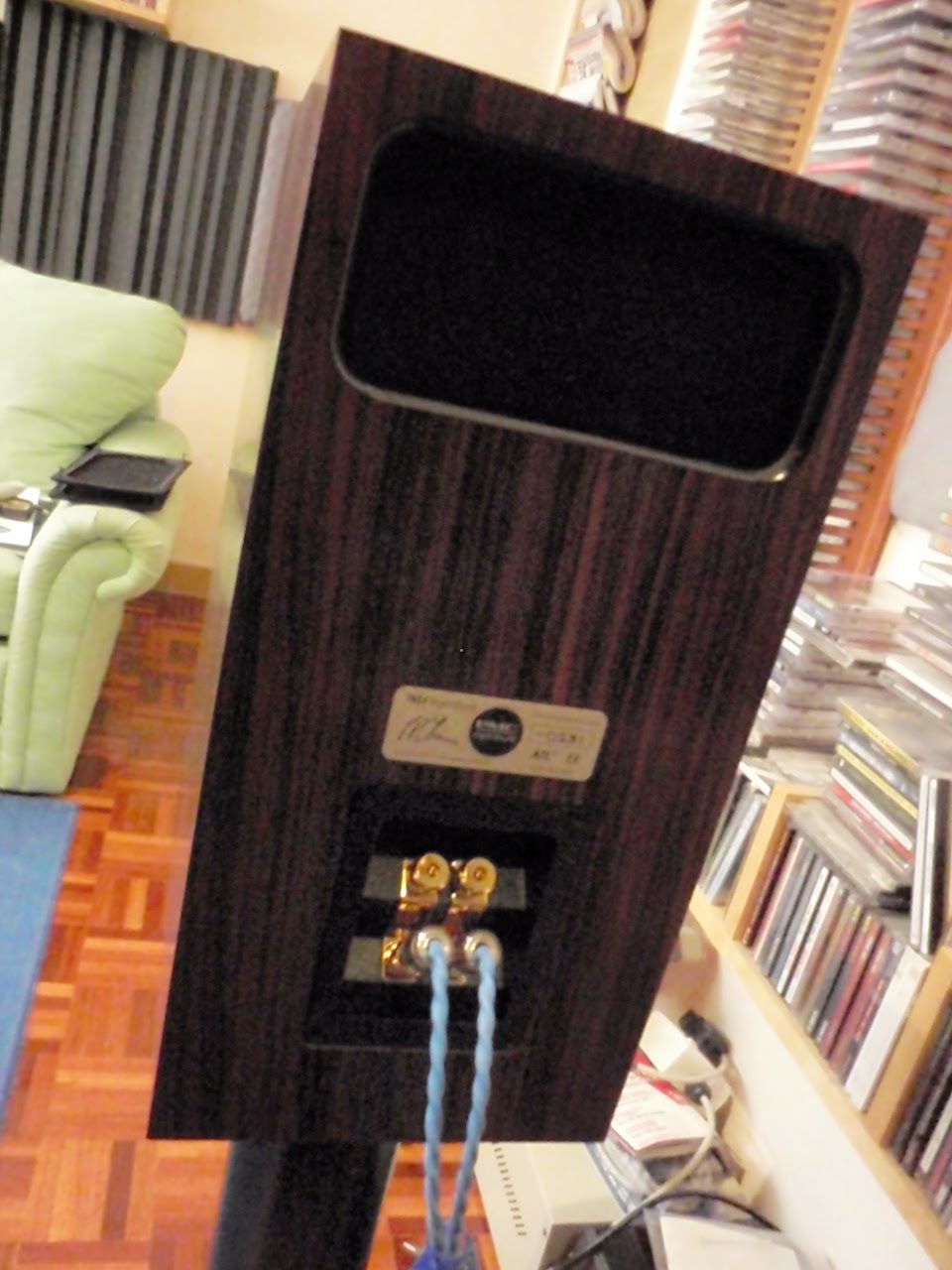
The TB2i uses PMC's proprietary ATL(Advance Transmission Line), it's rear facing port is on the top.

For the asking price, it's hard to fault the PMC TB2i Signature's musical performance, even if it doesn't do spectacularly well in any particular hifi parameter, but rather it's a balanced all rounder of a performer, within it's design limits.

Peter Thomas signed, with special serial no. and the speakers are bi-wire able. The links can can replaced for better transparency.

PMC loudspeaker is sold by AV Designs, contact James, Tony at 03-21712828.

Note the lock nut's position? On the left is bottom locking and on the right is top locking.

Some set up notes regarding the floor coupling speaker spikes, which is applicable with any floor standing, or stand mounted speakers that allows. The key to making a sonic difference with speakers in general is the placing of the locking nut of the spikes. There are two ways to do so.


First is to use the lock nuts from the top plate, which is usually my preferred method. I find that it is more practical as it is easier to manipulate the locking nut from the top, without the need to kneel and bow down to look for it. My big fat fingers also find it easier to just screw down the locking nut from the top. Sound wise, I find locking from the top usually gives the sound a slightly leaner and tighter presentation. Highs tend to be more exacting, although on some systems, it can mean a little dry too. Imaging tends to sharpened, or sound a little more forward and it's usually easier to focus the mouth of the vocalist, on closely miked recordings.


The second method is to lock from the bottom, which is the most commonly recommended. I find the sound to usually take on a freer, more laid back signature. The down side is that bass may become loose and bloated too!

Which method one chooses to use as floor coupling spike locking is largely influenced by owner preference and system balance. Neither is wrong or right, and best of all, this is a tweak that doesn't cost any $$$! It's also reverse able should one not like it, so there's really nothing to lose. Do try them out when time permits.

February 2, 2011

A Big Step Forward - Shunyata V-Ray v.II & Black Mamba-HC CX 20A

I am a Shunyata fan. My love affair with Shunyata started 3-4 years ago when I was looking for a power line conditioner and came across a Hydra 8 (version 1) unit. The Hydra 8 produced a beguiling midrange, added a little warmth to the bass, and imbued the whole sound with a musical energy which made it attractive for long hours of fatigue-free listening. I have been living with it since.

You could also call the Hydra 8’s sound a little rose-tinted or a little golden hued. After listening to a number of other power line conditioners, I found the others indeed may sound more neutral. I know, my meat could be someone else’s poison. However, if one fell for the Shunyata’s colours, it is not easy to pull away.

After the Hydra 8, I tried a Shunyata Taipan Helix power cord on my source component, a Copland CD822 CD player. The energy and poise the power cord added transformed that CD player’s performance. I liked it so much that I went the whole nine yards, changing all my power cords to Shunyata Taipan Helix and Python Helix.

Among the lot, the biggest contributor to the overall sound is the Python Helix 20A from the wall to the Hydra 8 unit and another Python Helix from the Hydra 8 to my current frontend, the Ayre C-5xeMP universal player. It is also my experience that Shunyata power cords shine best in a complete Shunyata system; having one or two pieces of Shunyata in an array of other brands would not allow the full Shunyata flavour to come out, in my opinion.

So, given my affinity for Shunyata, when Big E told me that CMY has taken over the Shunyata distributorship in Malaysia and the Hydra V-ray v.II, the top dog in Shunyata’s power line conditioner hierarchy, was available for a listen, I was extremely interested to say the least.


The Hydra V-ray v.II comes in with a list price of RM20,590. The construction is similar to the Hydra 8 (now also upgraded to v.II status), which is basically a very sturdily built rectangular box slightly bigger than a loaf of bread. It has an aluminium fascia, and comes with a power switch and 8 American style outlets at the back. Shunyata says that the outlets are individually filtered. The ‘magic sand’ inside the box is there, Shunyata calls it ZrCa-2000, a noise reduction compound. Therefore when you pick up the box and give it a shake, it sounds like sand sloshing inside the box. As a bonus, the V-Ray v.II comes with a free SR-Z1 wall outlet, the same kind as the ones on the V-Ray v.II itself.

The V-Ray v.II is rated for a power throughput of 2,400 watt, unregulated, and a 20 amp continuous / 50 amp peak current capability. The V-ray also has surge protection of 40,000 amp and an electromagnetic breaker for over-current.


I started by plugging the V-Ray v.II to the wall with my Shunyata Python Helix Alpha 20A power cord. I plugged all my components into the V-Ray v.II, just like I did with the Hydra 8. In my new room, I did try plugging the more power hungry monoblocks directly into the wall outlets. Initially, the sound seem to have become more revealing, however, long term listening showed that it was noisier and harsher, it was not comfortable to listen to beyond 20-30 minutes. So, at the end I preferred to plug the monoblocks into my Hydra 8. I had the same result with the V-ray v.II.

How did the V-Ray v.II performed? Let me just not beat around the bush, the performance of the V-Ray v.II is streets ahead of the old Hydra 8!

The first difference I noticed was pronounced – the frequency response of the system was much further extended, it went way low in one direction and way high in the other.

An excellent example is from a jazz piece - Sonny Rollins’ ‘Way Out West’ from the album of the same name. The double bass notes were energetically thumping away from the woofers, each pluck packing a little punch, going lower than I heard before from my system. Noteworthy too was the way the V-Ray v.II made the notes sound more distinct from one other, the tune in the double bass playing was heard much more clearly, and the rhythm it carried was simply infectious.

On the same track, the cymbals and high-hat were much improved on, there was much less of the feeling of ‘a cloud of high frequencies’, each hit was more cleanly delineated. They also had the spread-in-air and illuminating-the-space qualities.


In addition to the improved extension at the frequency extremes, the V-Ray v.II brought with it a much lower background noise, instruments and vocals were playing on a cushion of velvety blackness. Clarity and details improved further, focus was better. The vocal from Pop Pop Music’s ‘Brasileiro Z Yan’ album was locked in between the speakers and rendered a couple of feet further in from the speakers’ plane, the staging was also very dimensional. Despite all these improvements in details and focus, the sound did not lose its good body, which Shunyata is well known for. It did not become thin.

As a further improvement, Shunyata pulled the V-Ray v.II away from the old Hydra 8’s rendering of tonal colours. If you think the old Hydra sound was too ‘flavourful’ for your taste, sort of a little too much ajinomoto, then you’ll find the V-Ray v.II not having much of such folly. The V-Ray v.II takes a big step towards neutrality.


At the tail end of the listening period, I replaced my older Python Helix Alpha 20A on the V-Ray v.II with the new Black Mamba-HC CX 20A (HC stands for High Current). I was pleasantly surprised, the musical performance did not diminish one bit. This is despite the fact that the Black Mamba is the replacement for the Taipan, which was one rung lower than the Python, its price is also lower than the Python by 20-30%. For a 2m cord, the Black Mamba lists for RM3,100. The Black Mamba also took a step towards neutrality compared the old Python Helix, which I think is now the new general trend for Shunyata products.


The Shunyata V-Ray v.II and the Black Mamba-HC CX impressed tremendously. Those who love Shunyata and have the requisite deep pocket, you have my envy.

Shunyata is carried by CMY Audio & Visual, contact John, tel: 03-21439206

February 1, 2011

Starting A New Musical Journey. Bryston BDP-1 & BDA-1 Combo.


Where have all my CDs gone? Perhaps Jack The Ripper can answer that? Ha!Ha!

My Bryston BDP-1 Digital Media Player & BDA-1 DAC combo is finally here, after a long wait.

Can't wait to start my new musical journey during the CNY holidays. There's so much to do, so much to learn and lastly, so much music to enjoy.

I'll report more on my journey as I go along.

January 30, 2011

A 3 In 1 Audio And Video System.

Don't we all like 3 in 1 instant noodles and coffee, just because it's so convenient and taste rather good? How about a 3 in 1 A/V system? Rashid has been an audiophile since the days when turn tables was the music format of choice. Then the not so "Perfect Sound Forever" CD came to dominance, which Rashid had also adopted. Lately came computer audio, which once he had listened to the good Doc's system(see my posting about Doc's system titled "The Future Is Now" on the home visit tag), also quickly adopted. Well, how else can you get 3 in 1?

To complicate matters Rashid is also a movies guy, so the system must accommodate this wish too. In other words, this system does it all with discerning quality! Now where do we start?

Let's start with the dedicated AV room which measures 14 x 21ft, which is highly treated on every surface. All the room treatment was designed by Rashid himself. He is also a firm practitioner of isolation, with very precise and meticulous placement of cones and isolation racks. Rashid and his buddies are also avid cable DIY-ers, where they make all their own power cords, interconnect and speaker cables with excellent workmanship that results in factory like termination and finishing. Rashid is also big on Furutech wall sockets and ORB GG-8 high end power tap.
The view from the throne. There's a motorised roll up/down projection screen mounted on the front wall. When Rashid feels like music, the screen is rolled up, and is not visible.

The hard charging Eggleston Works Andra III.

Rashid's speaker choice is the Eggleston Works Andra 3, which has since relegated his previous Sonus Faber Concertino to center and surround roles in the AV system. He tweaks his speaker with an X-cap like tweak to smooth en the high frequency response.
The bi-wired speaker cables, with X-cap tweak for the high frequencies.

Sonus Faber Concertino speakers for AV center chanel...........


And surrounds!

The Linn Sondek LP12 turn table.

Threshold phono stage & Pioneer LX-52 Blu-ray player, tucked just beneath the turn table.

His turn table of choice is the venerable Linn Sondek LP 12, equip ed with the original Lingo power supply and an Audio Technica AT33 MC cartridge mounted on the Ittok LVII arm. A Threshold phono stage amplifies the cartridge signal.
Krell KCT pre amp and FPB 450 mono block power.

A Krell KCT pre amp takes the signal from the phono stage, CD player and out board DAC and passes them on to a pair of Krell FPB 450 mono block power amps, which runs in class A mode. It runs so..... HOT, I heard the heat sink ticking away as the heat stresses the metal.
Dedicated single phase, direct power to the room with circuit breaker box(left) and all Furutech wall sockets.

The ORB GG-8 High End Tap powers the whole AV system.

Top shelf, Theta Basic CD transport. Middle shelf, Wyred 4 Sound DAC 2. Bottom shelf, Krell Showcase AV processor.

A Theta Basic CD Transport feed digital signals to a Wyred 4 Sound DAC 2, which also receives digital signals from a Dell laptop for his latest computer audio craze. An external hard disk of 1 terabyte supplies all of Rashid's ripped CDs in native 16/44, and also 24/96 or 24/192 down loaded hi-rez files. Rashid uses J-Rivers music player software for his computer audio. An interesting feature is the Wyred 4 Sound DAC 2 also comes with a built pre amp to directly drive the pair of Krell mono blocks, which he also demonstrated.
Proceed power amps for AV center & surround chanels.

A Dell laptop running Windows 7 OS and J-Rivers music player software, with 1 terabyte external hard disk supplying a library of 16/44 rips and 24/96, 24/192 hi-rez downloads.

A 19 inch monitor mounted next to sofa for easy reference.

The main music source now are all here and it's digital!

The sound of this system is big, bold and can be beautiful, when the source allows, due to the system's highly revealing nature, it's really GIGO(Garbage In, Garbage Out) here. With well recorded music materials, such as Reference Recordings classical works, the system truly shines. It has fast transient response and dynamics scaling capabilities which few systems can match. This is not a system to pussy foot around with by playing sentimental sweet nothings. It does vocals relatively well too, if only a slightly forward high mid, a.k.a. the presence range will always put the vocals forward, should the singers on the CD's are too closely miked. Clearly, this system doesn't suffer for fools. This is one system that gets out of the way and let the music speaks for it self, for better or worse.

The sound stage is big and imaging is solid, with room filling spatial cues. That's the sound we heard from the CD source. The sound from the computer audio is a little different. While the computer audio had a similar tonal quality and sonic signature compared to his CD based system, it nevertheless had an anaemic and somewhat analytical quality to it. The music just doesn't seemed flow as freely as the CD based source. We did not get to hear Rashid's LP collection on his Linn LP12, due to time constraint. Further more Rashid says he seldom listens to LP anymore and that his turn table might be due for some up grades.
An overhead mounted JVC D-ila projector for excellent picture quality.

The system's AV capabilities are first class, with great picture quality from the AV Designs installed JVC D-ila projector, operating on standard 16:9 screen ratio with a retractable screen in front. There's a Krell Showcase AV processor as the heart of the system, with Proceed power amps powering the center and surround chanels. An interesting AV feature here is the use of two sub woofers, a Yamaha unit placed in the front and a Sonus Fabers unit placed near the sofa, a.k.a. the throne at the back of the room.
Room treatments on the back wall.

Ceramic cable lifters for routing cables.

A book shelf full of CDs, Rashid's physical library.

Ceiling treatments.

Corner traps.

When I ask Rashid what he felt can be improved in his system?

He replied that he is still looking for a better computer audio source, which I humbly pointed out the Bryston BDP-1/BDA-1 combo for his consideration.

He also feels that there's still more could be done with his room treatment. Perhaps any eagle eyed readers can make suggestions on this department here, in the comments section?

January 28, 2011

10 Qs For Andy Duffield, Sales Manager ROW, PMC Loudspeakers.

This is the second time I am talking to Andy Duffield of PMC speakers. I first met him during the 2009 KLIAV Show, when he was here to launch the Fact 8 model, which I eventually bought as my daily pair of reference speakers(which proved to be a highly controversial choice!).

Andy had just stepped in to his position then, but this time round, he is able to provide us with a whole lot more insight about what goes on behind the doors of PMC loudspeakers.

Andy with the big bad PMC boy, MB2-XBD active speaker system.

Big E: Hi! Nice to meet you again. For the benefit of our newer readers, please tell us some basic info about the PMC loudspeaker brand and company?

AD: PMC is based in Lutton, about 30 kilometers north of London. We have 34 staff working in the plant and most of our products are destined for major recording studios around the world, like Teldec, Sony Music, and WMG(Warner Music Group) amongst others . Many world class musicians, like Stevie Wonder, Robbie Williams and the artist formerly known as Prince, only work with the use of our monitors in the studios and their home audio system.

Domestic hifi loudspeaker has been our secondary market for a long time, but I can tell you that things are changing this year, PMC's 20th Anniversary as a company. We'll be coming out with a series of 20th Anniversary and Signature models to celebrate the occasion!

Big E: You mean near Lutton Airport? Care to tell us more about PMC's founders Peter Thomas and Adrian Loader?

AD: Yes, our factory is situated just at the end of the Lutton airport's runway. Peter was working in the Specifications Dept. at BBC and Adrian Loader was a console supplier to the BBC. They were good friends and serious audiophiles who shared a view that no loudspeaker could satisfy their needs at the time. They look at it from both ends, the professional(powerful dynamics but poor refinement) and the domestic hifi(very refined but lacks excitement of live music) sectors. They wanted to make a speaker that could do it all!

In the 1980's like the rest of British institutions, BBC was privatised. That led to many departments being closed and jobs cut. It was this time that Peter and Adrian started PMC loudspeakers in 1991.
The classic PMC LB-1 speaker is a highly successful model, too bad there will be no re-issues for the company's 20th Anniversary occasion.

Big E: With PMC's 20th Anniversary, would you be re-issuing the PMC LB-1 Anniversary speakers?

AD: It's funny that you asked, because our dealer in Japan, Taiwan and Hong Kong asked exactly the same question! And the answer is no. I would agree that the LB-1 is a very good loudspeaker, but we are unable to find parts to build them anymore. We have however designed the PMC Fact 3 as the spiritual successor to the LB-1. Actually the Fact 3 has benefited from newer design knowledge and parts quality improvement, which makes it a better loud speaker.
The PMC presentation session of the MB2-XBD, and other top active speaker systems.

Big E: Despite PMC's success in the professional field, I've found that since owning the Fact 8 loudspeakers, that many of my audiophile buddies don't really know much about the PMC brand or it's products. How do you plan to address that?

AD: I'd agree that our brand is kind of an open secret, it's like a secret branch of the audiophile society. People would hear a PMC based audio system, and they would say "it's a PMC, but shh.......!"(Andy did this in a whispering tone) I think this is one of our problems, and it's our own fault that we may have not done enough on the marketing side of things, to communicate with our target market, the audiophiles and quality conscious music lover. We would improve our communications with our targeted audience for sure.

Big E: In the crowded high end loudspeaker market, how does PMC plan to differentiate it self from the other players?

AD: There's a two pronged strategy we plan to employ. One, we'd like to leverage on our success in the professional side of things. Let our customers know that should one demand the most truthful speaker, such as those used by professionals on the job of recording, mixing and mastering, then PMC should be right up there amongst the considered candidates. Two, did you know that PMC is the only loudspeaker manufacturer that still use Advanced Transmission Line for the basis of bass reproduction? I know there were other manufacturers doing it previously, but it's only us now, as most have either gone out of business or have given up on the transmission line designs.

Big E: Regarding transmission line designs, most experienced audiophiles tend to react rather negatively to them, they would either complain about bloated or muddled bass from such design, even before listening!

AD: Like I said earlier, there were other loudspeaker manufacturer who made transmission line design based products. Some do it better than others, and many audiophiles may have experienced poor examples of the design due to a myriad of factors, including poorly set up systems or inferior loudspeaker design amongst others. All I can say is with today's computer aided designed and simulated loudspeakers, PMC's Advanced Transmission Line products are much more refined and exact in execution than all the previous older designs. I urge our customers to hear our demos and judge for themselves, without any prejudice if possible.

Big E: Which other loudspeaker manufacturer does PMC most admire?

AD: I would say B&W, as they are the biggest loudspeaker manufacturer by market size, everybody in the business would likely be using them as a benchmark of sorts. B&W has a sales turn over 10 times of PMC's! I would like to add though that B&W is more of a mass market manufacturer, by offering entry level and lifestyle products manufactured off shore(in the Far East), while covering the top echelons of the market as well. PMC on the other hand will only build high quality products in the UK, which I think is our strength given our target market for high quality loudspeakers.

Big E: I can see much modifications to the Bryston supplied amplifiers and electronic x-overs for the MB2-XBD active loudspeaker package. Are they built in Canada by Bryston to PMC specs, or does PMC modify them in house in the UK?

AD: All the electronics supplied by Bryston are modified by hand in our UK factory. The reason we modify them is "NOT" because we think the Bryston stuff is no good, but Peter Thomas is the sort of a guy who'd always like to push a concept further. He sees much room for modification to suit our loudspeaker design requirements, like parts tolerance matching, removal of certain non critical, but signal degrading circuits and beefing up the power supply section for example.

Big E: Then why not build your own electronics from scratch?

AD: I think Peter would be in much better position to answer that! However I think it's due to our long working relationship with Bryston. Why try to re-invent the wheel, when there's already a very good working example? But we do try to tweak the electronics more to our loudspeaker design requirements, I think.

Bryston by PMC electronics. A pair of these stack comes with every pair of MB2-XBD, including all the matching interconnects and loudspeaker cables!

Big E: There's a trend towards offering custom paint jobs and other finishes for loudspeaker designs, to make them more decor friendly. Is PMC venturing in to that direction as well?

AD: We're British! So we're naturally more conservative. PMC prefers to sell our products on sound quality above all, rather than emphasize on the decor friendly aspect. However, we would consider making custom finishes available for our highest loudspeaker models as an extra cost option. For example, recently we made a pair of BB5 XBD-A for a middle east client who wants the loudspeakers finished in the same colour to match his Lamborghini.

I would also like to mention another trend in the absolute high end speaker market, and that's active loudspeaker systems. I was in the Munich High End Show and saw many new designs of the active variety. Looks like an interesting time for us ahead.

Big E: Thanks for your time with me. We hope to see you here again during the KLIAV 2011 Show this year?

AD: I am sure I'd be here during the KLIAV 2012.

With that last question, I make way for prospective clients of the MB2-XBD loudspeakers who are waiting in line to chat with Andy. I had certainly gained a lot of insight in to the world of BBC, recording studios and PMC from this chat session.