HiFi, Audio, Home Theatre, CD Player, CD Transport, DAC, Turntable, Tonearm, Cartridge, Phono Stage, Pre-amplifier, Power amplifier, Integrated Amplifier, Loudspeaker, Interconnect, Loudspeaker Cable, Power Cord, Power Line Conditioner, Accessories, Tweaks, Tips, Music, CD, LP, DIY
Denon Remote Control Unit RC-102, which is suitable for all Denon cassette decks with remote sensor function
I love to complete my collection, period! Somehow that cheap compatible China remote works, I still crave for the original Denon item to complete the pairing. As written in last month's Denon DRS-810 cassette deck which I plan to keep, even if the sound quality is not so on par as expect of a 3 head tape deck.
I came across this remote in ebay and subsequently bought it and waited almost a month for shipping to arrive. The remote was pristine and functional as it should be, but most importantly, it completes the pairing with the cassette deck, when on sale during new, the remote was cost option.
The Denon DRS-810 cassette deck is unique as it uses a CD tray like drawer to load, rather than a standard cassette well
In the late 80's till sometime in the mid 90's cassette decks with a CD tray design for cassette loading was all the rage. I even had one from Sony installed in my car! So when I saw pictures of this Denon DRS-810 on the www, I was all smitten! Better yet, this Denon DRS-810 is a top spec deck too!
It comes with 3 heads, closed loop dual capstan 3 motor transport & non-slip reel drive. As with most CD drawer design decks, the casing is premium slim line, but I didn't quite like the smallish fluorescent display for time elapse, status & db meter, especially that cyan/red tone graphics color. What I really like though is the CD drawer like tray in which you have to press the Open/Close button on the right side of the tray to load a cassette! My, my......... after 30 years or so in service, the cassette tray still glides in & out smoothly & reliably. My unit came finished in typical Japanese satin black face plate, but the DRS-810 does have a version in Champaign gold color scheme that also comes with wood side cheeks as option. Now that would really desirable, and that's called the Denon DRS-810 G as pictured below.
The back panel
The back panel of the Denon DRS-810 is pretty standard cassette deck, with one pair of RCA in & out for recording & playback on the left, followed by power cord on the right. Build quality is decent & sturdy enough, but not battleship quality like as my Akai GX-95 MKII. The Denon weights in at 6.6kgs, not too shabby for a cassette deck, after all this unit lasted at least 30 years or so, and still very much alive & kicking. Like most hi-end cassette decks of the time, it comes with a remote too, but that was missing with my unit, but our resourceful Mr Oh did managed to get the remote codes and cloned an after market remote for my use.
With the drawer opened for cassette loading
I was happy man when I brought this unit home, hook it up to my system and just let there be sound! The sound took a while to bloom, as I think the previous owner seldom used it as he had too many decks to play with. However once the sound start to come together, I got a very stable, super low wow & flutter quality playback, the Denon has a chocolaty dark tonality, however that darkness doesn't mean rich or sugary sweetness either, and if compared to most entry level hi-end deck like my Teac V-670, would not disappoint but the Teac does sound way more open, less closed in. The Denon claws back points for having a more stable transport though. However, as I was coming in from the Akai GX-95 MKII, and it immediately shown the Denon to have limited dynamic range. The Denon can kick & rock hard, mind you, but the whole presentation just felt somewhat compressed by comparison. Otherwise, the Denon DRS-810 sounds pretty decent and enjoyable even.
Like all tape decks, the sound quality depended a lot on the cassette type & recording quality. With the Denon, the playback quality of normal type I tapes was decent, and naturally chrome type II tapes sounds way better, but the sound quality gap between chrome type II vs metal type IV tapes is somewhat limited. However, insert a well recorded chrome type II tape made from my Teac V-670 and the Denon does sound very nice indeed, with smooth highs, a prominent mid range and kick ass bass to boot.
The Denon DRS-810 G version shown here, minus the wood cheeks, seen here with the bottom flap opened to reveal the Dolby NR selection buttons and bias fine tuning knobs with headphone jack & volume control
The insides of the Denon DRS-810, like the CD transport, once the cassette is loaded inside, there is a ceramic clamp that locks & stabilizes the cassette during playback. The most un-appealing aspect of this design is when one needs to clean the tape heads & pinch rollers, one has to remove the top cover to do so, unless one is using a cassette tape head cleaner. The PCB used is typical 80's - 90's thru hole type which for me is much preferred, especially if repairs are needed
My verdict of this deck, is the top quality transport, somewhat let down by the audio output circuit which could be better implemented coming from a company of Denon's stature, which is a bit disappointing. I wonder if there's anything I could do to make it sound better on the audio board side?Only a long hard look will tell if some thing is possible at this point. However, this is what it is, an entry level hi-end deck with 3 heads for superior recording function and decent playback quality. And this Denon does it all with some unique style and flair typical of it's era. Worthy keeper for nostalgic reasons.
For these listening sessions, I moved the CCY Engineering F7 power amp (more details of the amp can be found here) into my main listening room. Initially, the set up for source and pre-amp was the same as the one I used in my last post, i.e., the Marantz DV7001 universal player as source and a no-name passive pre-amp for volume control. The one big change, in addition to the listening space change, was the loudspeakers - I switched to the TAD TSM-2201 monitor loudspeakers, rather than sticking with the dinky Missions.
The setup went through the normal adjustment process, with experimentation in loudspeaker positioning and cable swapping. A few days later, I thought I have wrung most of the performance that I could get from this system, but the end result was unsatisfactory to me. The positive side to the sound that I noted in my past post was there, i.e., the qualities of purity and smoothness, but I felt that the music replay was a little flat and loose, lacking somewhat the verve essential for music to sound interesting and, um, musical. Time and again I found my attention drifted mid-track when listening. If the CCY F7 could talk, I think it would say "come on man, please give me something more, something that I could work with". I thought something upstream was throttling the CCY F7.
On a hunch I decided to ditch the passive pre-amp and pressed my Musical Fidelity A1 integrated amp (2008 version) into service. The MF A1 has a pre-amp output and that was what I was looking for. This change turned out to be the one that finally made the entire system clicked.
The Musical Fidelity A1 (ver.2008) sitting on top of the Marantz DV7001 player. It is not an audiophile best practice to stack equipment on top of each other of course, but I ran out of wooden board, and I found that putting the MF A1 directly on the floor made the sound worse, so compromise, compromise.
Now, the sound through the CCY F7 amp bloomed, the soundstage opened up, and the music took on greater extensions. The sound coming out of the CCY F7 was tonally rich and dense, it was an oil painting now vs water colour from before the pre-amp swap.
This shows that the CCY F7 has a good level of transparency, being able to reflect changes made upstream. It deserves good quality partners for it to give its best. Don't be fooled by the CCY F7's price, it punches above its price class.
The CCY F7, with its class A pedigree, did not sound analytical like some solid state amps could, and it was also did not sound warm and fuzzy like some olden day tube amps. Its sound was rather "meaty" and not threadbare, so its music presentation was more natural than hifi-ish.
The CCY F7 had a lively presentation, with excellent dynamic expression and transient attack. Of course this was also subject to the CCY F7's power rating (20w into 8ohms, and 30w into 4ohm) and the sensitivity of the loudspeakers it was used with. With the TAD TSM2201 loudspeakers in my listening room, I could sense a little bit of stress occasionally with big orchestral crescendos, nothing that could not be solved by backing down on the volume control a notch or two, nothing catastrophic happened.
Soundstaging was pretty good. This was of course also subject to the room and the loudspeakers' capability too. Through the CCY F7, the TAD TSM-2201 conjured up a soundstage size close to what I heard when they were driven by my reference system, despite the huge gulf in price between the two systems (the no-name passive pre-amp shrunk the soundstage quite significantly though, again showing how important it was to pair the CCY F7 with good partners). Imaging has good specificity and focus, with good delineation and space in-between images.
The star in CCY F7's sound, especially when the price was taken into account, was definitely its purity in the mid and high frequency ranges, which also have an appealing thin layer of warmth added throughout. Further down at the bass region, bass notes were well delineated and quite agile, as opposed to being ponderous.
Overall, the CCY F7 served music very well in my system. Let me share a few video recordings of this system made with my iPhone SE with you:
For a start, a solo piano piece. Piano has wide frequency range and dynamic range. It has transient attack aplenty being a percussive instrument. Its sound is harmonically rich. So a piano album can be a challenge to systems that are a one-trick-pony, i.e., one that excels in one particular department only. The track used was from George Winston's album "Autumn", track 2 "Woods". With the CCY F7 in the chain, George Winston's piano sounded one piece and came with the requisite tonality, speed, and attack that I was looking for:
Looking to have the CCY F7 play something more bombastic? How about Rimsky-Korsakov's Scheherazade? This next recording is a 6-minute excerpt of Scheherazade 4th movement from Fritz Reiner's version on Living Stereo. That this 20-watter could take on this challenge without turning the sound into a complete mush was impressive. Though I could wish for better control at occasional spots in the music, it was nitpicking at this price point. The presentation was exciting and articulated, which were the most important factors for me for the listening enjoyment of this music:
Lastly, the obligatory female vocal test. This is from 2V1G's debut album, track 8 "Don't want to be alone 不愿一个人", the overall musicality in the vocal and guitar was very well expressed:
The CCY F7 power amp truly impressed. At an introductory price of RM1,688, the performance-to-cost ratio is very high. Check it out if you are stepping up from an integrated amp, or are planning to put together a system with budget of say, up to RM20k-RM30k. Suitably matched the CCY F7 power amp will save you a ton of budget in the amplifier department. Highly recommended.
I asked Mr. Chong CY, the founder of CCY Engineering about his background and the genesis of the F7, this is what he told me:
"I am a
full-time electronic engineer dealing with high power half bridge designs, the
applications included LLC switching power supplies and transformerless 100V
PA industries Class D power amplifiers. I like dealing with circuits related to audio and have been lurking in the DIYAUDIO forum since my studying time till now.
The whole
idea started in the beginning of the COVID-19 pandemic, when everyone was forced to
stay at home and do nothing. I told myself why not make something crazy and put it on the market? What if I made the cheapest class A amplifier in the
world that everyone would buy without any hesitation? With a price tag of RM888
for a 25w dual mono class A push pull power amp, which was cheaper and better than anything on Aliexpress, that was how my first power amp (the A2540) was born. But the sad thing was that the sales response was not going to the way I was expecting at all.
On the bright side, I met quite a lot of really nice people throughout this journey, Wilson Teoh from My Hifi News, Matthew Ong from AFC
Top Hi-Fi, Mr. Hassan from RayaMusicWorld, YF Fong from AudioTech Service
Network, and many others.
I
was reading on the F7 topology one day - applying positive feedback right after
the speaker impedance load and distorting the input signal intentionally? It sounded very unique! I dug out my old F5 (with a chassis very alike the F7) that I built during 2010, put two resistors on it, one 0.33R in series to the ground and one 33.9k back to the input. And wow! That’s a very
different sound compared to the original F5! From there, I quickly work on my
first F7 prototype and asked my friends to drop by for a listen. The sound was
so warm and tubey that they requested me to make a few more for them. That’s
where the first F7 Clone pre-order started."
I seldom do New Years postings these days. As I get older, I don't seem to find much new worthy to write home about. This new year however will be a bit different as I got involved in to a new venture called Gelombang 2022, A Festival of Sight & Sound.
Wilson Teoh, a seasoned event organizer, have been actively campaigning to get this show on the road for the last 18 months or so, mainly thru social media and the On-Off MCO lockdowns didn't helped his cause either. I watched along the side lines with little interest, as I have lost all appetite dealing in the AV industry, that is until one fateful day where our paths crossed at an old friend's place.
Wilson's infectious passion on the subject matter was plain to see, but still I felt un-moved, and will possibly be something forgotten after a while. Then Wilson kept in contact over the period of next few months, running thru some of his plans with me, but still nothing happened. Then in October, when our last MCO lockdown came to an end, Wilson asked me to join him, saying it's now or never!
And thus I had joined the dark side of the force again, as they say. I am delighted to discover that many of my old friends in the industry still welcomed my return. And with that, we moved fast to bring dealers participation on board, and by December 2021, we have sold 85% of the show space in Gelombang! The Gelombang Show is announced ON. It seems there's strong appetite for events in the AV industry and amongst the AV community.
Wilson has a very different vision of what an AV Fest should be, compared to what local show goers have been experiencing to date. He promises a new show going experience and I am very confident in his abilities to execute his vision as I become a part of this new exciting journey.
The Gelombang 2022 Festival of Sight & Sound will happen over the weekend starting Friday 25th March 2022, at The Melia Hotel Kuala Lumpur. Get ready for a breath of fresh air, in about 3 months time. See ya all there!
Digital media is no doubt the current trend of things in almost all of our daily lives. In audio world this is not exception. Many have tried to tap into the benefit digital media can offer for audio and is very common this days to see streaming as the source. Many brands have come out with different kind of solution to digital playback no matter is physical media or streaming. It is always a dream to have many different features or functions that can be found in one box. Is not doubt value for money is one key consideration on media box. Myself have personally like CD very much but don't quite like to have a CD player. My alternate option is to have a digital player to play the CD that has been ripped into wav files or other file format. Of course consideration of storage as well but price for storage is very affordable. Not much of concern. As I was looking for storage, I came across this Japanese company IO-Data (https://www.iodata.jp/fidata/en/) . Its a company that produces hard disk and storage. What is interesting about the company is it takes interest in audio. The company has developed some very high end storage for the sole purpose of audio quality. Being high end the price is also a premium. Not exactly something I was looking for. Looking further in the company product, I came across a more affordable product which is also very interesting with all its functions. (https://www.iodata.jp/ssp/soundgenic/en/). The product is a network server and storage named Soundgenic. After watching some review on youtube and it does look very promising. I took the plunge as it is available in Malaysia.
I made the order and is send from Japan. The thing to take note is this unit is from Japan its all in Japanese language only. The international version will have English language. A little of a bummer but no big deal. The good news is the mobile apps for this server is all in English. 😁 This is a 2 TB model of the network storage server. This is the lowest spec model out of total of 4 different models offer from IO-Data. With some discount I bought online, it came to about RM1300 include shipping. This model has the usual 2TB hard disk and other model come with SSD drive. As a start for me I think this will do.
Out from the box this looks very simple as a black box. The company name in front with Hi-Res audio sticker. No display of any kind except on the top right corner has a small LED light for indicator if the unit is turn on.
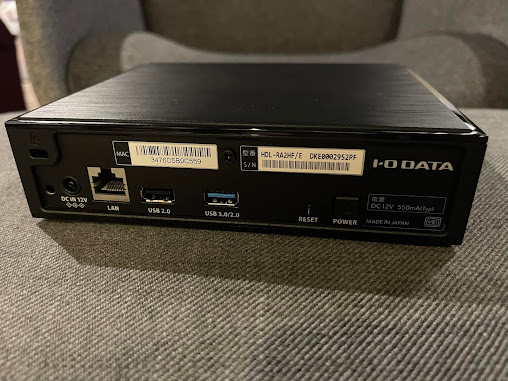
On the back is all the connections. From the left is the power with 12V DC input. The next port is the usual LAN port that support 1000mbps. Than it has 2 USB ports with USB 2 and USB 3. There is the hard reset button and follow by the power button. Is pretty simple and the unit is design as headless unit with controls all on mobile apps which is supported by Android and Apple. The unit is pretty much just plug and play. The one thing to take note is the unit need a LAN cable for it to work as this is also a NAS storage itself. There is no WIFI for this unit which I think it make sense.
To setup is very straight forward. First thing is to install the mobile apps of Fidata and connect the soundgenic to your home network via the LAN cable port. Once is turn on, it will be auto recognized by your network as a network storage device. The storage can be accessible from your normal windows or mac machines as a network drive. Pretty much can copy anything into the storage as if this is a normal hard disk on the network. Once the files are inside the storage , it can be use any other devices within the same network.
With the fidata apps, there are a lot more you can do with the soundgenic. First thing, you can do is use it as a player. From the picture above, it looks quite typical kind of player. You can use the Apple airplay or normal bluetooth to playback from your mobile devices through the player even with Spotify Connect. Of course playback from the hard disk in the soundgenic is also one other option. How this is output will be through the USB port. The USB can be connected to external DAC of your hifi component. The USB port is also able to connect with external USB hard drive.
What is the important or attraction for me is the USB optical drive supported by the unit. In this case, I have a USB optical drive connected to the soundgenic. This means, it will now be a CD player too with the external drive. The feature I really wanted is the ability to ripped the CD into the hard disk without any software or control. Once you pop in the CD, the soundgenic will automatically ripped the songs from the CD into WAV or FLAC of your choice. The cover art and information is all automatically populated as well as the unit is also using your internet for this purpose. Once the files are ripped you can share it to any other devices within your network.
Overall this is all in one box for all the things pretty much needed for the need of digital audio. For the price and what it can offer in features, I will think is very hard to beat. This is all made in Japan comparing to many Chinese made products in the market that are on the same price range. The sound quality playback from the unit itself is also remarkable. I personally compare it with my Asus Tinker board with Volumio playback to be almost on par. This is definitely a worthy investment for a good quality audio playback and storage.